Featured Article
Protein purification can be a bottleneck when developing biologics, so any time saved during this step improves progress by enabling faster downstream analysis. The chromatography system described here improves efficiency by automating the identification of optimal conditions, an essential step prior to multicolumn purification of a monoclonal antibody (mAb). It accelerates time to results and improves upon reproducibility with fully automated, pushbutton mAb purification over five different columns.
Introduction
Biologics are becoming more prevalent in the therapeutic landscape due to their targeted treatment of a range of conditions, from autoimmune diseases to cancer. Biologics like monoclonal antibodies are produced by expressing the protein of interest in cell lines. Because the cell lines express their own host cell proteins (HCPs), there is a risk of these HCPs coeluting during purification of mAb therapeutics, which may lead to an adverse immune response in the patient. Therefore, HCP levels are routinely monitored during the development process, and these data are submitted to regulatory agencies when applying for a biologics license application (BLA). To show that this fully automated purification is viable in a small-batch mAb therapeutic production setting, aggregate analysis was performed along with an HCP ELISA.
Automation of multicolumn purification schemes
For automated optimization and multicolumn purification, an NGC Discover 10 Pro chromatography system (Bio-Rad Laboratories, Hercules, CA) with an extracolumn switching valve was used. Researchers must identify optimal purification conditions for each column before combining them into a single automated multicolumn or multidimensional (Multi-D) purification scheme (http://www.bio-rad.com/webroot/web/pdf/lsr/literature/Bulletin_6745.pdf). They must confirm in-line column compatibility and know when and how much of their protein of interest will be eluted. Due to the time it takes to optimize methods, Multi-D is beneficial in routine purifications to preserve precious protein and improve reproducibility.
For tandem and 2-D purification, the eluate off one column is not collected as a fraction before being applied to the next column. For tandem purification, protein is eluted and injected directly onto another column without detection. Tandem purification requires that columns have compatible pressures, buffers, and binding or elution volumes. Columns should have similar column pressure to avoid resin compression and column destruction. Successful purification depends on assessing the pH and solvent of the elution buffer of the protein from one column to the next, and ensuring that each column has a binding capacity or a maximum load volume like size exclusion or desalting columns. Understanding the amount or volume of purified protein that elutes from one column to the next is critical to purification.
Two-dimensional purification does not require the same level of optimization as tandem, because columns that do not have pressure or buffer compatibility can be used together. The same considerations need not apply with 2-D purifications, because the eluate that contains the protein of interest goes through the detector, is shuttled back into the system via an outlet valve, and is injected to a sample loop housed on a column-switching valve before being applied to the next column. This allows different buffers to be used to equilibrate columns prior to sample application and for pressure not to play a factor.
In addition to the time it takes to identify optimal conditions for each method, making up buffers and programming the software to create these optimization and Multi-D methods can be daunting. During the single-column purification steps, buffer creation was automated with the buffer-blending valve. Eliminating the potential for human error or differences in making up buffers increases reproducibility of separation. Additionally, the scouting wizard on the NGC chromatography system’s ChromLab software helps identify ideal conditions in days versus weeks. The wizard automatically facilitates screening parameters such as flow rate, %B, duration, pH, columns, and sample. Tandem and 2-D templates are available to customize with the optimized conditions determined for each step, resulting in a fully automated multicolumn purification protocol.
Automated mAb therapeutic purification
Once optimal purification conditions were identified, the automated four-column mAb purification scheme, followed by an analytical size exclusion chromatography (SEC) column to determine aggregation, was created. The first two columns (Bio-Rad) run in tandem were an affinity purification column (Bio-Scale Mini UNOsphere SUPrA affinity cartridge) for capture followed by a desalting column (Bio-Scale Mini Bio-Gel P-6 desalting cartridge). mAbs are captured at high pH buffer and eluted in low pH buffer; thus, a buffer exchange step is required to neutralize the sample, preserve mAb functionality, and reduce aggregation. Since buffer exchange is typically carried out via an overnight dialysis step, this tandem step saves time and preserves protein by eliminating the dialysis postcapture step.
The eluate was shuttled to a sample loop before being applied to two ion exchange (IEX) columns in tandem. In order for a tandem IEX purification to be possible, a 20-mM bis-tris/tris buffer with suitable pH for both columns was identified by testing a pH range of 6.5–8.5. A buffer of pH 6.5 was chosen to maximize recovery and reduce levels of co-binding HCPs. First, an anion exchange (AEX) column (ENrich Q 5 × 50 column, Bio-Rad) was used to bind negatively charged HCPs and host cell DNA. The flowthrough, which contained the positively charged mAb of interest, was applied to a cation exchange (CEX) column (ENrich S 5 × 50 column). To avoid contamination of any proteins or nucleic acids that bound the AEX column from coeluting, the AEX column was taken out of line prior to the elution of mAbs from the CEX column. The use of these four columns in tandem and 2-D concludes the mAb purification steps (Figure 1).
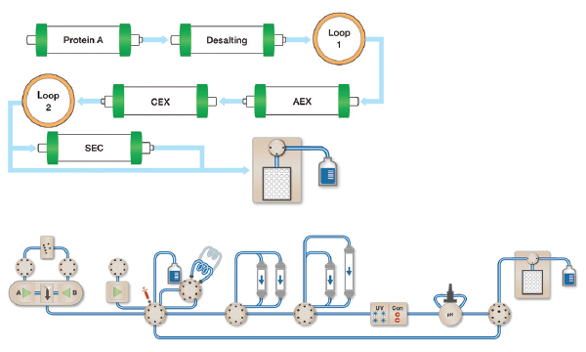 Figure 1 – Schematic outlining the Multi-D purification steps and the NGC chromatography system configuration required to carry out the automated purification of monomeric therapeutic mAbs.
The ENrich 650, 10 × 300 SEC column was used postpurification to separate mAb aggregates from monomers. A small amount of the CEX-purified mAbs was loaded onto the SEC column for analysis. Post-SEC run, the remainder of the purified mAbs from the loop was collected in a fraction collector. Examination of the chromatogram showed successful separation of aggregated mAbs from their monomeric form, with a large monomer peak that followed a very small dimer peak (Figure 2).
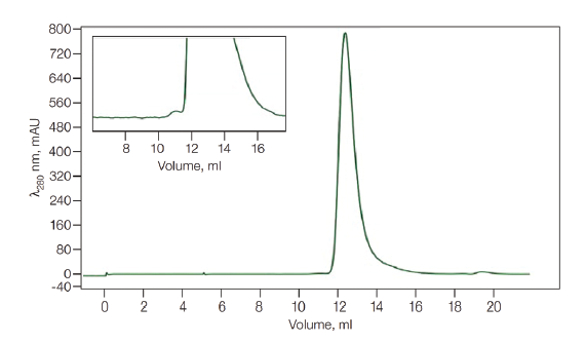 Figure 2 – Purified mAb was successfully separated over an SEC column into aggregated dimers and monomers as shown by the magnified portion of the absorbance trace.
Measuring HCP levels in purified mAbs
Providing HCP levels for therapeutics is part of the data submitted to regulatory agencies when filing a BLA since they may affect patient safety. During the development process for the Multi-D purification method, a series of single-column purifications were run to optimize conditions. After each column was run, the purified mAb eluate was assayed for HCP using an anti-CHO HCP ELISA kit (Cygnus Technologies, Southport, NC). A standard curve was used to interpolate concentrations of the HCP equivalents in nanogram per milliliter. HCP equivalent concentration was normalized to the mAb concentration and reported in parts per million (ppm). For the Multi-D purification scheme, the HCP ELISA was run only after the final CEX column purification. When comparing the results for the single-column and Multi-D chromatography at 0.7 ± 0.2 and 1.1 ± 0.4 ppm HCP equivalent (errors reported at 95% confidence), respectively, the remaining low levels of HCP were determined to be similar between the two methods (see Table 1).
Table 1 – HCP analysis of traditional sequential column and automated Multi-D purification result in purified mAb samples with comparably low levels of HCP 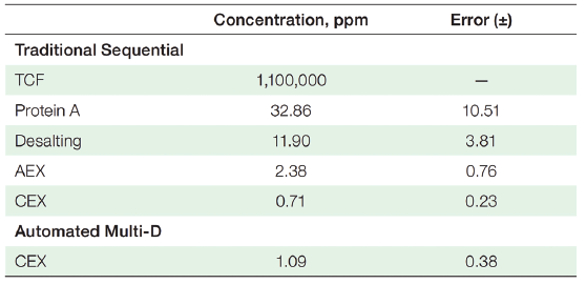
Conclusion
These experiments describe how Multi-D chromatography reduces time to results and increases the robustness and reproducibility of small-batch biologics purification in comparison to the traditional single-column purification method. Additionally, loss of precious sample is reduced using a Multi-D purification scheme. Although small columns were used for this automated purification scheme, Multi-D can also be adapted using other techniques and larger columns as long as optimization is carried out first and those optimized steps are combined into one Multi-D method. The NGC chromatography system reduces barriers to method optimization by cutting down the time it takes to optimize single-column purification with the use of the buffer-blending valve and scouting options. With optimized conditions determined, Multi-D chromatography for routine processes increases the purification efficiency and batch-to-batch reproducibility of biologics production.
Candice Cox is a global product manager in the Protein Purification Marketing group at Bio-Rad Laboratories, 6000 James Watson Dr., Hercules CA 94547, U.S.A.; tel.: 510-741-4788; e-mail: [email protected]; www.bio-rad.com. For more information see www.bio-rad.com/webroot/web/pdf/lsr/literature/Bulletin_6745.pdf.