Featured Article
Access to safe and nutritious food is key to sustaining life and good health. According to the World Health Organization (WHO), an estimated 600 million people fall ill after eating contaminated food, with 420,000 deaths every year. Children under 5 years old make up approximately a third of deaths, with diarrheal diseases being the most common from the consumption of contaminated food. Food supply chains often cross national borders, and good collaboration between governments, producers, and consumers with sufficient testing for contamination from foodborne pathogens, toxic compounds, and nutritional content helps to ensure the safety and quality of foods.
The food chain typically starts on the farm within the agricultural sector, where most of the food that is eaten passes downstream to food and beverage manufacturers for subsequent processing or transformation and then on to retailers or consumer services until reaching the final consumer. This journey from farm to fork generally passes through various wholesalers and involves other service providers such as transport and warehousing.
Food safety strategy covers not only the safety of food for human consumption, but also animal feed, animal health and welfare, and plant health. The process must ensure that food is traceable as it moves from the farm to the consumer, especially when transported internationally.
From primary agricultural production to food processing and consumption, it is essential that food quality and safety standards are met. Analytik Jena and its parent company Endress+Hauser offer products that meet the needs of the food industry and the regulations that uphold high standards.
Primary agricultural production
Soils and fertilizers
The quality of soils and fertilizers used to grow and support the variety of agricultural products we consume plays a significant role in the quality of the food products found on supermarket shelves. Analytical instruments from Analytik Jena are designed to meet the high demands of the industry that require fast and comprehensive chemical analysis of soils and fertilizers, including detection and quantification of toxic metals such as cadmium, lead, arsenic, mercury, and chromium that can potentially be passed on to the consumer.
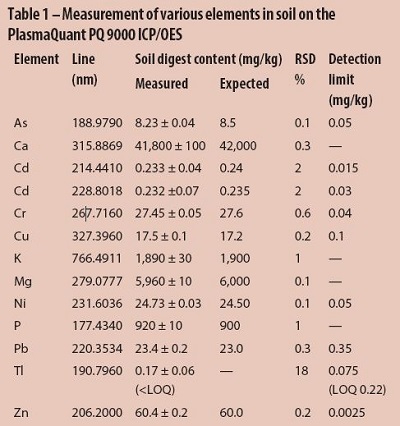
The PlasmaQuant range of inductively coupled plasma/optical emission spectrometry (ICP/OES) and inductively coupled plasma/mass spectrometry (ICP/MS) elemental analyzers are capable of measuring toxic metals to ultratrace levels and well below those defined in European and other important regulations (see Table 1 and Figure 1). The extensive linear range of these products also allows for the determination of many essential and nutritional elements, including calcium, magnesium, potassium, iron, selenium, zinc, copper, sulfur, and phosphorus, to name a few.
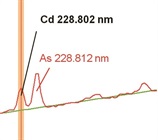
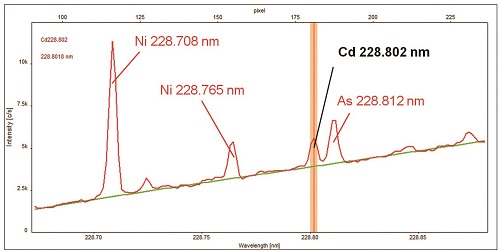 Figure 1 – Simultaneous determination of Cd, As, and Ni on the PlasmaQuant PQ 9000 ICP/OES with automatic background correction (in green).
For laboratories with smaller sample numbers, element requirements, or budgets, atomic absorption spectrometers (AAS) are a cost-effective option with a lower capital cost compared to ICP techniques. Dual flame and furnace systems are also capable of measuring major, minor, and trace elements, where sample throughput is low to moderate.
Measuring the health of the soil used to grow crops and animal feed is vitally important for maximizing yields and keeping toxic metal concentrations below regulatory levels. The same is true for fertilizers, and having the correct nitrogen:phosphorus:potassium (N:P:K) ratio and other essential elements is critical to having to best mix for specific crops, while also being another potential source of toxic metals.
Animal feed
Animal feed typically refers to foods or forages given to animals and include hay, straw, silage, compressed and pelleted feeds, oils and mixed rations, and sprouted grains and legumes. Feed grains are the most important source of animal feed globally. The two most important feed grains are corn maize for energy and soybean meal maize for protein. Other feed grains include wheat, oats, barley, and rice.
Animal feed plays a significant role in the daily uptake of nutrients and fibers to maintain the health of livestock. Besides the organically bound elements hydrogen, carbon, nitrogen, and oxygen that are primarily derived from air and water, there are more than 30 dietary elements necessary for the correct functioning of living organisms.
Phosphorus, potassium, and sulfur are regarded as macronutrients in all living systems. Calcium and magnesium are required in relatively large quantities while living organisms need the remaining minerals in trace to minor amounts. Of the trace elements required for normal plant growth, also referred to as micronutrients, boron, copper, iron, manganese, zinc, and molybdenum are regarded as the most important and best understood. The remaining micronutrients play definitive roles in the metabolism of animals and humans, while chloride and sodium are known to have plant growth functions.
Calcium, for example, is the main component of bones and teeth for strength and also helps with blood clotting and proper functioning of the nervous system. Calcium deficiency can cause osteoporosis, metabolic disorders, and other problems in humans and animals. Magnesium is important for ruminants to prevent grass tetany, selenium is known to be a major factor in the fertility of cows, and deficiency of manganese causes skeletal deformation in animals and inhibits the production of collagen in wound healing.
On the contrary, toxic elements will have adverse effects on organisms. Examples of such harmful elements include Be, Sb, Bi, Ba, U, Al, Tl, Hg, Cd, and Pb. Toxic elements tend to accumulate in organs including the liver, kidneys, pancreas, and lungs. For instance, cadmium causes kidney damage and cardiovascular disease, while lead affects almost every organ and system in the body, especially the brain and nervous system, with children being most susceptible. Mercury is considered by WHO to be one of the top 10 toxic chemicals, especially in its methylated form, and has toxic effects on the nervous, digestive, and immune systems as well as on lungs, kidneys, skin, and eyes. Exposure mainly occurs through consumption of fish and shellfish contaminated with methylmercury.
Conclusion
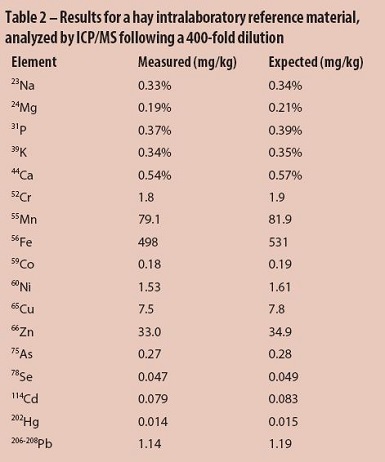
Looking upstream in the food supply chain, and in particular to the agricultural industry, it is clear that providing the correct balance of macro minerals and trace metals in animal feed helps livestock to thrive and remain disease-free. Accurate measurement of elemental composition in food and agricultural products is essential to ensuring product safety and to maintaining adequate levels of nutritional content. With concentrations typically ranging from sub-parts-per-billion to high-parts-per-million in solution, ICP/OES and ICP/MS are vital tools for providing fast, reliable, and routine analysis of samples over a large concentration range, as shown in Table 2.
Oliver Buettel is sales director, Analytik Jena US LLC, 2066 W. 11th St., Upland, CA 91786, U.S.A.; tel.: 909-946-3197; e-mail: [email protected].com; www.us.analytik-jena.com