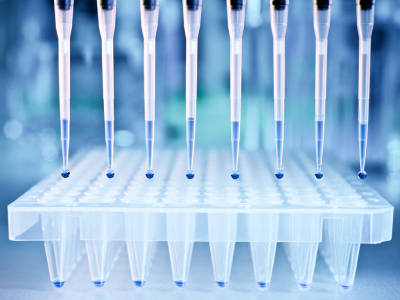
Polymerase chain reaction (PCR) is a valuable tool that has been extensively used in research since its discovery in the 1980’s. Principally, PCR is a molecular biological technique to amplify DNA sequences using thermal cycling. Several types of PCR have been developed to address different research questions, though the most common types are PCR, qPCR, and dPCR. These techniques are commonly used in basic biological research, biotechnology and pharmaceutical research, environmental testing, forensics, and more. One of the key things that distinguish these tools depends on whether the PCR is an endpoint reaction where the DNA product can be analyzed by agarose gel, for instance, or whether the PCR reaction is analyzed over time as with quantitative PCR. Additional differences between these types of PCR will be discussed.
What is PCR?
The development of PCR was enabled by the discovery of Taq polymerase, a heat-resistant enzyme derived from the bacterium Thermus aquaticus that was found in hot springs and hydrothermal vents. The activity of this enzyme is optimal at high temperatures of 75-80°C and can withstand temperatures around 95°C that denature double-stranded DNA. In addition to DNA polymerase, other required materials for running PCR are a DNA template containing the desired region to be amplified, two DNA primers complimentary to the 3’ end of the sense and anti-sense DNA strands, deoxynucleoside triphosphates (dNTPs), buffer, and bivalent cations (typically magnesium, Mg2+). Once combined, a thermal cycler is used to cycle through 3 steps at specific temperatures for 20-40 cycles.
3 steps of PCR cycling:
- Denaturation: A short step typically around 95°C to break the double-stranded DNA.
- Annealing: This step occurs at 50-65°C to allow primers to bind to each strand of the single-stranded DNA templates.
- Elongation: This step is typically run at 72°C and Taq polymerase uses dNTPs to extend DNA complementary to the template in 5’-to-3’ direction.
PCR is best used when you want to amplify a DNA region and get a yes/no answer whether your gene of interest is present or absent, for instant when genotyping mice or for plasmid cloning. PCR products are analyzed on an agarose gel to determine the presence of a wildtype, knockout, or transgenic gene or confirm the correct size of a DNA insert for cloning.
What is qPCR?
Quantitative PCR (also referred to as qPCR, real-time PCR, or RT-PCR) involves the use of fluorescent dyes or DNA probes to intercalate into double-stranded DNA following elongation. Fluorescence is measured by a detector in real time. Since real-time PCR has a broad dynamic range with five to six orders of magnitude, this technique is best used for quantifying samples with both high and low expression levels. qPCR is ideal for screening a large number of samples, as this method is available in high-throughput and automated formats. While it is possible to run qPCR for simple PCR applications like genotyping mice, this would be an unnecessary use of reagents, since quantitation for genotyping is unnecessary.
What is RT-qPCR?
Reverse transcription quantitative PCR (RT-qPCR) combines reverse transcription and qPCR in a one-step or two-step reaction by first converting RNA into cDNA followed by quantitative PCR. This technique is ideal for measuring relative gene expression changes in cells and tissues of interest following treatment or disease. Fluorescence is measured at each cycle and upon completion, an amplification curve will be generated that consists of an initiation phase, an exponential phase, and a plateau phase. When the DNA reaches the exponential phase and surpasses a threshold, the cycle number is recorded, and this number is referred to as the Ct value (threshold cycle value). Target DNA levels can then be quantified by comparing Ct values to a standard curve with known DNA concentrations. Relative gene expression changes are assessed by comparing the gene of interest to a reference gene, also called a housekeeping gene, whose expression is expected to remain stable regardless of the treatment or conditions. Common housekeeping genes that are used include beta-actin, beta-tubulin, and glyceraldehyde 3-phosphate dehydrogenase (GAPDH), to name a few, though these may not be the best reference genes2.
What is dPCR?
Given that qPCR and RT-qPCR are semi-quantitative methods, digital PCR (also called droplet-based digital PCR or ddPCR) was developed to enable absolute quantification of DNA. One advantage of this technique is that digital PCR does not require a standard curve or reference gene for comparison. With digital PCR, samples are divided into thousands of droplets and each drop may contain none, one, or a few copies of the target DNA. Individual PCR reactions occur in these droplets and fluorescence is detected following amplification. The combination of limiting dilution, PCR and Poisson statistics allows for absolute quantification of targets3. Thus, digital PCR is ideal for detection of rare targets in a variety of applications such as in single cell analyses, determining copy number variation, quantifying viral load, and more. See Table 1 for examples of the best type of PCR to use for specific research applications.
Table 1. Best type of PCR to use in common research applications.
| Application | Type of PCR
| Reason |
| Mouse genoytyping | PCR | For determining wildtype versus mutant or transgenic animals |
| Cloning | PCR | For amplifying DNA inserts |
| Gene expression | RT-qPCR | To quantify target mRNA levels |
| Pathogen detection | qPCR | For a wide range of detection and high-throughput screening |
| Site-directed mutagenesis | PCR | For amplifying plasmids before transformation into bacteria |
| Viral titer quantification | dPCR | Absolute detection of AAV genome copies for gene therapy |
| Methylation | qPCR | To quantify methylated/unmethylated DNA following bisulfite conversion |
| CNV | dPCR | To detect small changes in CNV with few replicates |
PCR versus qPCR versus dPCR
PCR is a simple and powerful method for researchers, however there are a few differences to consider ensuring that the best type of PCR is being used. The key difference between PCR and qPCR or dPCR depends on when the PCR product is analyzed, with PCR being an end-point assay while the product in quantitative PCR is measured at each cycle. Additionally, PCR requires DNA as the starting material while reverse transcription PCR requires RNA as the starting material. In regard to qPCR versus dPCR, both are quantitative methods, though qPCR requires comparison to a standard curve or reference gene while dPCR provides absolute quantification. Furthermore, dPCR is superior to qPCR in that it is more precise and less sensitive to PCR inhibitors. However, qPCR has a wider dynamic range than dPCR and allows for automated and high-throughput screening. Ultimately, careful considerations should be made when choosing the type of PCR to use for best experimental outcomes.
References
- “A beginner’s guide to RT-PCR, qPCR and RT-qPCR,” Article by Grace Adams, Biochem (Lond) (2020) 42 (3): 48–53. https://doi.org/10.1042/BIO20200034
- “Identification of best housekeeping genes for the normalization of RT-qPCR in human cell lines,” Article by da Conceição Braga, Leticia et al. Acta histochemical (2022) vol. 124,1: 151821. https://doi.org/10.1016/j.acthis.2021.151821
- “Digital PCR,” Article by Vogelstein, B., & Kinzler, K. W., Proceedings of the National Academy of Sciences (1999). 96(16), 9236-9241. https://doi.org/10.1073/pnas.96.16.9236