Many of us have had that “AHA!” moment or said, “Why didn’t I think of that?” In lab planning, it’s important not to overlook any details. A good lab planner will listen to clients and researchers, and design a workspace specific to their needs. Lab planning requires an understanding of the broader purpose beyond the walls, as well as the specifics of lab use to create an optimal solution.
What is lab planning? Lab planning and design lays the foundation for successful scientific work. It is the process of taking both basic program elements and highly technical blocks and arranging them to create a space that is both safe and efficient.
Great lab design solves the riddle of how to incorporate more science into less space while creating architectural and engineering balance.
In lab planning, the main puzzle pieces that need arrangement are:
- Benching and space types: Benching includes worktables, casework, and adaptable moveable systems with gases, power, and other utilities and levels of automation and robotics. Space types are not just tissue culture spaces, they include disruptive science which can be clean rooms, low humidity rooms, or nanotech spaces.
- Equipment: This can range from small weighing balances to large freezers and highly technical robots.
- People: You must consider how to keep researchers and scientists safe while working as efficiently and comfortably as possible.
- Engineering Strategy: Picture an iceberg. The ice above the water line is your lab’s layout. But there is a much larger portion of the iceberg below the water line. That is your engineering strategy and a good lab planner can lead and support an effective strategy.
Focus on lab planning details to make a difference
If a researcher is struggling to perform a particular task, making a change to the architectural details of the lab space can help improve productivity. Many innovative details can be used; here are a few:
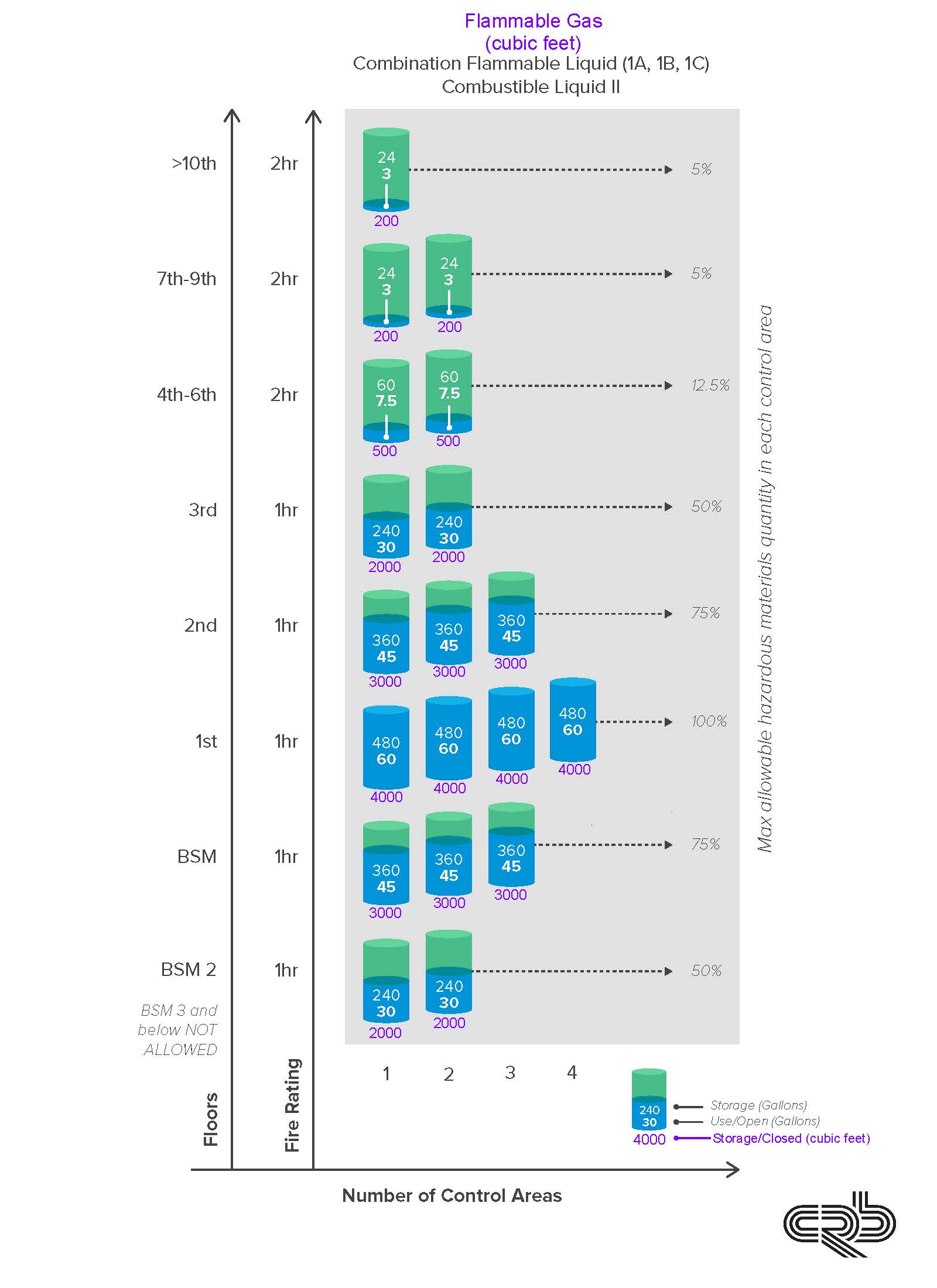
Maximum Allowable Quantities (MAQs) for Chemicals
Common Setup: Lack of inventory and not knowing what you have.
Issue: A major safety consideration when chemicals have exceeded their building code limitations, this can be a dangerous scenario.
Better Detail: Use a bar coding system or a chemical manager, similar to what libraries use to keep track of books. Leverage a proper Control Area Strategy.
Elevators for Labs
Common Setup: The elevator is too small or doesn’t have the appropriate weight capacity.
Issue: Overloading the elevator can be costly, and if your equipment does not fit you may need a crane and a removeable window which can drive costs up more.
Better Detail: Generally, for labs, a common size freight elevator has an 8-foot-deep cab, and ideally 4.5 foot to 5-foot-wide door at 8-foot-tall. A 5,000-pound capacity with Class C loading. A Class C elevator allows for 100 percent of the weight loading whereas a Class A elevator can only take on 25 percent of the maximum weight in a single load. Freezers and specialized equipment can easily exceed 4,000 pounds in a lab.
Lighting for Labs
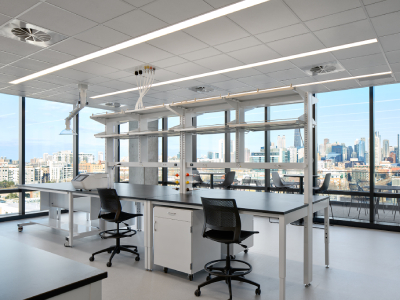
Common Setup: 2-foot x 4-foot lights centered in your casework aisles.
Issue: Lack of lumens or footcandles at the bench and shadows.
Better Detail: Recessed strip lighting aligning with the edge of the bench. This eliminates shadows from either the person or the shelving. In a lab you need the highest level of contrast as well, therefore your countertops are ideally black, otherwise you leave yourself open to eye strain and fatigue.
Vibration Sensitive Equipment
Common Setup: Lack of vibration control in the lab.
Issue: There are many levels of sensitivity with equipment, but there are ways to solve this if your building is not well suited for labs.
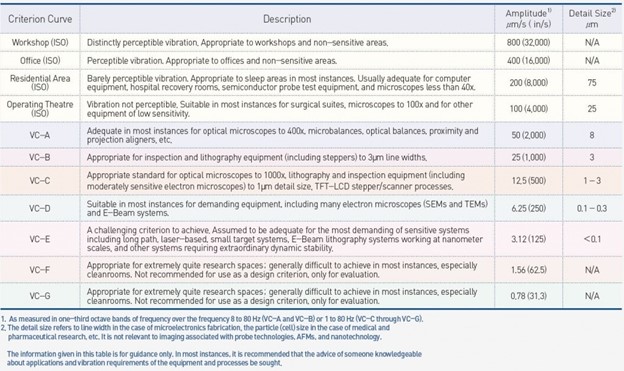
Better Detail: Ideally your building is designed for a VC-A level at 2,000 micro-inches per second or “mips”. Pay close attention to the 2,000 number – many sites call out the criteria, but at high numbers that doesn’t solve for lab vibration. In some cases, you can add air tables, or look for stiffer parts of the structure at larger beams, shear walls or columns. Keep your equipment located away from common footfall traffic in main corridors.
Bonus Article: Lab Vibration Control: A Paramount Part of Lab Planning and Design | Labcompare.com
Biosafety Cabinet – Lab Gas Connections
Common Setup: Lab gases are connected to the BSC with fixed copper piping.
Issue: The fixed piping takes up space, can be a safety issue when exposed, and makes the BSC stationary.
Better Detail: Connecting the gases with a quick connect system and hoses allows the unit to be moved. The supply side of the gases should also be fed from overhead or high on the wall. This allows the BSC and other equipment to be located tight to the wall so circulation space is not reduced.
HPLC’s at the Bench
Common Setup: HPLC equipment is placed on fixed benches.
Issue: Difficult access to the waste bins and back of the equipment.
Better Detail: Placing the HPLC’s on a proper cart designed for this type of equipment improves access. A waste piping collection system can also be installed to limit the waste bins needed. This improves overall ergonomics and safety, while reducing down time when access is needed.
Mass Spec’s at the Bench
Common Setup: Mass Spec’s equipment is placed on fixed benches.
Issue: Small equipment takes up bench space.
Better Detail: Placing the Mass Specs’s on a proper cart designed for this type of equipment improves access. Add a lower shelf to this unit- this is a great place to store the dedicated UPS battery. During design, be sure you have the appropriate exhaust snorkel device- is it for heat, fumes, or both? Many snorkel types are available, but only a few can match to a Mass Spec and are ergonomically easy to use.
Maximize Storage
Common Setup: General lack of storage space.
Issue: Not enough of the right type of storage.
Better Detail: Place storage in areas that take advantage of unused spaces. An example of this would be placing recessed cabinets next to thickened walls that hide services or low wall returns. Look for high density systems to improve your amount of storage.
Location of Gas Fixtures and Electrical/Data Raceway at the Bench
Common Setup: Horizontal location of raceway and deck-mounted fixtures.
Issue: The raceway and fixtures conflict with deep bench top equipment.
Better Detail: Place both the raceway and fixtures vertically to open up the bench space. Another option would be to place overhead service panels in the ceiling.
Pegboard Details
Common Setup: Paper towel and soap dispensers are placed in inconvenient locations.
Issue: The location of the paper towel and soap dispensers is not accounted for.
Better Detail: Allow for space on the actual pegboard to locate the paper towel and soap dispensers. Additionally, integrating the waste bins at the casework eliminates safety issues by leaving the bins in the circulation aisle.
Freezer Rooms are Too Hot
Common Setup: Multiple freezers placed in an equipment room.
Issue: The density of freezers causes the room to overheat.
Better Detail: Place a split system in the ceiling, similar to a computer server room, to provide cooling when needed.
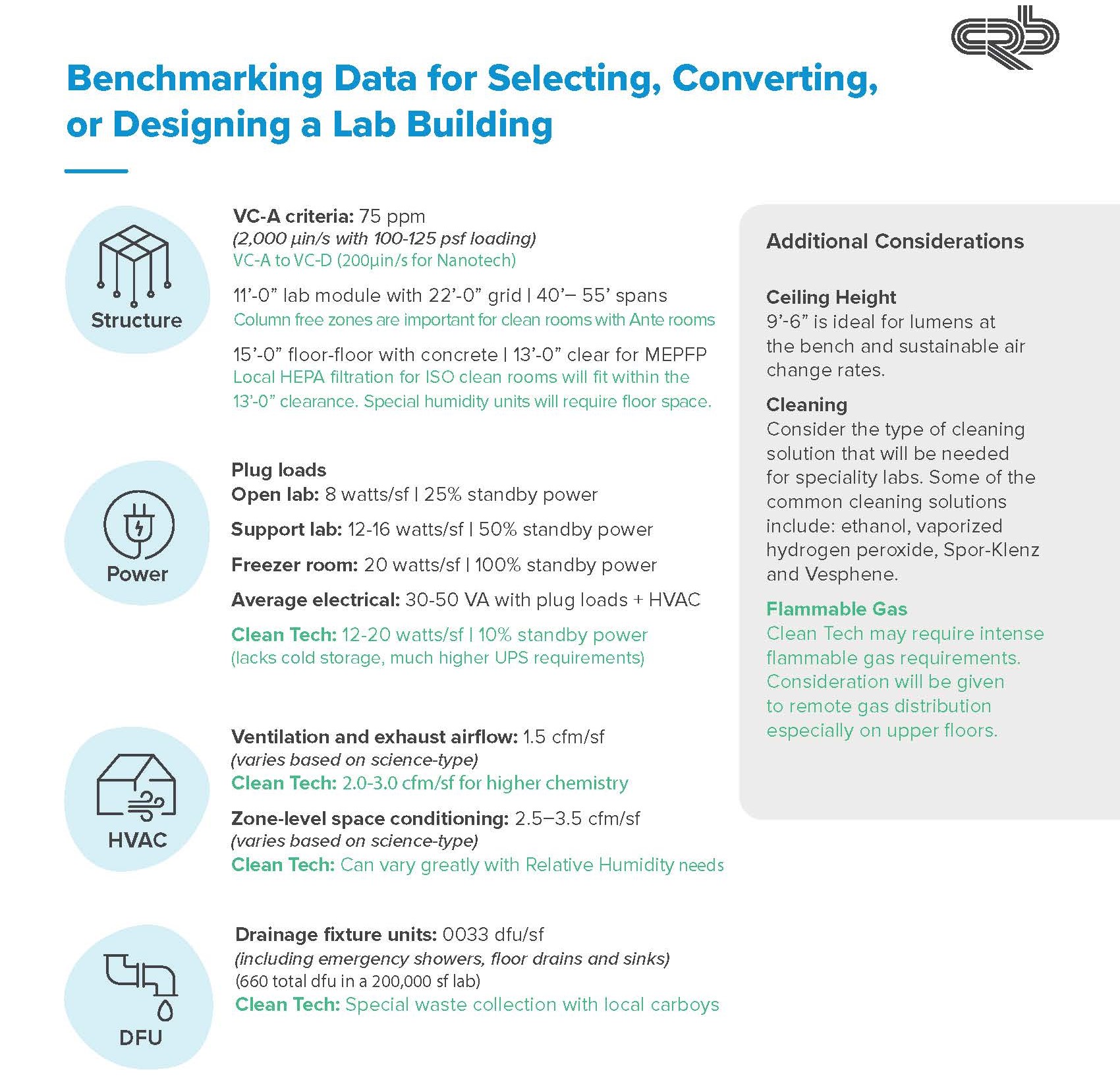
Benchmark your Project
Typical Project: A project has difficulty moving forward because of insufficient funding.
Successful Project: When presenting to leadership, benchmark your project in order to provide data, especially if itis a renovation or relocation. Sell your results by showing how you can improve efficiency while gaining more linear feet of bench and equipment space with less overall square footage.
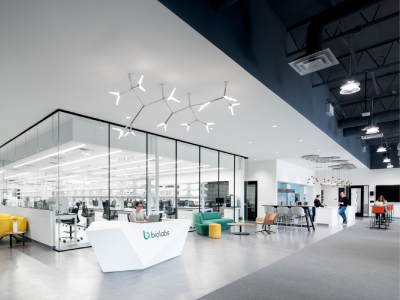
Establish Tour Routes
Typical Project: A project may lose momentum over time or not obtain sufficient funding.
Successful Project: When planning your lab, include tour routes for potential clients and donors early in the design phase. This also creates an added bonus by providing safety in the lab.
Right-size Flexible Casework
Typical Project: Not all projects need 100% flexible casework.
Successful Project: Yes, flexibility is an important aspect in lab design. Keep in mind that this added flexibility can cost more. Keep flexibility simple and be sure it is necessary for the researchers. Casework is no different than buying a car. They all get you from point A to B, but some need more maintenance and others cost more up front. Look at the options and accessories and add value to your project, not cost.
Innovation is on the rise and the need for lab space will continue on its growth trajectory., Scientists are using traditional models in novel ways and leveraging emerging technologies like AI to amplify their research. From drug production to clean and carbon technology, we will begin to see an acceleration in lab space that was not unlike the early progressing of computer chip technology. As we learn about new game changing science on the horizon, these lab planning details will help us improve productivity, generate successful outcomes, and, even potentially, decrease costs.

About the Author: Mark Paskanik, AIA, is a talented lab planner and licensed architect. With a focus on the lab ecosystem, Mark strives to make each lab successful through a holistic approach of examining the support system of the lab beyond its walls while understanding industry best practices to attract the best and brightest employees. He has over 20 years of experience programming, planning, and designing research facilities worldwide, and in that time, he has planned over 20 million square feet of laboratory projects ranging from wet lab to dry lab with specialties in BSL, GMP, and vivaria. Mark is a member of Labcompare's Editorial Advisory Board.