Using a mass spectrometer as a GC detection system has many advantages when it comes to compound identification and quantification, but GC-MS users have another untapped opportunity: speeding up analyses by using the MS vacuum to lower pressure within the column. The amount of the GC column that is affected depends on the column dimensions, with traditional column formats limiting the vacuum’s effect to the last few meters of the column. However, when you lower the pressure throughout the whole column you can really speed things up!
Low-pressure GC-MS (LPGC-MS) is a technique that uses the MS vacuum system, along with a specially designed column setup, to lower pressure inside the entire column, thereby significantly speeding up analysis. Low-pressure GC has been described theoretically in the literature since the 1960s and has even been tried in labs around the world in the years since, but it hasn’t seen widespread adoption. The value of the technique is widely recognized [1-15], and in addition to the speed benefit, LPGC-MS can also provide a cost savings by dramatically reducing helium consumption. By using a short, 0.53 or 0.32 mm analytical column that is inserted directly into the MS and a flow restrictor on the GC inlet side, low pressure can be maintained throughout the analytical column. Using LPGC-MS, some efficiency is traded for speed, but because a mass spectrometer is used, most coeluting components can be deconvoluted by the MS.
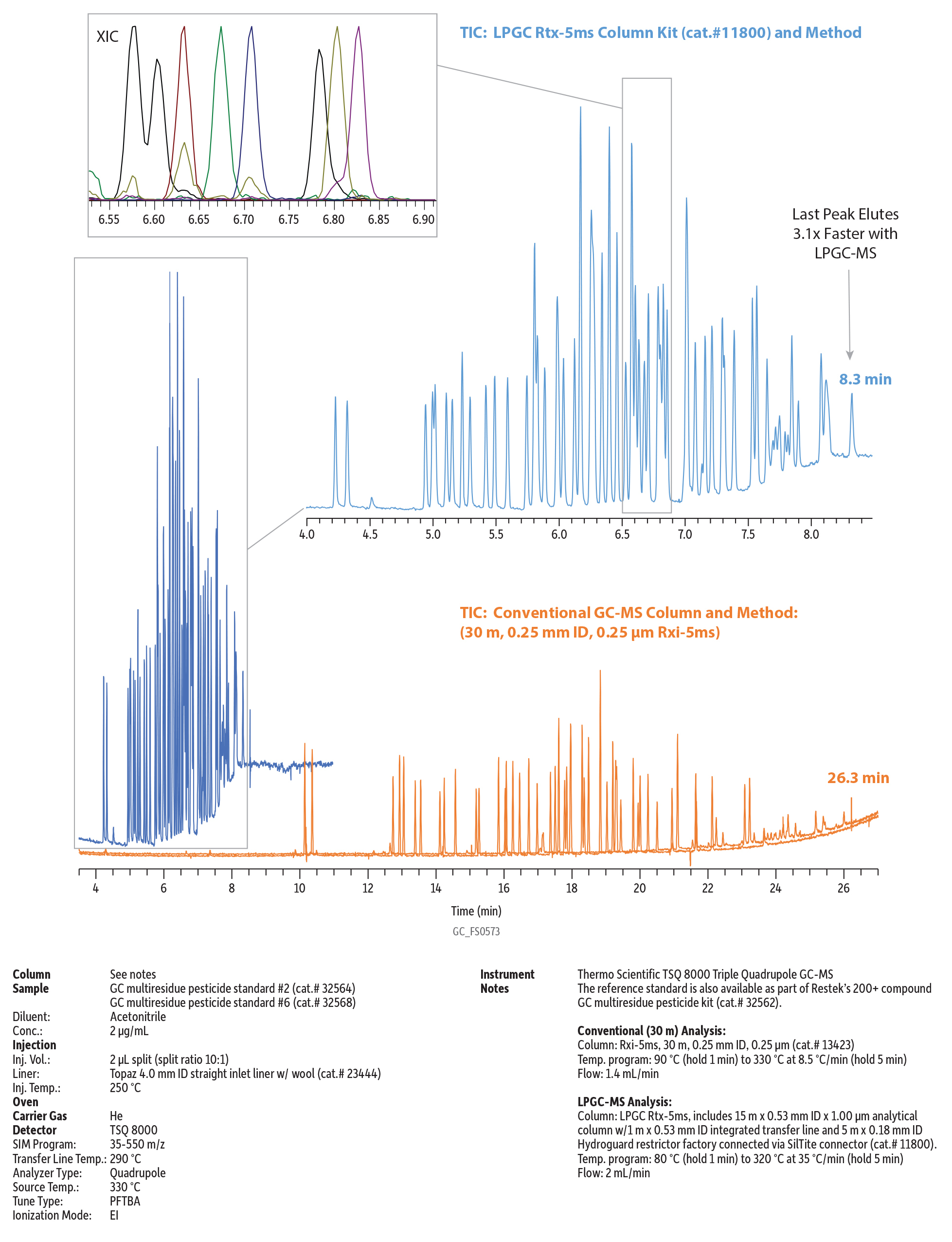
Figure 1 and Table I demonstrate the performance gains that can be achieved by lowering the pressure in the GC column compared to using a conventional GC-MS setup. This technique, not surprisingly, is known as “vacuum-outlet GC,” or more commonly as “low-pressure GC-MS” or LPGC-MS. This article will explore how to utilize LPGC-MS and specially designed, pre-connected LPGC column kits to speed up gas chromatographic analyses.
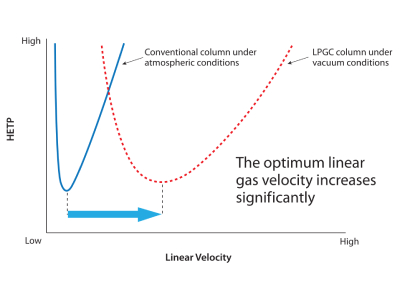
Figure 1: This LPGC-MS analysis of pesticides in food is 3.1x faster and uses 54% less helium than a conventional setup even though a lower efficiency column is used. Because of the increased linear velocity, peak widths are narrower, creating taller peaks and potentially providing greater sensitivity. In addition, even densely populated peaks can still usually be resolved spectrally.
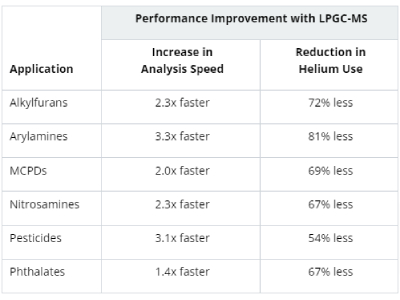
Table I: Compared to conventional GC-MS, LPGC-MS provides significant speed gains and cost savings from reduced helium use.
Why Use LPGC-MS for Fast GC-MS?
What makes LPGC-MS a favorable choice among the options for fast GC-MS? For MS work, 30 m x 0.25 mm ID columns are typically used. This format generates about 120,000 theoretical plates; has optimum carrier gas flow rates within the MS vacuum pump capabilities; and can maintain positive inlet pressure, despite the vacuum at the end of the column. By comparison, an LPGC column kit consists of a short, 0.53 or 0.32 mm ID analytical column that is factory coupled to a restrictor column. The LPGC column configuration used in Figure 1, for example, produces about 30,000 theoretical plates and can be operated at standard flow rates of around 2 mL/min. Because of the vacuum inside the analytical column, optimal carrier gas linear velocities are very high, resulting in very short analysis times (typically up to 3.3x faster than for a 30 m x 0.25 mm column). Peak widths are 1.5–2 seconds, which is broad enough for sufficient MS data acquisition. Additionally, 0.53 and 0.32 mm columns have higher capacity than narrow-bore columns.
Here's how the LPCG-MS approach used in Figure 1 compares to different ways to increase the analysis speed of a flow-optimized 30 m x 0.25 mm ID column.
- Use a shorter, narrower column
A 10 m x 0.10 mm column will provide similar efficiency (plate number) and resolving power to a 30 m x 0.25 mm column. However, this format has very low column capacity, requiring very low concentrations or injection volumes to avoid peak distortions (e.g., “fronting”). - Use the 30 m x 0.25 mm column in the MS at a higher flow
Increasing the flow is easiest way to reduce analysis time. But, to get a 3x faster analysis time, a flow of approximately 12 mL/min is needed, which requires an inlet pressure of approximately 63 psi. This is problematic for injection, MS data acquisition rate, and MS pump capacity. - Use a 10 m x 0.25 mm column at optimal carrier gas flow rate
A 3x shorter column has about 40,000 theoretical plates and should give 3-4x faster analysis time, but the inlet pressure required for this column is about 0.35 psi, which is very difficult to control. At such pressures, split injection is a challenge, column trimming is hardly possible as it impacts pressure, and MS data acquisition can be difficult due to very narrow peak widths.
How Does LPGC-MS Speed up Analyses?
At the heart of the benefits LPGC-MS has to offer is the concept of “low pressure.” To see why low pressure matters, let’s start with the idea of a column’s “optimal linear velocity.”
In any GC column, there is a carrier gas linear velocity that will produce the most efficient analysis. Too slow of a carrier gas velocity will result in broader peaks and less resolution. Too fast, and the different components of the sample won’t have sufficient time to interact with the column’s stationary phase and, again, resolution will be lost. For this reason, operating a GC column at its carrier gas’s optimal linear velocity is an important element of achieving the greatest resolving power from a chromatographic system.
It is important to understand that optimal linear velocity is a pressure-dependent value. Lowering the pressure throughout the GC column lowers the carrier gas viscosity, which increases the optimal linear velocity (Figure 2). For a given column, this results in a very similar separation in a lot less time when everything else remains constant.
Figure 2: In this experiment using 0.53 mm ID capillary columns, the Van Deemter plots illustrate that maximum efficiency, which occurs at the lowest HETP value, occurs at higher linear velocities under lower pressure conditions. (HETP = height equivalent to a theoretical plate.)
However, lowering the pressure throughout the entire length of a GC column is not easy to do. This is especially true for the column dimensions that are typically used in GC-MS applications (e.g., 30 m x 0.25 mm ID). You need a means of effectively evacuating the entire length of the GC column at the outlet while allowing head pressure to build at the inlet, and that has not always been simple to do.
One good solution has been to capitalize on the vacuum system of mass spectrometers coupled to GCs. The same vacuum that is pumping out air and carrier gas from the MS can also help lower the pressure in the GC column. However, to get an effective evacuation of the GC column, relatively short, wide-bore columns were necessary, which brings us to the problem of maintaining a head pressure in the GC inlet. With the vacuum extending all the way through the column, it is difficult or downright impossible to achieve a stable head pressure.
That problem was elegantly resolved in the early 2000s by introducing the use of a “restrictor column” on the front end of the analytical column. This relatively short length of very narrow capillary tubing allowed the GC inlet to build pressure while the MS vacuum could effectively lower the pressure in the analytical column. With the recent advent of more reliable connectors to fit the restrictors to the analytical columns, LPGC has become more accessible than ever.
Welcome to Faster Runs and Saving Carrier Gas
Taking advantage of your mass spectrometer’s vacuum system to greatly accelerate GC separations has never been easier. Low-pressure GC columns for vacuum-outlet GC-MS makes increasing your instrument’s productivity as easy as a quick column change and method update. With this setup, you can start processing more samples per shift, save money by using less helium, have more time for other tasks, or even put off that next big capital investment in a new instrument to accommodate your workload.
References
- B. Gruber, F. David, and P. Sandra, Capillary gas chromatography-mass spectrometry: Current trends and perspectives, Trends Anal. Chem. 124 (2020) 115475. https://doi.org/10.1016/j.trac.2019.04.007
- S.J. Lehotay, J. de Zeeuw, Y. Sapozhnikova, N. Michlig, J. Rousova Hepner, J.D. Konschnik, There is no time to waste: Low-pressure gas chromatography–mass spectrometry is a proven solution for fast, sensitive, and robust GC–MS analysis, LCGC North Am. 38 (8) (2020) 457–466. https://www.chromatographyonline.com/view/there-is-no-time-to-waste-low-pressure-gas-chromatography-mass-spectrometry-is-a-proven-solution
- S.J. Lehotay, N. Michlig, and A.R. Lightfield, Assessment of test portion sizes after sample comminution with liquid nitrogen in an improved high-throughput method for analysis of pesticide residues in fruits and vegetables, J. Agric. Food Chem. 68 (2020) 1468–1479. https://pubs.acs.org/doi/10.1021/acs.jafc.9b07685
- L. Han, S.J. Lehotay, and Y. Sapozhnikova, Use of an efficient measurement uncertainty approach to compare room temperature and cryogenic sample processing in the analysis of chemical contaminants in foods, J. Agric. Food Chem. 66 (2018) 4986–4996. https://pubs.acs.org/doi/10.1021/acs.jafc.7b04359
- S.J. Lehotay and Y. Chen, Hits and misses in research trends to monitor contaminants in foods, Anal. Bioanal. Chem. 410 (22) (2018) 5331–5351. https://pubs.acs.org/doi/10.1021/acs.jafc.7b04359
- S.J. Lehotay, L. Han, and Y. Sapozhnikova, Use of a quality control approach to assess measurement uncertainty in the comparison of sample processing techniques in the analysis of pesticide residues in fruits and vegetables, Anal. Bioanal. Chem. 410 (22) (2018) 5465–5479. https://pubs.acs.org/doi/abs/10.1021/acs.jafc.7b04359
- Y. Sapozhnikova, High-throughput analytical method for 265 pesticides and environmental contaminants in meats and poultry by fast low pressure gas chromatography and ultrahigh-performance liquid chromatography tandem mass spectrometry, J. Chromatogr. A 1572 (2018) 203–211. https://doi.org/10.1016/j.chroma.2018.08.025
- J. Hinshaw, Fast gas chromatography, LCGC North Am. 35 (11) (2017) 810–815. https://www.chromatographyonline.com/view/fast-gas-chromatography-1
- L. Han, Y. Sapozhnikova, and S.J. Lehotay, Method validation for 243 pesticides and environmental contaminants in meats and poultry by tandem mass spectrometry coupled to low-pressure gas chromatography and ultrahigh-performance liquid chromatography, Food Control 66 (2016) 270–282. https://doi.org/10.1016/j.foodcont.2016.02.019
- S.J. Lehotay, L. Han, and Y. Sapozhnikova, Automated mini-column solid-phase extraction cleanup for high-throughput analysis of chemical contaminants in foods by low-pressure gas chromatography—tandem mass spectrometry, Chromatographia 79 (2016) 1113–1130. https://link.springer.com/article/10.1007/s10337-016-3116-y
- J. de Zeeuw, S. Reese, J. Cochran, S. Grossman, T. Kane, and C. English, Simplifying the setup for vacuum-outlet GC: Using a restriction inside the injection port, J. Sep. Sci. 32 (11) (2009) 1849–1857. https://doi.org/10.1002/jssc.200900009
- K. Maštovska and S.J. Lehotay, Practical approaches to fast gas chromatography–mass spectrometry, J.Chromatogr. A 1000 (1-2) (2003) 153–180. https://doi.org/10.1016/S0021-9673(03)00448-5
- M.S. Klee and L.M. Blumberg, Theoretical and practical aspects of fast gas chromatography and method translation, J. Chromatogr. Sci. 40 (5) (2002) 234–247. https://doi.org/10.1093/chromsci/40.5.234
- K. Maštovska, S.J. Lehotay, and J. Hajšlova, Optimization and evaluation of low-pressure gas chromatography–mass spectrometry for the fast analysis of multiple pesticide residues in a food commodity, J. Chromatogr. A 926 (2) (2001) 291–308. https://doi.org/10.1016/S0021-9673(01)01054-8
- J. de Zeeuw, J. Peene, H.-G. Janssen, X. Lou, A Simple way to speed up separations by GC-MS using short 0.53 mm columns and vacuum outlet conditions, J. High Res. Chromatogr. 23 (12) (2000) 677–680. https://doi.org/10.1002/1521-4168(20001201)23:12<677::AID-JHRC677>3.0.CO;2-L