
By Cristian Cojocariu, Director, Routine Mass Detection, Waters Corporation
Ensuring the purity and safety of pharmaceutical products is a critical aspect of drug development and manufacturing. Impurities in drugs, whether from synthesis, degradation, or contamination, can have profound implications for patient health. Mass spectrometry has emerged as a powerful analytical technique for detecting and characterizing these impurities, but the complexity of traditional mass spectrometry systems has posed challenges for routine drug impurity testing, especially for quality control (QC) laboratories.
The Challenge of Drug Impurity Testing
The presence of impurities in pharmaceuticals is a complex issue that requires meticulous attention to detail. Identifying and quantifying these impurities requires analytical methods capable of detecting trace levels of contaminants. Traditional approaches to drug impurity testing often involve laborious sample preparation steps and complex instrumentation, leading to lengthy analysis times and labor-intensive workflows. As a result, there is an increasing demand for streamlined analytical techniques that can expedite the testing process without compromising the accuracy or reliability of the results. These advancements aim to minimize the risk of overlooking impurities and ensure patient safety.
Mass detection, a powerful tool for routine drug impurity analysis
Mass spectrometry has become a cornerstone technology in analytical chemistry, offering unparalleled sensitivity and selectivity for the detection of chemical compounds. By ionizing molecules and measuring their mass-to-charge ratios, mass spectrometers can identify and quantify substances with remarkable precision. In drug impurity testing, mass spectrometry enables researchers to distinguish between active pharmaceutical ingredients (APIs) and various impurities, providing invaluable insights into the quality and purity of pharmaceutical formulations. Recent advancements in mass spectrometry have addressed many challenges associated with drug impurity testing. Notably, the introduction of compact and user-friendly mass detectors has streamlined the analytical process, and is complementary to UV detection, while maintaining high levels of performance (sensitivity and repeatability of results). These instruments incorporate features, such as automated calibration and simplified, compliant chromatography data system (CDS) software for easy integration into existing enterprise networks, and intuitive user interfaces, making them accessible to a wider range of researchers and technicians.
Streamlining routine impurity analysis in Atorvastatin
A study aimed to simplify routine impurity analysis in Atorvastatin using the ACQUITY™ QDa™ II Mass Detector to enhance the detection and quantification of related impurities, in conjunction with UV chromatographic workflows. Atorvastatin is a widely prescribed medication for managing hypercholesterolemia, but impurities in its formulation can compromise safety and efficacy.[1] Traditional UV-based chromatographic methods, while fundamental, may have limitations in accurately identifying impurities in drug substances and/or drug products. The study sought to address this by adding complementary mass detection to UV-analytical workflows, offering enhanced identification, quantification, and structural characterization of drug-related known and unknown impurities.
Experimental conditions involved using commercially available Atorvastatin samples and related impurities, which were dissolved and analyzed using the ACQUITY QDa II mass detector. Method development focused on optimizing chromatographic conditions, such as mobile phase composition and column selection, resulting in a more efficient, shorter, and sustainable greener analytical method compared to traditional approaches.[2]
Linearity studies confirmed the reliability of the method across a range of concentrations for both Atorvastatin and selected impurities. Calibration curves showed high linearity (as per Figure 1) and low residual errors, ensuring accurate quantification.
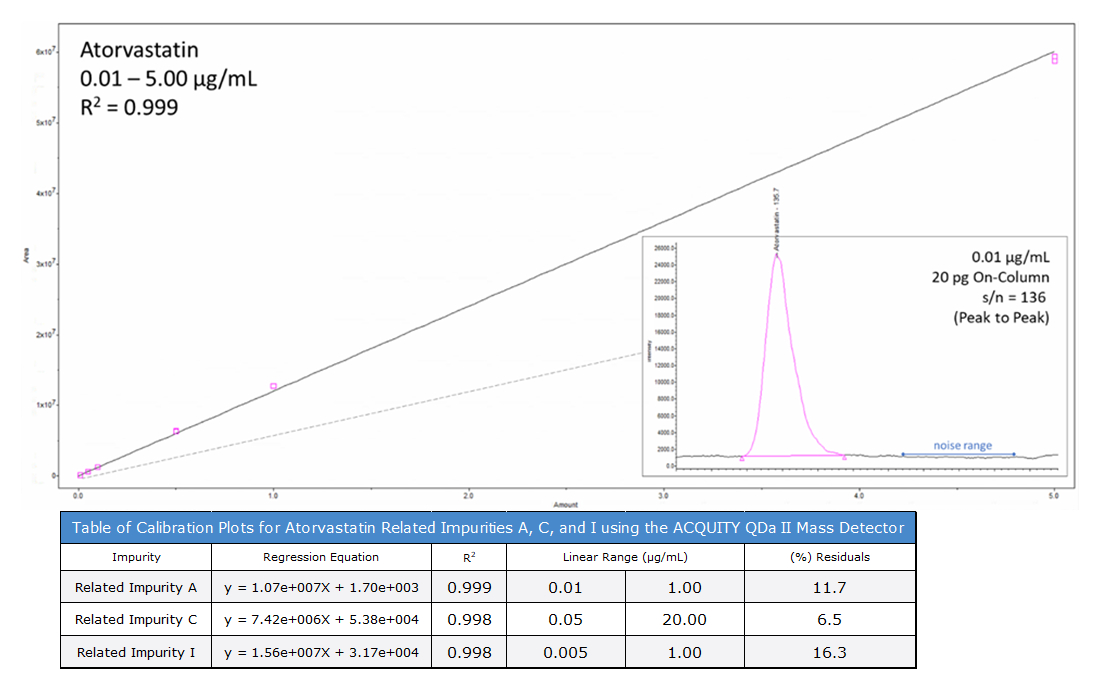
Figure 1. The linearity of Atorvastatin-related impurities was assessed using the ACQUITY QDa II Mass Detector.
Quantification of impurities at a 0.15% threshold demonstrated the method's sensitivity and repeatability, essential for compliance with regulatory guidelines.[3] Additionally, in-source fragmentation provided structural insights into unknown impurities, aiding in their characterization (Figure 2).
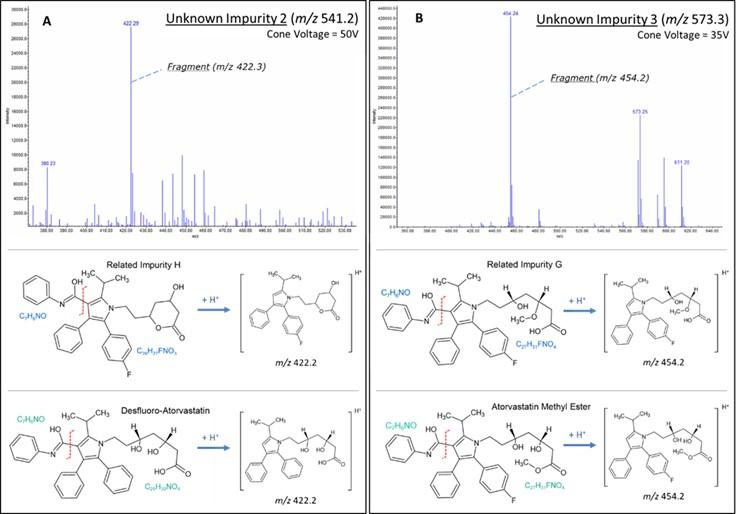
Figure 2. In-source fragmentation can provide valuable chemical structure information on detected impurities.
Mass detection revealed co-eluting impurities, which might lead to overestimation when relying solely on UV detection (Figure 3). This underscores the importance of mass detection in ensuring accurate impurity quantification, and the ability to identify and manage co-elutions effectively.
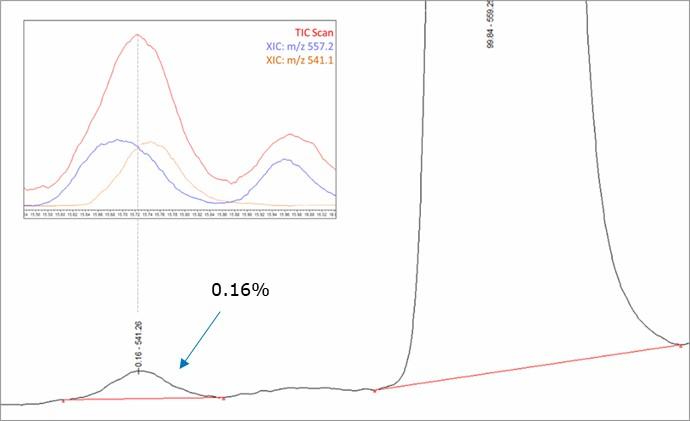
Figure 3. Mass detection detects coeluting Atorvastatin impurities not evident by UV.
The study leveraged EmpowerTM CDS software for streamlined data reporting, enabling efficient assessment of impurity concentrations within sample batches, and ensuring compliance and data integrity. The results underscored the benefits of integrating mass detection into UV workflows for impurity analysis in Atorvastatin. This integration enhanced accuracy, and sensitivity, and provided valuable structural insights, thereby improving quality control in pharmaceutical analysis.
The role of sustainability in analytical chemistry
In addition to improving analytical performance, there is a growing focus on sustainability within the scientific community. Laboratories are increasingly seeking ways to minimize their environmental impact and reduce energy consumption without compromising research outcomes. In response to this trend, manufacturers of analytical instrumentation are developing technologies that integrate sustainability principles into instrument design and operation. For instance, modern mass spectrometry instruments are designed to consume less power, generate less heat, and reduce solvent waste generation through more efficient chromatographic separation with ultra-high-performance liquid chromatography (UHPLC). These innovations not only help laboratories adhere to green chemistry principles but also reduce operational costs, making sustainability a practical and economically viable goal.
The integration of mass detection techniques in pharmaceutical impurity testing represents a significant advantage in ensuring drug safety and efficacy. Adding mass detection capabilities into traditional UV-based workflows can help to streamline complex analytical methods, achieving required results without repeated experiments and promoting more sustainable operations. Mass detection enhances simplicity, sensitivity, accuracy, and efficiency, as demonstrated with Atorvastatin, making it a superior choice for modern analytical practices.
As the pharmaceutical industry continues to evolve, the adoption of cutting-edge mass detection technologies and sustainable practices will be crucial in meeting regulatory standards and ensuring the highest levels of drug purity and safety. This holistic approach, combining technological innovation with environmental responsibility, sets the stage for a future where analytical chemistry not only safeguards public health but also promotes sustainable practices.
References
- Vukkum P, Moses Babu J, Muralikrishna R. Stress Degradation Behavior of Atorvastatin Calcium and Development of a Suitable Stability-Indicating LC Method for the Determination of Atorvastatin, its Related Impurities, and its Degradation Products. Sci Pharm. 2013 Jan-Mar;81(1):93-114.
- Shulyak, N. et al. (2021) ‘Development of a novel, fast, simple HPLC method for determination of atorvastatin and its impurities in tablets’, Scientia Pharmaceutica, 89(2), p.16.
- Impurities in EW drug substances Q3A(R2) - ICH (Oct 2006) ICH - Q3 Guidelines. Available at: https://database.ich.org/sites/default/files/Q3A%28R2%29%20Guideline.pdf (Accessed: 09 February 2024).
ACQUITY, QDa, and Empower are trademarks of Waters Technologies Corporation.