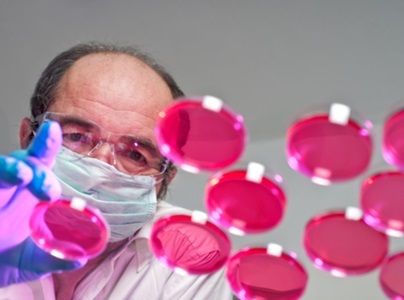
By very precisely regulating CO2, humidity and temperature, cell culture incubators produce in vivo conditions in vitro. Creating the ideal environment for cell and tissue work, however, is an extremely sensitive process that requires optimum and reproducible growth conditions.
DO: Ensure optimal starting conditions
Scientists need blank canvases to begin the difficult cell cultivation process. Trying to cultivate a new batch of cells in an incubator with E.coli still hanging around from the last run is a disaster waiting to happen. Dry heat sterilization is an effective decontamination method for CO2 incubators. By heating the interior to 180˚C for at least two hours, dry heat causes cell death through denaturing of all proteins, destruction of nucleic acids and desiccation. The sterilization cycle can even be run overnight for 8 hours to minimize active downtime in the laboratory. This ensures germ-free starting conditions for the next morning’s first run.
DON’T: Overcrowd the culture vessels…
…or leave the cells unattended for long periods. Regularly monitor cell cultures and maintain appropriate feeding and media changes. You should also maintain appropriate cell densities to avoid altered cell growth and ensure optimal growth, and prevent the accumulation of toxic metabolites.
DO: Minimize contamination risk
High-heat dry sterilization will kill bacteria hiding in the shadowed crevices of an incubator chamber, such as the undersides of shelves or within shelf mounting hardware. While some incubator crevices are unavoidable; the fewer contamination hiding places, the better. Incubators with obstacle-free interiors and coved corners help provide an easy-to-clean environment that ensures a low risk of carry-over contamination. These features also ensure quick routine cleaning, giving scientists back valuable minutes of their day.
DON’T: Ignore signs of cell culture issues
Be vigilant for signs of cell culture problems, such as changes in cell morphology, growth rate or contamination. If you observe any problems, address them promptly by troubleshooting or even repeating experiments, if necessary. Avoid prolonged storage of the culture, ensuring to never let the culture media expire. Plan ahead during your experiment to ensure you are opening the incubator door as minimal number of times as possible to ensure temperature uniformity for the samples left within. While many CO2 incubators have alarmed doors nowadays, it doesn’t hurt to double-check that the incubator door did indeed close after every use.
DO: Choose fail-safe options
Any cell and tissue culture expert’s worst nightmare is to return to the lab on Monday morning to find their incubator running out of parameter, with ruined cells inside. Given the extremely sensitive nature of cell cultivation, incubators with fail safe systems can make all the difference in the event of sensor failure. BINDER’s CO2 fail-safe option, for example, maintains CO2 concentration in a range that enables the cell cultures to survive over the course of a few days. The principle of the fail-safe function is based on stopping CO2 regulation immediately should a sensor fail, in order to prevent too much gas being fed into the incubator. At the same time, CO2 control that works on the basis of preset levels is activated to prevent the CO2 content from dropping too much.
DON’T: Ignore safety rules
Use sterile equipment and reagents, and clean work surfaces and reagent bottles with 70% ethanol or a biocide before starting work. Additionally, use a biosafety cabinet to contain infectious aerosols and splashes; but be sure to avoid waste pile-up within the safety cabinet as well as the incubator itself. Ensure that critical equipment, like cabinets, are approved for use and in line with their calibration schedules (typically an annual check).
DO: Choose the correct size incubator
CO2 incubators come in a variety of sizes to fit a wide range of culture conditions and applications Choosing the correct size incubator for your specific media is imperative to ensure precision, uniformity and repeatability of in vitro conditions.
50 L
Oxygen is a fundamental part of the stem cell niche with research showing a physiologic oxygen environment is beneficial in multiple ways, from increasing proliferation to maintaining pluripotency, increasing yield and preserving stemness. Normal oxygen is approximately 21% in air. When a 5% CO2 level is introduced, O2 levels reduce to 19.95%. Automatic control of both CO2 and oxygen in the cell culture environment permits the most accurate in vitro replication of the in vivo physiology, which can range from 1% to 18% or to near ambient O2 levels.
165 L
A decontamination system that effectively destroys a broad range of bacteria, molds, yeasts and viruses is the backbone of a good incubator. Germicidal protection and a UV lamp that operates on an automatic cycle are a couple of the most common ways to ensure a contamination-free environment. PHCbi’s exclusive H2O2 decontamination process converts aqueous H2O2 to vapor, which remains inside the chamber for approximately 30 minutes before it is resolved as benign water vapor. This allows the decontamination process to conclude in just 3 hours rather than overnight.
230 L
Cell culture environments must create humidified air to prevent desiccation of cell culture media. A condensation probe or "dew stick" made from antibacterial material will condense moisture if an incubator nears 100% saturated humidity. Condensation drips into a removable humidity pan, which holds clean, distilled water that evaporates naturally. Incubators with multi-zone heat sources offer flexibility in moderating elevated humidity from lower to higher levels.
850 L
Disease treatment with T-cell-based immunotherapies is increasing, as is research into the most effective ways to culture these cells. Generally, mature T-cells can be exposed to oxygen concentration between 3% and 19%. That being said, research has shown gender matters for T-cells. A 2017 study, for example, showed that in vitro female T cells are more sensitive than male lymphocytes to low O2 concentration, with female cells more likely to experience a decrease in their proliferation dynamics.