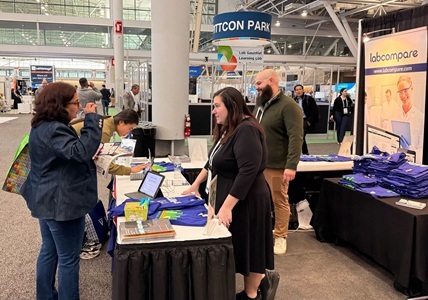
Returning from a successful visit to the West Coast in 2024, Pittcon 2025 was held at the Boston Convention & Exhibition Center March 1 through March 5. With nearly 500 exhibitors, over 1,100 sessions on six different tracks—bioanalytical & life sciences, cannabis & psychedelic, environment & energy, instrumentation & nanoscience, pharmaceutical & biologic, and professional development—there was a little something for everyone, regardless of industry and/or expertise.
Given the talent that convenes at Pittcon, it is an ideal forum for manufacturers and professionals to collaborate and discuss innovative solutions that can make the world a better place. This year, those conversations included: user-informed designs, easy-to-use mass spectrometry, PFAS and AI and contributing to society through innovative science and technology.
The power of client feedback
This year, multiple manufacturers expressed their commitment to customers through “user-informed design” of their new products. While performance is always prioritized, some manufacturers focused on the look and feel of their laboratory solutions much more than in previous years.
For example, Denise Bell, LabVantage Solutions’ Director of Product Management, spoke about “client-centricity” when she announced the release of LabVantage 8.9—the latest iteration of the company’s flagship laboratory information management system (LIMS). When designing version 8.9, LabVantage put themselves in the shoes of the customer, asking questions like, “Do I like clicking the button?”, “Do I enjoy working on the system?”, “Is if visually appealing?”
This perspective led the company to add an intuitive drag-and-drop interface, more colors inside the software, and new personalized display options tailored to meet individual workspace preferences. For example, while your colleague likes to see the sample number first followed by the sample name, you would rather see the sample name followed by the number. The personalized display options allow users to make these small but meaningful changes.
At Labconco, the team used customer feedback they received from trade shows like Pittcon to completely redesign their CentriVap Centrifugal Concentrator. The concentrator, a workhorse lab instrument last redesigned in the 1990s, now has a 5” touchscreen display that operates without any extra equipment, such as a computer. It also features stackable sample rotors to double your lab’s sample capacity, as well as a strobe light to allow in-run sample monitoring without stopping the instrument.
Zachary Zakibe, Product Manager at Labconco, said the design team focused on the “look and feel of the CentriVap, and how users interact with it.” For example, the instrument is now charcoal as that is the color of most lab benches, allowing the concentrator to easily blend in. Labconco did the same to their biosafety cabinets—they are now a pure white, as opposed to off-white, to blend in better with most laboratory walls.
"Many users are giving tours of their labs to investors, students, and the general public—the instrumentation needs to look nice and perform well," said Zakibe.
Additionally, Labconco’s product designers emphasized accessibility in the new version of the CentriVap, ensuring all visual and audio upgrades were designed with accessibility in mind, including the new high-contrast touchscreen. Zakibe says the team also gave considerable thought to how users could reach the instrument, whether that be standing, sitting, or somewhere in between.
A customer asked HORIBA if they could design a high-throughput plate reader that could read a 96-wellplate in 10 minutes. At Pittcon 2025, HORIBA debuted the PoliSpectra Rapid Raman Plate Reader (RPR) that scan 96 wells within 1 minute.
The development of the PoliSpectra RPR was what HORIBA calls a “yes, we can” project. These “yes, we can” projects are requested by customers to address a specific pain point. Leveraging their strong, proven background in engineering, HORIBA takes on these projects to develop a complete solution for customers.
“We have proven ourselves by combining analysis, sample handing and software with our strong engineering background,” said Andrew Whitley, VP of Sales at HORIBA. “We can establish that kind of footprint in the life sciences by partnering with others and building something together that addresses their pain points.”
The PoliSpectra RPR performs non-destructive analysis for real-time monitoring of reactions, and its patent-pending rapid Raman reading technology, along with a plate heater, supports live process monitoring through rapid plate reading and transfer at reaction temperature. The system features full automation, including a motorized door, dedicated software and server access for seamless integration with automated liquid handling systems or with robotic arm microplate loaders.
The PoliSpectra RPR is HORIBA’s first “yes, we can” project. For that reason—in addition to the fact that the completed design works so well and is now being used beyond the initial customer— Whitley said it is his favorite project to date. The HORIBA team is currently working on a second “yes, we can” project that involves vials.
Easy-to-use mass spec
At Pittcon, HORIBA also debuted the SignatureSPM, a multimodal characterization system built on an automated atomic force microscopy (AFM) platform and integrated with a Raman/photoluminescence spectrometer. The instrument offers comprehensive analyses of topographic, mechanical, electrical, magnetic, optical and chemical data in a single, real-time measurement. It requires less sample handling and provides faster co-localized data acquisition, which streamlines workflow and provides results in less time. The combination of AFM with Raman and photoluminescence spectroscopy enhances chemical identification. Additionally, the instrument is easy to use—a minimal learning curve enables users to start measurements in under 5 minutes.
“Any customer can perform spectroscopy with this small, integrated platform,” said Whitley.
Working on his Ph.D. in cosmochemistry, Jeff Williams became frustrated with how many instruments and software it took to meet his research needs. So, he left the program to develop a small, portable instrument with multiple modalities that could analyze as many elements as possible. The result is Exum Instruments’ Massbox, the first commercial instrument to use Laser Ablation Laser Ionization Time of Flight Mass Spectrometry (LALI-TOF-MS). It combines Exum’s patented LALI technology with industry-leading TOF mass analyzer for rapid, high-sensitivity chemical characterization and trace-level detection of nearly the entire periodic table—from lithium to uranium. Taking up just 2 feet of desk space, the Massbox can provide qualitative analyses, quantitative analyses, elemental mapping and depth profiling in solid samples in minutes.
The Massbox’s compact design brings it outside the traditional laboratory environment, and it’s intuitive operation means there is no need for a “specialist.”
“We are broadening access to mass spec to more of a population of scientists,” said Jeff Streger, President of Rave Scientific, the Eastern U.S. distributor of the Massbox.
Returning trends and applications
Over the past few years, PFAS and AI became common topics at Pittcon, especially in 2023 and 2024. This year was no different, with multiple vendors debuting instruments, software and workflow solutions that can handle the ever-changing demands of PFAS and the ever-growing capabilities of AI.
PerkinElmer launched the QSight 500 LC/MS/MS System, specifically designed for the advanced detection of PFAS and other emerging contaminants. The system excels in the precise, high-sensitivity analysis of complex samples such as sludge, grease and other difficult matrices.
Additionally, the instrument is designed to keep contamination out, preventing buildup and ensuring long-term performance with minimal maintenance—more than 25,000 continuous analysis can be run without cleaning. By reducing contamination, the QSight 500 minimizes the need for extensive sample preparation, saving significant dollars per year in consumables, reagents and labor costs. By eliminating the need for QuEChERS (quick, easy, cheap, effective, rugged, and safe) and replacing it with a simple blend-and-inject workflow, the QSight 500 also saves time—taking as little as 5 minutes from sample to result.
Shimadzu debuted its LCMS RX series of triple quadrupole mass spectrometers with new CoreSpray technology. CoreSpray, a newly developed gas delivery system, improves performance and uniformity of nebulization with higher flows and better heat transfer—greatly enhancing reproducibility from instrument to instrument, site to site. For example, Shimadzu scientists ran 20,000 consecutive analyses of pesticide residues in black tea with no internal standards and recorded “extreme uniformity.”
Landon Wiest, LCMS Product Manager at Shimadzu, said the RX series is also well-suited for PFAS analyses as the instruments effectively remove matrix contaminants, resulting in lower noise levels, high data quality, sensitivity and rapid analysis capabilities. Additionally, the LCMS RX line has an innovative “Ecology Mode” that automatically checks system status and shuts the instrument down after sample queues are completed, decreasing energy consumption by 31%.
LabVantage’s 8.9 upgrade includes “Lottie AI,” voice command functionality for hands-free operation. Just as users ask Siri and Alexa for help, laboratory technicians can now say, “Hey Lottie, can you open Row 1?”
“In this release, we’ve done things to harden the software so we can start adding more AI in the future,” said Bell. “We’re trying to build out a digital labor force within our LIMS. What are those items we can use AI to take the burden off our lab folks?”
The 8.9 also incorporates VantageXpert, an eLearning/training platform tailored to each user’s individual learning style, ensuring maximum effectiveness. This is all part of what LabVantage calls SaaS 2.0—a changeover from today’s Software as a Service to tomorrow’s Service as a Software.
“Part of what we see happening is scientific large language models built into the local research environment—semantic layers that allow the system to learn more about us as a community within that laboratory environment,” said Alan Marcus, Chief Growth Officer at LabVantage.
Generations of inspired science
In 1925, Ralph Callaway, a salesman, stopped by Philip Goldfisch’s garage to get his car battery repaired. While there, an unusual contraption caught Callaway’s eye—an invention of Goldfisch’s own: a long metal pipe that held round bottom flasks for a local grain laboratory to remove acid fumes. The process was known as Kjeldahl nitrogen determination.
Callaway and Goldfisch formed a partnership named Laboratory Construction Company. Their mission—to build and sell Kjeldahl apparatus to the numerous milling companies in the area. In 1939, Callaway’s son, Redman, joined the business. During his 60-year career, his brand of building relationships, serving customers and caring for people helped the company thrive. In 1957, Labconco—as we all know it today—outgrew the garage it started in and moved to its present headquarters in Kansas City. This year, the company celebrates 100 years of serving and caring for customers and innovating for science.
On March 31, 2025, Shimadzu Corporation will celebrate its 150th anniversary. Established in 1875, Genzo Shimadzu Sr., a craftsman of Buddhist altars in Kyoto, was inspired by the idea that Japan should establish itself as a leader in science, and began to manufacture educational physics and chemistry instruments. His aspiration was to contribute to society through science and technology.
Genzo Shimadzu Jr., who followed in the footsteps of his father, developed the family business into a company, starting with X-ray technology and storage batteries. Shimadzu Jr. took on new challenges one after another, creating the prototype of the current company.
At its booth at Pittcon, Shimadzu showed off beautiful HPLC and GC instruments with special designs that incorporate different techniques from Kyoto's traditional crafts. By fusing these techniques with industrial products and working with Kyoto’s master artisans, Shimadzu created concept models of unique one-of-a-kind products that blend art and science.
Shimadzu isn’t the only company inspired by its Japanese roots. HORIBA is guided by founder Masao Horiba’s belief in the power of “Joy and Fun” and “HONMAMON.” The pursuit of Joy and Fun by HORIBA and all its employees contributes to a sustainable planet, the health of diverse living beings, improved technological development and one-of-a-kind innovations. “HONMAMON,” derived from the Japanese word “Honmono” (meaning authentic), is an expression used in Kyoto that indicates the highest class of real. Each person may have a different interpretation, but HORIBA’s Whitley describes it as “the feeling that something is just right.”
“To achieve our vision, ‘Joy and Fun for All,’ we will stand beside innovators leading change as a trusted partner, and provide them with the solutions required to make the best possible choices for our world,” reads HORIBA’s mission statement. “Essential in this pursuit are our capabilities for producing HONMAMON technologies. Our distinctive power of HONMAMON and diversity will create solutions that guide the way forward to a brighter future.”