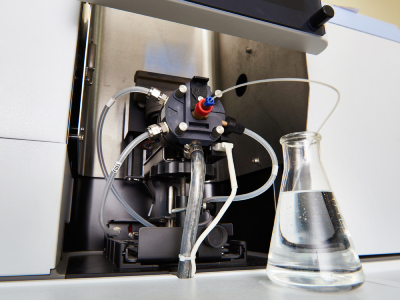
Atomic absorption spectrophotometry is an analytical technique used to determine the concentration of target elements in a sample by detecting and measuring the amount of light absorbed by the atomized sample.
Atomic absorption spectrophotometry primarily utilizes one of two methods to achieve sample atomization. In flame atomic absorption spectrophotometers (FAAS), acetylene (C₂H₂ ) is mixed with an oxidant, either oxygen or nitrous oxide (N₂O), to create a flame which atomizes the sample. Alternatively, In graphite furnace atomic absorption spectrophotometers (GFAAS), samples are heated within a hollow graphite tube until vaporization occurs.
To determine the concentrations of target elements, an AAS analyzes the amount of light absorbed by the atomic vapor created during atomization. Elements characteristically absorb light at different wavelengths allowing for precision identification and quantification of their concentration. To achieve this, an AAS uses a light source (typically hollow cathode lamps) to emit light at different wavelengths and passes that beam of light through the atomic vapor. Once light passes through the atomic vapor, the instrument will then analyze the amount of light absorbed at a specified wavelength and calculate the concentration of the target element.
While each type of AAS works on the same principle of light absorption, each can provide slight benefits and drawbacks when compared to the other. While a flame AAS is more tolerant of challenging sample matrices, the sensitivity of the instrument is typically limited to the PPM range. For laboratories that require trace analysis, graphite furnace instruments can operate in the PPB range if the sample matrix is kept clean. Many modern instruments are combo units that can perform both graphite furnace or flame atomization.
The primary drawback of an AAS is analysis time. Since elements absorb light at different wavelengths, multiple lamps are needed to cover the full range of neccesary wavelengths. In some instruments this could require changing the bulb to achieve a full range of analysis, making AAS analysis a poor fit for screening work. To remedy this, many instruments can now have multiple lamps installed at once enabling sequential analysis of the same sample, enabling faster sample throughput and general elemental screening.
Below you will find a few of our top-rated atomic absorption spectrophotometers, you can compare specifications or request a quote from leading suppliers.
Looking for more? Be sure to read our Atomic Absorption Spectroscopy Buyers Guide which can help you make informed decisions for your laboratory with overviews of popular products and solutions, as well as recent trends and applications.