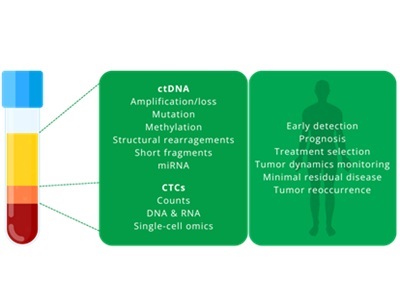
Figure 1. Molecular and phenotypic insights obtained through ctDNA and CTC analyses and their applications in monitoring cancer progression.
by Marwan A. Alsarraj, Translational Research Segment Manager, Bio-Rad Laboratories Inc.
Advances in blood-based diagnostics, including liquid biopsy and the analysis of circulating tumor cells (CTCs) and, more recently, circulating tumor DNA (ctDNA), have transformed cancer research. This powerful alternative to intrusive tissue biopsies allows researchers to continuously monitor tumor-derived genomic biomarkers, tumor progression, treatment response, and recurrence by offering a minimally invasive approach for sampling solid tumors in real-time.
Connecting tumor heterogeneity to progression, survival and treatment response
Tumor heterogeneity is a major barrier to successful cancer treatment due to its influence on tumor progression. Specifically, the effectiveness of cancer therapy is largely dependent on the characterization of tumor heterogeneity and the identification of specific genetic mutations that influence a tumor’s susceptibility to a particular drug or hormone therapy. Traditionally, cancer detection is performed by tumor biopsy, which is considered the gold standard approach, and imaging technologies, such as ultrasound imaging or nuclear magnetic resonance imaging. However, tumor biopsy is often an invasive procedure, which impacts its suitability for serial sampling and continuous monitoring. It also restricts the molecular information obtained to a single tumor region and has implications for tumor metastasis and injury-related risks.1 As such, approaches to improve the early detection and monitoring of tumor heterogeneity are critical for advancing cancer research.
CTCs are cancer cells that have shed or actively migrated from the primary tumor or tumor metastases into the circulatory system and offer valuable molecular insights into tumor-specific mutations, tumor heterogeneity, and epigenetic changes, as well as phenotypic insights from intact tumor cells to assess tumor progression, patient prognosis, and response to treatment.2 Although CTCs are rare in blood samples (as few as 1 cell/mL of blood), their enumeration is an established predictive marker for patient survival in many solid tumor cancers, such as metastatic breast cancer3, lung cancer4, and metastatic colorectal cancer5, as CTCs are rarely found in benign patients or healthy controls.6
Epithelial-to-mesenchymal transition (EMT) is a process that involves the loss of adhesion of tumor cells from the primary tumor, invasion of the basal membrane and surrounding tissues, and intravasation into the blood or lymphatic vessels. EMT contributes to generating CTCs, which can survive throughout the peripheral system before extravasating and proliferating at secondary sites, forming secondary tumors in distant organs. As a result, CTCs not only provide critical insight into primary tumors, but can provide phenotypic and molecular insights into other aspects of cancer biology including metastasis.7
Figure 2. CTC capture and immunostain-based enumeration and recovery for downstream analysis
CTCs can impact treatment response by possessing genetic mutations and surface markers not present in cells from the primary tumor. They may not be receptive to therapies targeting the primary tumor and, therefore, require different treatment strategies. For example, an exploratory study investigated whether patients with gastric cancer could benefit from trastuzumab therapy (an anti-HER2 monoclonal antibody) despite having HER2 negative primary tumors based on the presence of HER2+ CTCs.8 This is also true for localized treatment strategies, such as radiotherapy, which may fail to target CTCs.
Similarly, ctDNA – genetic material secreted by tumor cells from primary tumors, CTCs, or metastatic lesions – has become a valuable tool in clinical research for its potential as a biomarker for real-time monitoring of tumor heterogeneity and cancer progression. This is due to its ease of isolation from the blood and source of valuable molecular information on cancer-specific genetic mutations.9
The combined assessment of CTCs and ctDNA through liquid biopsy-based sampling could provide researchers with valuable insights into the phenotypic and molecular characteristics of primary and metastatic tumors to help predict patient prognosis, identify the most effective treatment strategy, and monitor recurrence (Figure 1). This approach to improving the prognostic value of liquid biopsy has shown potential in a recent clinical trial in metastatic breast cancer and is paving the way for the more effective treatment of cancer through precision medicine.10
Advancing CTC monitoring and ctDNA analysis
Despite the promise of CTC and ctDNA analyses in cancer diagnosis, prognosis, treatment monitoring, and predicting recurrence, potential clinical integration requires unbiased, efficient, rapid, and cost-effective technologies. Due to their rarity in the blood, CTC capture technologies must be capable of isolating a sufficient quantity of cells from liquid biopsies and seamlessly integrate with advanced sequencing or quantitative tools and functional assays to support accurate data-driven therapeutic decision-making. Similarly, ctDNA is also present in a low concentration in the blood, representing a small proportion of the total cell-free DNA. Therefore, effective detection strategies must be capable of detecting low levels of ctDNA in small sample volumes. Despite these challenges, technological advances used to assess CTCs and ctDNA have improved their utility in cancer research.
CTC capture and enrichment
Strategies to capture and enrich CTCs can utilize antigen-dependent or antigen-independent approaches. Antigen-dependent capture typically involves selective CTC capture based on the presence of a specific antibody that is highly expressed on CTCs, including the Epithelial Cell Adhesion (EpCAM) biomarker, with minimal expression on other cell types found in the blood.11 CTCs usually lack the expression of markers specific to normal blood leukocytes, like CD45, and are therefore used as a negative biomarker and reduce the contamination of CD45+ white blood cells. The current FDA-approved method for CTC detection and enumeration relies solely on the expression of specific CTC surface markers. However, mesenchymal CTCs – CTCs undergoing EMT – are associated with the loss of the expression of epithelial adhesion biomarkers, resulting in this subpopulation of CTCs going undetected. Due to the challenges in extracting CTCs based on a single biomarker due to their genetic heterogeneity and instability, single-cell multi-omics analysis offers a solution that uses multiple biomarkers.12 This approach can provide valuable insights into disease progression when combined with long-term follow-up data.
Antigen-independent approaches leverage physical properties such as charge, size, density, or elasticity for CTC enrichment to overcome challenges relating to the dependency on the expression of specific biomarkers. Size-based selection enables the selective capture of CTCs, ranging from 8-30 µm. White and red blood cells fall below 8 µm in size and are therefore eliminated during selection, reducing contamination. Some innovative approaches integrate size-based detection with immunostaining to enable the detection and enumeration of CTC subpopulations, including both mesenchymal and epithelial CTCs, using biomarker-based selection. Instruments that integrate microfluidics can offer this dual functionality within a single workflow using microfluidic slides and enable the retrieval of viable CTCs for downstream analysis, such as immunohistochemistry or fluorescence in situ hybridization (Figure 2). This combined approach enhances the sensitivity of CTC detection and has demonstrated higher capture efficiency than CTC detection relying solely on the expression of EpCAM13 or multiple biomarkers14.
Innovations in sequencing technologies to support ctDNA detection and analysis
The growing attention to the potential of ctDNA analysis in monitoring tumor heterogeneity, detecting recurrence through molecular residual disease (MRD), and optimizing therapeutic strategies is partly due to advances in next-generation sequencing (NGS) and digital PCR technologies that have improved detection limits.15 NGS is well-suited for simultaneously evaluating unknown mutations across kilobases or megabases of a genome in a single run. However, ctDNA analysis using NGS is complicated by the limited detection limits, which is not well-suited to the low abundance of some mutations in low sample concentrations. Additionally, NGS is a laborious and time-consuming process, creating a huge cost burden for repeated and long-term monitoring applications, and often requires biostatisticians due to the complexity of the data analysis.
Droplet Digital PCR (ddPCR) has emerged as an innovative alternative solution, capable of absolute quantification of nucleic acids with high precision and reliability. Due to its low detection limits, based on nanoliter-sized water-in-oil emulsion droplet technology, ddPCR technology requires low sample volumes and concentrations. It is, therefore, well-suited to rare mutation detection and can also be used for copy number variation analysis and DNA methylation analysis. These attributes make ddPCR technology ideal for routine monitoring, providing a relatively low-cost and easy-to-use method for ctDNA analysis in research labs. Several cancer research studies have demonstrated the potential use of ddPCR solutions to assess ctDNA mutations. For example, ddPCR technology was used to correctly identify KIT gene alterations in the ctDNA from patients with mucosal and acral melanomas in a study evaluating the efficacy of nilotinib, a tyrosine kinase inhibitor, in advanced KIT-mutated melanoma.10 In another study, ddPCR technology enabled three glioma mutations, IDH1, TERTp, and EGFRvIII, to be reliably detected.16 These studies demonstrate how advancements in PCR-based ctDNA analysis have improved the detection limits and detection of rare variants.
Final thought
Advances in technologies to support comprehensive liquid biopsy analysis, together with the integration of data from CTC and ctDNA analyses, represent a promising approach for the early detection of genomic biomarkers, real-time monitoring of tumor heterogeneity, and to provide valuable insight into treatment response, tumor progression, and recurrence. Ongoing research and collaborative efforts between researchers, clinicians, and industry partners are directed toward improving the specificity, reproducibility, and validation of ctDNA and CTC-based detection systems to advance the translation of these innovations into routine clinical practice and harness their potential to improve outcomes for patients with cancer.
About the author
Marwan Alsarraj is the Translational Research segment manager, at Bio-Rad. He has been at the forefront of developing, marketing, and commercializing technologies in the past 19 years in the life science research industry. Marwan obtained his MS in biology at the University of Texas, El Paso.