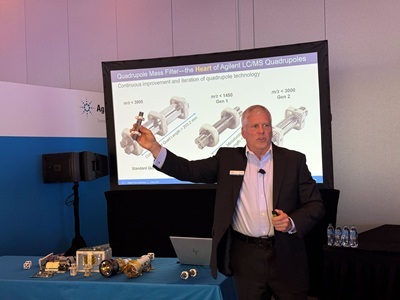
Agilent's Shane Tichy introducing the Pro iQ series at ASMS 2025.
The 73rd Conference on Mass Spectrometry and Allied Topics (ASMS) held last week in Baltimore was all about seeing deeper and deeper into ‘omics samples to truly drive precision medicine—moving the industry closer to the day where treatments can be developed for each individual patient’s specific immune system.
“[The industry is] taking steps toward individualized therapies that are made just for you,” said Jennifer Van Eyk, Director, Basic Science Research in the Barbra Streisand Women's Heart Center (California). “If a drug is not responding in a clinical trial, it does not mean the drug is not working— the person may not have the correct cells. We may have to shift the patients’ proteome to be responsive.”
Once the full human genome was sequenced, scientists thought we would uncover and understand a lot more about disease in the human body—and we did. But, researchers also discovered the genotype is only one piece of the puzzle. We now know characterizing the phenotype is necessary too, including the microbiome, metabolome, proteome and transcriptome.
This new era featuring higher levels of data and elevated insights from that data relies on advanced mass spectrometry.
Thermo Fisher Scientific’s MS for proteomics
Thermo Fisher Scientific launched the Orbitrap Astral Zoom mass spectrometer (MS) and the Orbitrap Excedion Pro mass spectrometer at ASMS.
The Orbitrap Astral Zoom MS builds off the success of its predecessor—the Orbitrap Astral MS. The new version enables 35% faster scan speeds, 40% higher throughput, and 50% expanded multiplexing capabilities, delivering higher sensitivity and increased flexibility.
“Researchers can see what is in their samples faster, leading to acceleration of their discoveries,” said Pushkin Pant, VP/GM, Life Sciences, Thermo Fisher Scientific. “We can shorten analysis time for 6,000 patient research samples rom 1,000 days to 100 days.”
Pant and other Thermo Fisher Scientific representatives referenced the explosion of the proteomics market in recent years, both in terms of literature and samples. For example, where a laboratory was maybe analyzing 10 samples a day 5 years ago, they are now working on 100 samples a day.
The development of the Orbitrap Excedion Pro MS is a reflection of the proteomics market. It is the first platform to combine next-generation Orbitrap hybrid mass spectrometry with alternative fragmentation technologies, a technique for efficiently analyzing complex biomolecules. With the instrument, researchers can gain a deeper understanding of biotherapeutics, including therapeutic proteins, monoclonal antibodies (mAb), oligonucleotides, fusion proteins, and more—accelerating the development of treatments across areas such as cardiology, neurology and oncology.
With enhanced sensitivity, dynamic range and reliability, the Orbitrap Excedion Pro MS delivers faster, higher-quality, protein and post-translational modification data along with small molecule insights to drive robust biological understandings.
Agilent’s LC detector for intact proteins
Agilent Technologies’ debuted a mass detector series for liquid chromatographs that has been 5 years in the making.
“The Agilent InfinityLab Pro iQ Series was a 5-year conversation about mass range,” said Jennifer Gushue, associate vice president of LC/MS Product Marketing at Agilent. “You need larger and larger pressure to be able to analyze intact proteins. Normally, you use a small time-of-flight to do that—but things have evolved. The biopharma market is looking at peptides, intact proteins, oligonucleotides and more. You need to be able to look at all of these molecules on any given day. The complexity of the molecules necessitates a high mass range without loss of sensitivity.”
The Pro iQ Plus system features an expanded mass range of m/z 3,000 and enhanced sensitivity through Agilent Jet Stream (AJS) technology, supporting both routine and trace-level detection of small and large molecules. It is it ideal for monitoring complex biomolecules and detecting impurities. Meanwhile, the Pro iQ Series features a mass range of m/z 2–1,600, making it a reliable choice for optimized small molecule analysis in standard laboratory workflows.
“We are operating this quad at the physical limit,” said Shane Tichy, Associate Vice President, LC/MS R&D at Agilent. “It is the new gold standard.”
Essentially, the Pro iQ series is a single quadrupole with the power—but not the size—of a triple quadrupole.
Additionally, the stable quad drive is unaffected by temperature, allowing laboratories the flexibility to manage their temperature control as needed. The stability also means the lab does not need to recalibrate the instrument as often. As an example, Agilent scientists ran 13,700 nonstop injections of salmon matrix. While the source was extremely contaminated around the outside by the end of the test, the contamination did not get pulled into the instrument, ensuring the spectra was the same for each sample. This capability makes the Pro iQ series ideal for PFAS and PFOA testing, as well. Lastly, the detector’s data processing takes users from sample automatically to deconvoluted spectra so you can quickly analyze and characterize the most challenging samples.
Both the Pro iQ and Pro iQ Plus systems are designed for efficiency and ease of use, enabling faster compound confirmation with greater specificity and selectivity than traditional UV detection—even for chromatographically unresolved compounds.
SCIEX’s TOF for metabolics
Sciex’s new ZenoTOF 8600 system can quantify what was previously difficult to even identify, with up to 30x higher sensitivity than its predecessor.
“We are not just seeing more things, we are identifying them, and at times 30-40% more,” said Nicola Zamboni, principal investigator and adjunct professor at ETH Zurich.
The OptiFlow Pro source, DJet ion guide, and QJet ion guide enables the system to generate and transmit more ions. When combined with the Zeno trap, this facilitates a high level of improvement in sensitivity. The system’s ZT Scan DIA 2.0 covers a larger mass range so scientists can now quantify even low-level metabolites across all ‘omics disciplines.
“Metabolites are an ideal complement to genomics,” said Zamboni. “By measuring metabolites, we have a functional readout of the interplay within the human body, including the effects of the environment.”
The MS can analyze 500 samples per day, including in vivo for those working in drug discovery laboratories.
SCIEX’s CEO Chris Hagen said the company will be sharing the data behind the ZenoTOF 8600 system with its customers to “really prove” how powerful the instrument is.
Bruker’s trio for proteomics
All three MS launches by Bruker at ASMS address gaps in the ‘omics research community. The first, the timsMetabo, was developed out of customer demand, according to Matthew Lewis, VP of Metabolomics and Lipidomics at Bruker.
“We listened to our customers and this is what they wanted—something specific to the field,” he said.
The timsMetabo is a next-generation 4D-Metabolomics mass spectrometer that delivers enhanced sensitivity, separation power and annotation confidence for small molecules. The system combines trapped ion mobility separation (TIMS) technology and time-focusing for exceptional sensitivity. Novel Mobility Range Enhancement (MoRE) acquisition leverages the enhanced ion capacity of the dual-stage TIMS-MX ion funnel, expanding its mass-to-charge and mobility ranges. Coupled with a new high-precision quadrupole and Athena Ion Processor (AIP), the timsMetabo excels at resolving isomers, isobars and interferences in routine operation, delivering highly-selective MS1-based quantification—at speed and scale.
For assays requiring precision at the limit of quantitation, the timsMetabo provides cleaner, less-chimeric MS/MS acquisition at rates up to 300 Hz for targeted quantitative analysis using parallel reaction monitoring. The AIP leverages mobility information encoded by TIMS in each acquisition cycle for optimal transfer of MS and MS/MS-derived ions for TOF mass analysis.
The system also produces a “digital metabolome archive” for every sample, which can be enhanced with AI, bringing machine learning into metabolomics research.
“The technology will help us better understand this biologically diverse class molecules routinely, at speed and scale,” said early user Peter Dorrestein, Director of the Collaborative Mass Spectrometry Innovation Center at UC San Diego.
Bruker scientists described timsOmni, the second new MS system introduced at ASMS, as having “Swiss Army knife flexibility in electron and collision-induced ion fragmentation for next-gen proteoform insights to transform disease research, biologics development and advanced bioprocessing QC.”
The flexibility enables the identification of low-abundant, aberrant proteoforms—the structurally altered versions of proteins—arising from genetic mutations, alternative splicing, or post-translational modifications that deviate from normal physiological forms, disrupting protein function, misfolding or aggregation. The proteoforms often play critical roles in the onset and progression of human diseases, including cancer, neurodegeneration, cardiovascular disorders, and autoimmune conditions. Bruker says these next-gen proteoform insights from the timsOmi will help usher in a new era of “preoteoformics”—a focus on functional, therapeutic and pathological protein isoforms.
Lastly, the timsUltra AIP mass spectrometer delivers up to 35% more peptide and 20% more protein identifications for significant advances with complex biological samples, such as fine-needle aspiration tumor biopsies, immunopeptidomics, single-cell proteomics and metaproteomics. The system also enables more comprehensive ion coverage for de novo peptide sequencing and immunopeptidomics neoantigen discovery.
Waters’ MS for PFAS
In the same way scientists need more insight into the human phenotype, they need to go deeper into “forever chemicals.” Thus, it’s not surprising that the MS manufacturers who focused their launches on ‘omics research at ASMS 2025 also repeatedly mentioned that the new systems could analyze PFAS as well.
Waters went the other way—they touched on the new Xevo TQ Absolute XR MS for pharmaceutical quantitation, but significantly highlighted its ideal sensitivity and high-efficiency for PFAS detection and testing.
“The key to PFAS testing is extremely low-level toxin testing—lower and lower and wider and wider,” said Bharat Chandramouli, a Product Director at SGS who has worked with the EPA on PFAS methodology.
The Xevo TQ Absolute XR Mass Spectrometer uses up to 50% less power and nitrogen gas, produces 50% less heat than any other high-performing tandem or triple quadrupole on the market, and takes up to 50% less bench space, making it the ideal system for laboratories striving to reduce their environmental footprint without compromising throughput or performance.
Typically, there is a tradeoff between robustness and sensitivity for high-performing mass spectrometers. However, the Xevo TQ Absolute XR overcomes this hurdle. The innovative StepWave XR Ion Guide incorporates sophisticated technology designed to minimize the risk of unplanned downtime—so much so that the MS does not see a drop off in performance even after 15,000 injections.
In commercial labs for example, calibration for PFAS needs to be done every week, which takes an instrument offline for half of a (24 hour) day. For these labs, performance without calibration is critical. Tailored for high-throughput applications in pharmaceutical companies, contract testing organizations and government laboratories, the Xevo TQ Absolute XR MS is designed to deliver exceptional performance for the most sensitive trace-level analyses in complex matrices.
“There has been a 25 to 30% growth in the PFAS market year over year for the last few years. The challenge is keeping up with PFAS testing needs and demands,” said Chandramouli. “PFAS is now moving from an emerging contaminant to a regulated contaminant. In the future, commercial labs need to be able to answer questions in minutes—not days. Labs will need the ability to measure in the field at very low levels so answers can be found in real-time.”