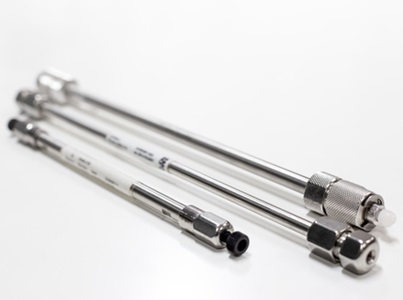
Proper storage of HPLC columns is necessary to maintain performance and extend a column’s life, and different columns have specific requirements based on their stationary phase chemistry and the mobile phase used.
This guide outlines general tips for storage practices for common column types, highlighting recommended solvents and best practices for sealing and labeling to help maximize your column’s life.
“Take the time to store your column correctly even if you only expect them to be stored for short periods of time,” says Jonathan "Munch" Keim, Content Marketing Manager at Restek. “This will reward you with longer lifetime.”
Label HPLC columns
Depending on the lab, HPLCs are used at different frequencies and by different numbers of users. Some labs, such as smaller academic labs, may use them only once a week with one or two users, while larger labs may use them for multiple runs per day. To help prevent mix-ups, users should clearly label the column with the first date it was used, the solvent, and the date of storage. This information will be helpful so that later users know what’s inside the column and can choose a compatible solvent, as well as how long it’s been in storage.
Keep a column logbook
In addition to labeling the column itself, it's good lab practice to keep a column logbook or datasheet, which might include a record of each column’s usage, any performance notes, or storage details. When storing long-term, you might also include a printed copy of the certificate of analysis (COA) or a test chromatogram in the box to help verify that the column’s performance hasn’t deteriorated. A reference chromatograph, along with the conditions needed to reproduce it, can help provide a baseline to determine what has changed over time.
Flush out buffers and salts
Make sure to purge the column of buffered mobile phases to prevent salt crystallization and corrosion, as any salts remaining in the column can form deposits if any solvent evaporates. Chloride salts are particularly problematic, as chloride ions can corrode the metal frits to generate metal compounds that contaminate the stationary phase and interfere with analyte detection.
Never allow a column to dry out with salts present, as the solid crystals that form may clog the packing. For example, it is recommended to flush 10–30 mL of buffer-free solvent through the column after a buffered run. Some manufacturers, like Waters, recommend rinsing with HPLC-grade water followed by acetonitrile if the column was used with buffers.
“It is best to first flush out with your mobile phase that matches your initial run conditions minus any additives for 10 to 20 column volumes,” said Keim. “Once this initial flush is complete, you can then transition to your storage solvent. You do want to keep solvent miscibility in mind and you may need to use an intermediate solvent if your mobile phase and storage solvent are not miscible. Ultimately, you’ll want to run another 10 to 20 column volumes of your final storage solvent. You’ll now be ready to securely plug the column, note the date and storage solvent, and store the column in a draw or rack.”
Store at room temperature
Store columns at ambient laboratory temperature, unless the manufacturer suggests otherwise. Standard analytical HPLC columns should not be stored in a refrigerator or freezer, as low temperatures can cause precipitation or phase separation of solvents.
Exceptions are specialty biological columns such as protein affinity columns or enzyme reactors, which may require cold storage per manufacturer instructions, as well as size exclusion columns (SEC), which may be stored at 4–8 °C to deter microbe growth.
Seal stored columns
Whenever an HPLC column is removed from the system for storage, proper sealing and labeling are important to avoid evaporation and to ensure that the correct mobile phase is used in the next run. Always use end caps on both the inlet and outlet of the column, which typically come with the column upon purchase. Avoid leaks and evaporation by checking that the end plugs are screwed in firmly, but be careful not to over-tighten them.
A sealed column prevents solvent evaporation, oxidation, and drying of the packing, even during short-term storage. After flushing the column with the storage solvent, stop the flow, then immediately cap the outlet, and then the inlet (to keep it full of liquid with no voids).
Avoid storing in mobile phases with extreme pH values
Most silica gel columns can safely operate in a pH range of 2–8, but for separations outside this range, other types of columns may be necessary. Covalently-bonded silane ligands undergo hydrolysis in mobile phases with a high pH, and the siloxane bonds themselves of some monomeric silanes are also slowly hydrolyzed at pH 9–10. The longer the mobile phase is in contact with the support, the higher the likelihood of this occurring, so it’s best to flush the column with acetonitrile before storage to avoid this.
Know the expected storage duration
The storage duration will determine whether you need to flush the column or if the mobile phase can remain. For example, if you’re certain you’re going to use the column for a run the very next day, it’s probably okay for the mobile phase to remain in the column.
For medium or long-term storage (more than a few days), it’s best to completely flush the column. The number of column volumes to use during the wash will depend on both the mobile phase and the column chemistry.
Long-term storage is also an option.
“If columns are stored correctly, they can be stable for months—if not longer,” says Keim. “This is where following all the details carefully can make all the difference. First, a proper flush and then fill with the column manufacturers’ recommended storage solvent is essential. But if you really want to have the best chance of that column maintaining its performance, you won’t want to skip over other best practices, including making sure the column end plugs are tight, the storage temperature is correct, and that you have carefully noted the date of storage and the storage solvent. This puts you in the best possible position to get that column back up and running quickly and smoothly when you need it.”
Taking a column out of storage
When you take a column out of storage, it’s often necessary to recondition it by flushing out the storage solvent with the mobile phase. If the storage solvent is immiscible with the mobile phase it will be necessary to use a mutually soluble solvent and to perform a gradient increase in the mobile phase content. As noted earlier, you can perform a test run and compare the resulting chromatogram to a standard chromatogram or the CoA.
“The keys here are that you need to safely transition your column from its storage solution to your mobile phase, and then give your column time to equilibrate,” says Keim.
Last thought
The tips offered in this guide are meant to provide general guidance for HPLC column storage to help users maximize the lifetime of their HPLC columns. HPLC users should always consult and follow manufacturer recommendations for their specific column.