by Nicolas Triballeau, Ph.D., Director, Drug Discovery – Chemistry, Revvity Signals Software
Great Scott! It’s been four decades since a time-traveling DeLorean made Hollywood history—but in 1985 invention wasn’t just brewing on the silver screen. While chemical illustration was still in a relatively rudimentary phase—drawing a chemical structure called for plastic shape templates, multicolored pens, rub-down letters, and tons of patience. Then in 1985, three people—a high-school teacher, a professor of organic chemistry, and a grad student—co-invented ChemDraw, and the chemical world, quite literally, never looked the same again.
Let’s take a tour to the ancient chemical past: pre-Tik Tok, pre-computing, back through history and even pre-history. Why are we so keen on drawing what cannot be seen?
In fact, humans have always had an eye for art, and we like to draw from our imagination and keep note of events. Outside of chemical reactions, we have been drawing, painting, counting and keeping tabs for a very, very long time.
The earliest cave paintings were probably created about 60,000 years ago, in Spain, with further examples in Indonesia from around 40,000 years ago. Since the birth of humanity, we wanted to create a permanent record to say, “We were here, we did this.”
Over the following tens of thousands of years, drawing and record keeping continued in much the same way. In Mesopotamia around 1200 BCE, perfumier Tapputi-Belat-Ekalle, often recognized as the earliest chemist, recorded ingredients for scents on clay tablets. Either clay acted as the preferred permanent record, or papyrus records have not survived the ravages of time; either way, history reminds us how past data can be easily lost.
Revolution came with the advent of wood-based paper (approximately 200 BCE) and printing. These advances made communicating ideas from one generation to the next radically easier. Books were published using the new-fangled moveable type (in China, around 1000 AD and in Europe, around 1400 AD) transforming arts and science. For example, Antoine Lavoisier’s book Méthode de nomenclature chimique, printed in 1787, ran to two editions and his ideas revolutionized chemical nomenclature. However, apart from the illustrated frontispiece—which includes a reference to alchemy, apparently—drawings were in short supply.
Even with the advent of computers and computing, drawings remained resolutely manual until the late 20th century. Students, researchers, and professional chemists relied on plastic shape templates (see image), and multicolored pens littered the workbench. In that world, a single mistake in permanent ink could mean a complete re-do, and you were literally going back to the drawing-board.
Thank You Steve Jobs and Steve Wozniak
ChemDraw was borne out of frustration and genius. The short story is that Selena ‘Sally’ Evans cajoled PhD student Stewart Rubenstein to write a drawing program that would be able to produce chemical structure drawings for Sally’s husband, chemistry professor David Evans, who wanted the drawings for classes and publications. Sally steered program design and David provided user acceptance, while Stewart wrote the software, initially for an IBM mainframe. When Sally, Dave and Stewart saw MacDraw on the newly launched Apple Mac, they realized that the perfect platform had arrived at the perfect time.
In July 1985, David Evans presented the first working version of ChemDraw during a break in proceedings at a Gordon Conference on Reactions and Processes, in New Hampshire. With the novelty of MacDraw—the first drawing program to use what-you-see-is-what-you-get technology—and the intuitive simplicity of ChemDraw, within a few weeks the sales ($295 for individuals, $495 for industry) took off. The Apple Mac’s novel use of a computer mouse and 2D user interface launched the user experience from tedious command-line instructions into the modern era, elevating ChemDraw to a must-have tool for professional chemists and researchers. The rest, as they say, is history.
Originally supplied for Macs only and delivered on floppy disk, the ChemDraw core functionality was—by modern standards—limited. Critically, though, ChemDraw removed the need for personal drawing skills. In particular, ChemDraw eliminated the enormous frustration of having to re-do an entire drawing because of a single mistake; instead, users could erase and re-draw on screen and simply print out the new version, which at the time was an almost mind-boggling innovation. In addition, ChemDraw offered a library of thousands of shape templates, all at the same scale, hugely accelerating drawing production, and freeing up time for research at the bench.
User Interface is Everything
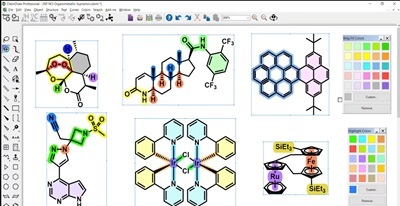
Over the years, ChemDraw has been downloaded by millions of users, and the latest versions run on multiple platforms, including a cloud-native edition. In addition, ChemDraw’s capabilities have naturally expanded to include perspective structures and 3D animations, connections to internal and external research databases, and embedded intelligence to help super-power the research process.
Like the original, the three current editions—ChemDraw Prime, ChemDraw Professional, and Signals ChemDraw—are each designed to take chemical communication workflow to the next level. The famously intuitive user interface remains a key attribute, while the power of AI, cloud and the internet are transforming productivity. Although the mouse is still critical for useability, the introduction of hotkeys and keyboard shortcuts have made it easier for users to action and refine drawings. Want to add a phenyl group? Just press 3. Molecules can be drawn almost as quickly as we can type. Strategically, though, the core advantage remains that ChemDraw helps you to spend less time on drawing and more time on research.
As well as creating beautiful, publication-ready drawings, ChemDraw also produced an entirely unanticipated impact on the world of cheminformatics: machine-readable chemical structures. Researchers who were formerly painstakingly encoding molecules manually could draw the same structures in ChemDraw and provide an error-free, machine-readable description. Not only did this capability transform cheminformatics productivity, these comprehensive databases also provide the perfect resource for training today’s AI models, enabling vast libraries of known substances to be screened, filtered and optimized for potential new uses.
The latest version of Signals ChemDraw offers an entirely new experience, combining remarkable drawing tools with extensive communication capabilities. For example, it is possible to hunt down and re-use drawings hidden in Excel, PowerPoint, and Word files, search for structures within Signals Notebook experiments, render realistic 3D conformations of your molecules, access safety data from regulatory agencies, and even find chemical suppliers.
Happy 40th Birthday ChemDraw
When ChemDraw was born in 1985, Marty McFly and Doc Brown clambered into the DeLorean. Since then, NASA launched the International Space Station (1998), Apple released iTunes (2003) and the iPhone (2007), Satoshi Nakamoto created Bitcoin (2009), high-school chemistry teacher Walter White pursued a life of crime (Breaking Bad, 2008 to 2013), Marty arrived in the future (2015), and OpenAI released ChatGPT (2022).
The world’s technology will no doubt continue to develop apace, achieving future levels far beyond our current comprehension. But whether we are cave painting or drawing chemical structures, we will want to make our note for tomorrow: “We were here, we did this, we drew this.”
Whatever the next 40 years holds, Happy Birthday ChemDraw!
About the author
Nicolas Triballeau, Ph.D., has 17 years of experience in drug discovery – not only providing direct project support and leading teams, but also playing a significant role in establishing scientific standards and ontologies. Nicolas holds a master's degree in chemical engineering with a specialization in organic chemistry, a Pharm.D. and a Ph.D. in Drug Design from the University of Paris. His email is [email protected]