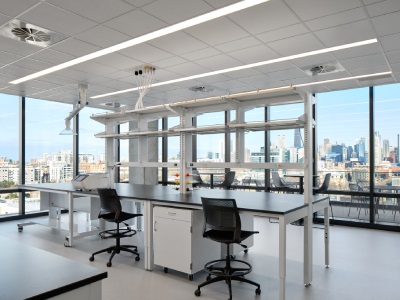
In the world of scientific discovery, the lab is more than just a workspace—it's a launchpad for innovation. Whether you're developing life-saving therapies, decoding genetic mysteries, or teaching the next generation of scientists, the design of your lab directly impacts your ability to succeed. As someone who has spent over two decades planning and designing research environments, I’ve seen firsthand how thoughtful lab design can empower researchers, accelerate breakthroughs, and prepare labs for future science and adaptability.
The Lab as a Living Ecosystem
Why do some research facilities produce more patents? Why do some have greater throughput given the same amount of time and space? Not all labs are created equal. While brilliant minds push science forward, great lab design supports their work by anticipating and filling their needs so they can focus on the work.
A lab is not a static structure—it’s a dynamic ecosystem. It must evolve with the science it supports. That’s why exceptional lab design starts with listening—to researchers, to facility managers, and to science itself. Every decision, from bench layout to vibration control, should be rooted in the needs of the people and the processes that define the space.
Designing an efficient and safe lab is a multi-step process. A design kickoff meeting gives all stakeholders an opportunity to voice their ultimate vision for their lab. The goal of this meeting is to arrive at a consensus of the purpose of the space and how it will be used. The planning session is also a good time to review client preferences re: the openness of the work environments. There has been a trend of massive open labs, but certain pieces of science need to happen in private spaces. Understanding what works culturally for a certain lab is an important piece of the puzzle.
In many cases, a high-level visioning process can be used in combination with practical approaches to create that vision in a day. Lab owners are often familiar with certain lab layouts, but it can be exciting to bring new configuration options into the mix. One of my favorite activities is visiting a lab showroom, and letting our clients decide what type of system works best for them.
With careful advanced planning and use of interactive, visual tools, the process itself can build consensus and be fun for the groups involved. These days we use 3D photographs of completed construction projects and we can walk around a complete lab in real time.
In my article “Lab Planning Details that Matter,” I emphasize that great design solves the riddle of how to incorporate more science into less space while maintaining architectural and engineering balance. This isn’t just about efficiency—it’s about enabling discovery.
Three Pillars of Purposeful Lab Design
At its core, lab planning revolves around three critical elements:
1. Benching and Infrastructure
Flexible casework, adaptable utilities, and modular systems are essential. Labs must be able to pivot quickly as research evolves. Whether it’s a startup company developing a new idea or a large corporation developing an established product, flexibility is the foundation of resilience. We are seeing a great demand in clean tech and material science. This means more chemistry-based labs. Concurrently, we are also seeing new science such as Xenobot, Metamaterial, Synthetic Embryology and even Astrobiology 2.0.
2. Equipment Integration
From precision balances to robotic automation, equipment is the heartbeat of the lab. But it’s not just about fitting machines into a room—it’s about designing around them. In “Lab Vibration Control,” I explore how even subtle vibrations can compromise sensitive experiments. Strategic structural planning can mitigate these risks and protect millions of dollars in research investment. Be careful when considering a steel or wood structured building versus one built out of concrete. Concrete inherently provides the natural stiffness and vibration mitigation for lab equipment. And that is not just specialty items, it is all lab equipment.
3. People-Centric Design
The most advanced lab is useless if it doesn’t support the people working in it. Ergonomics, daylighting, acoustics, and intuitive layouts all contribute to a healthier, more productive environment. In “Beyond the Blueprint,” I discuss how a holistic approach—one that considers wellness, collaboration, and sustainability—creates a lab that attracts and retains top talent.
Designing for Discovery, Not Just Delivery
Too often, labs are designed to meet a checklist of requirements. But the best labs go beyond compliance—they inspire. In “Exceptional Lab Design that Lays the Foundation for Discovery,” I write how labs should not be designed just for today, but for what they might become tomorrow.
Among other elements, this means:
- Planning for AI and data-driven research
- Building in scalability for future growth, and
- Designing for interdisciplinary collaboration
For example, collaboration fuels creativity. Therefore, creating comfortable spaces for collaboration is part of good lab design. “Collision” spots—the places along circulation routes and public areas where occupants cross paths—can be leveraged to create serendipitous encounters. These small nooks and other gathering spots can encourage face-to-face interaction and sharing if they include connection (Wi-Fi), comfortable seating, coffee, and other amenities.
It is also very valuable to have designated meeting space within the lab zone. This removes the need for researchers to take off all their PPE, leave the lab space, and travel back and forth from a conference room. By using a location adjacent to the entry/exit to the lab, someone from the outside can come into this interim space with lower levels of PPE required. Consider adding a table, comfortable seating, a whiteboard, and a TV screen to these areas.
No-Cost Improvements that Make a Big Impact
Not every improvement requires a big budget. In “5 No-Cost Lab Design Improvements,” I outlined simple strategies that can dramatically improve lab performance:
- Reconfiguring underused space
- Enhancing natural light
- Improving signage and wayfinding
- Encouraging cross-functional collaboration zones
- Streamlining utility access
These small changes can yield big returns in productivity, morale, and operational efficiency.
If a lab is a place of research, then it is also a place for researchers. Good lab planning, therefore, must take the human factor into account. In the past, lab spaces had a bad reputation for stale air and basement vibes with little or no daylight. There is an increased focus on employee wellness and good workflow to encourage happy workers. Some labs have even gone as far as creating bright, social space like Silicon Valley tech startups.
The Future is Flexible
Science is changing faster than ever, and it can be frustrating to feel that a lab is barely complete before it’s time to renovate and accommodate new technology. Traditionally, laboratory design has been based on a rigid layout with rows of benches. In many cases, this can be a very effective and efficient approach, but integrating modular layouts with collaboration and workplace spaces can also have a very positive effect on the culture and environment of the research. Even when robotics, automation and drones are at play, a properly designed module can also work with this future technology.
Instead of renovating a lab as science changes, a modular lab design creates adaptable spaces. It may use things like tables on wheels, electrical connections hanging from the ceiling, and sets of plug-and-play quick connects.
Modular designs factor in:
- Relationship of the office to the lab
- Level of openness and flexibility
- Percentage and location of collaboration/interaction spaces
- Blurred lines of territory
- Technology
Modular layouts can also be set up to run in both east-west and north-south directions. A traditional lab layout is usually based on only one direction, but if your module allows for benches to be rotated 90 degrees you can have more freedom in your design. There are also other unique ways to use a modular layout. A hexagonal shape can create a unique way of displaying work for touring while also increasing the linear feet of usable bench space.
The pace of scientific advancement is accelerating. Labs must be ready to adapt. Whether it’s a shift from wet lab to dry lab, the integration of AI, or the need for hybrid research spaces, flexibility is no longer optional—it’s essential.
As we look to the future, lab design must continue to evolve. It must be sustainable, inclusive, and technologically forward. But most importantly, it must be human-centered. Because at the heart of every breakthrough is a person—and the space that empowers them to discover.
About the author
Mark Paskanik, AIA, is a lab planner and licensed architect with more than 25 years of experience in visioning, programming, planning, and designing research facilities worldwide. He has planned more than 25 million square feet of laboratory space, ranging from wet lab to dry lab, with specialties in BSL, GMP and vivaria. As an advisory board member, author, and frequent speaker, Mark publishes articles on laboratory design and has been a peer reviewer for the National Institutes of Health. He is a founding board member for the NC-Triangle Chapter of International Institute for Sustainable Laboratories (I2SL) and a Fellow at CRB. Driven by a passion for innovation and a relentless pursuit of excellence, Mark continues to redefine the standards of laboratory design, delivering solutions that inspire breakthroughs and fostering scientific advancement.
"In the world of scientific discovery, the lab is more than just a workspace—it's a launchpad for innovation. Whether you're developing life-saving therapies or decoding genetic mysteries, all labs have an opportunity to create that innovation we need."