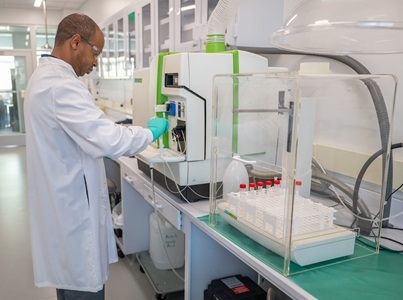
Raleigh Water's Drinking Water Compliance Laboratory opened in April 2025. Credit: City of Raleigh Communications Department
Driven by the need to safeguard public health and support advanced manufacturing efforts, multiple state-of-the-art laboratories opened their doors this summer. With scientific funding from the federal government at jeopardy, these facilities and the companies and states behind them have committed to providing high-quality analysis, support, innovation and more.
Manufacturing
In June, the U.S. Pharmacopeia (USP) opened its Advanced Technologies Laboratory in Rockville, Maryland. USP will use this lab, and related solutions and expertise, to develop, pilot, and scale innovations that foster more efficient and expanded production of quality medicines for stronger and more secure supply chains.
The lab expands USP capabilities to help manufacturers overcome barriers in the adoption of advanced manufacturing technologies by developing new approaches and processes for flow chemistry and additive manufacturing coupled with advanced analytical techniques such as process analytical technologies (PAT) that can enable real-time quality monitoring. The lab will also support development of alternative and novel synthetic routes to produce active pharmaceutical ingredients (APIs) and key starting materials. Taken together, these capabilities are essential in efforts to create stronger supply chains through strategic onshoring, distributed manufacturing, and personalized medicine.
Accurate, comprehensive mapping of the medicines supply chain helps identify supply chain risks, such as over consolidation, and pinpoints opportunities for intervention. The Advanced Technologies Lab will help industry and regulators accelerate the adoption of new technologies that help to mitigate supply chain risks and, where appropriate, establish guidance that supports regulatory predictability, process efficiencies, and faster time to market, all of which can strengthen domestic manufacturing capabilities.
“Advanced manufacturing technologies make possible the responsive, distributed manufacturing and onshoring strategies that make our medicine supply chains more secure and reliable. But adoption at commercial scale can be challenging, especially for generic manufacturers,” said Ronald T. Piervincenzi, Ph.D., Chief Executive Officer of USP. “The Advanced Technologies Lab will help launch and scale innovations that get products to patients more efficiently, while strengthening our medicine supply chains.”
Last week, Thermo Fisher Scientific opened a manufacturing center of excellence facility in Mebane, North Carolina. The new 375,000-square-foot carbon neutral site will be capable of producing at least 40 million laboratory pipette tips per week.
Pipette tips are critical tools for research and diagnostics, enabling precise liquid handling in high-volume applications such as disease studies and diagnostic testing. The new Mebane site is built for efficiency, with advanced automation that produces 96 tips every 12 seconds and 5,000 finished assemblies per hour. Designed for seamless operations, it also features automated packaging and shipping to meet growing demand.
The new Mebane site has already hired 40 people and is expected to add 50 jobs in manufacturing, engineering and business operations. The site results from a $192.5 million contract, in coordination with the U.S. Department of Health and Human Services (HHS) and the U.S. Department of Defense (DoD), awarded in 2021.
Water
Also in North Carolina, Raleigh Water debuted the new 15,000-square-foot Drinking Water Compliance Laboratory in April. The state-of-the-art facility will enhance water quality testing and ensure continued excellence in drinking water for over 650,000 residents across seven counties.
The new water lab is nearly 10 years in the making. In March 2016, a laboratory study evaluated aging infrastructure at two laboratories—E.M. Johnson Water Treatment Plant and Neuse River Resource Recovery Facility. While the Neuse River facility was renovated, it was determined a new lab was needed to replace E.M. Johnson to meet growing needs, demands and technologies.
Equipped with cutting-edge water testing equipment, the facility provides dedicated office space and ample storage to support the analysis of approximately 52,664 water samples annually.
"The tangible difference this new lab will make in the lives of those in our community is what's most exciting," said Raleigh Water Director Whit Wheeler. "This move to bring more of our analysis in-house is a key step that moves us forward in becoming a world-class utility, allowing us to be responsible with ratepayer dollars and ensure efficient use of our resources.”
At a time when water is more vital than ever, Veolia has built one of the largest PFAS treatment systems in the U.S. and the largest of its kind in the Northeast.
The Stanton Water Treatment Plant in Wilmington, Delaware, which opened in June, removes regulated PFAS compounds from drinking water and ensurez high-quality drinking water for over 100,000 residents, fully meeting the U.S. Environmental Protection Agency’s PFAS regulations. It establishes a replicable model for cost-effective PFAS treatment projects in water systems globally.
Veolia began designing the Stanton PFAS system in early 2022, ahead of the new EPA regulations for some PFAS levels in drinking water, and worked to deliver a state-of-the-art plant that minimized construction costs and left maximum flexibility for the future. It took three years to design and build the 17,600-square-foot facility, which features 42 large vessels, each 22 feet high and filled with 40,000 pounds of granular activated carbon. The vessels are designed and optimized for the carbon material to adsorb regulated PFAS compounds from up to 30 million gallons of water per day that enters the plant from two nearby rivers. The plant includes a laboratory to continually test new filtration media and treatment methods, providing additional flexibility and cost savings in the future.
The $35 million facility is in addition to 33 existing PFAS treatment systems Veolia already operates for water customers in the United States. Veolia will continue to install treatment systems to achieve PFAS treatment at more than 100 water production sites in the country in the coming years, which will help secure high-quality drinking water for almost 2 million people and comply with regulations in the most cost-effective way possible.
The U.S. isn’t the only country concerned with water analysis. Last week, CSIRO—Australia's national science agency—unveiled a $6.5 million investment in new research infrastructure that will deliver unprecedented analytical capability used in environmental and groundwater assessment and management.
The new facilities at CSIRO’s Waite Campus in Adelaide include two analytical labs that will support Australia’s critical water needs and help manage pollution and waste in the environment.
The Ion Cyclotron Resonance (ICR) facility provides the gold standard for chemical analysis. The $4 million facility houses one of the most powerful mass spectrometry instruments in the world to analyze complex samples like PFAS, natural organic matter and environmental samples from water, soil, waste and food. The laboratory can also identify the sources of contamination, such as where a chemical spill originated.
Meanwhile, the $2.5 million Tritium Facility via INgrowth (TRIFIN) boasts groundbreaking analytical capabilities that will play a critical role in supporting Australia’s water needs. TRIFIN can determine how quickly groundwater is replenished to help manage water resources and prevent communities running out of water.
“Groundwater can take years, decades, or even centuries to millennia to replenish. However, groundwater contained in aquifers that contains tritium is likely only years or decades old,” said Dirk Mallants, CSIRO Senior Principal Research Scientist. “Our technology can detect very low levels of tritium in groundwater to tell us how quickly it is being replenished. This new technology means Australia’s groundwater resources can be managed to build resilience against climate impacts, while supporting a net zero future for Australia across agriculture, hydrogen and critical minerals, through better management of groundwater resources.”