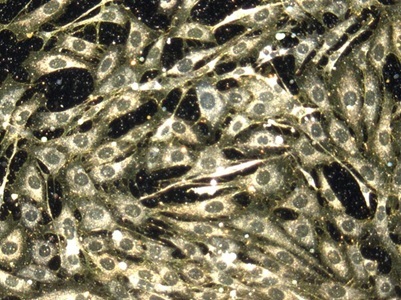
Gold nanoparticles in cell cytosol. Credit: Veronika Sapozhnikova, Konstantin Sokolov, Rebecca Richards-Kortum, M.D. Anderson Cancer Center; Rice University
The size, morphology, and structure of polymeric nanoparticles often affect their suitability for applications such as drug delivery and nanotechnology. Electron microscopy techniques like SEM and TEM can be used to characterize these properties, but they may also cause radiation-induced changes during characterization. This article discusses considerations when preparing and analyzing polymeric nanoparticles using SEM and TEM, as well as radiation-induced changes in samples that may occur during imaging and how to mitigate them.
Changes in nanoparticles due to sample preparation
Although damage during electron microscopy can cause changes in polymer nanoparticles, the preparation methods used before SEM or TEM imaging can also change or damage nanoparticles. Understanding how these preparation methods can change your samples is critical to ensuring accurate characterization.1
Air drying
Air-drying involves placing a droplet of a nanoparticle suspension on a TEM grid or SEM stub and then letting the solvent evaporate. During dehydration, polymer nanoparticles can aggregate and cluster due to capillary forces. To mitigate this, the drying kinetics and surface chemistry can be controlled by adding a small amount of macromolecules or surfactant to the nanoparticle suspension before drying.2
Freeze drying
For TEM, cryo-TEM or liquid-cell TEM can entirely avoid the need to dry samples by preserving the solution’s colloidal state, but it can also introduce artifacts. Compared to critical-point drying, freeze-dried polymer hydrogels or lattices can show different microstructures, with new microscale pores that were nanoscale pores in the original network appearing after freeze-drying.3 When polymeric nanoparticles are frozen in liquid nitrogen, the water in the pores freezes rapidly but not quickly enough that ice crystals do not form, leading to sample deformation. Controlled cooling methods such as plunge-freezing into cryogens like liquid ethane (which freezes faster than liquid N₂) or even high-pressure freezing.
Chemical fixation and resin embedding for TEM samples
Chemical fixation or resin embedding are used to observe the internal structure of nanoparticles before TEM. A typical protocol involves fixing the sample with an aldehyde, dehydrating it in ethanol, infiltrating it with a liquid epoxy resin, and then curing the resin to form a solid block that can be sectioned into ultrathin slices. However, polymer nanoparticles may shrink during the dehydration and embedding stage.4 This may change the nanoparticle distribution, as nanoparticles that were isolated in solution may aggregate in the resin matrix. To minimize artifacts, consider using gradual dehydration or including crosslinking fixatives to lock structures in place before dehydration.5
Heavy metal staining
Staining in TEM uses heavy metals to improve contrast of low-electron-density specimens. Negative staining may flatten or distort soft nanoparticles. Correlating stained images with unstained techniques such as cryo-EM can help verify a structure.6
Conductive coatings for SEM samples
SEM imaging of polymer nanoparticles often requires coating samples with a thin conductive layer of gold or platinum to prevent charging and improve image contrast. However, this may cause a slight increase in apparent particle size due to the coating’s own thickness. To minimize the impact on nanoparticle measurements, use the thinnest effective coating. Modern sputter coaters allow fine control, and 2–3 nm of platinum or gold is often enough for imaging.
Avoiding beam damage during electron microscopy
Polymer nanoparticles may be damaged by an electron beam, causing shrinkage, melting, or structural collapse. The organic components may even volatilize under the electron beam, especially if the polymer has residual solvent, a low thermal stability, or radiation-sensitive groups within the sample.
When electrons impinge upon a polymer nanoparticle, they deposit energy into the material, potentially ionizing molecules and breaking bonds via radiolysis. This may result in chain scission, which may lead to volatilization and ultimately result in mass loss, shrinkage, embrittlement, and ripening of the polymeric nanoparticles being imaged. Electron beams can also generate free radicals that can induce cross-linking. This mimics the scenario in which some materials are intentionally cross-linked to form a resist pattern during electron beam lithography.7
Transmission Electron Microscopy (TEM)
TEM offers high-resolution images of nanoparticles down to the nanoscale level, but polymer nanoparticles are often highly sensitive to electron-beam damage.8 For example, polystyrene latex nanoparticles may decrease in size when imaged using TEM, resulting in a 14% diameter reduction after 15 minutes of low-intensity electron irradiation.9 Thus, a TEM image may not always represent the original nanoparticle dimensions if the beam dose is not carefully limited.
To resolve fine details of polymer nanoparticles, extremely low electron doses (~0.2 electrons/Å2) can be used to avoid destroying the structure.10 This may involve spreading the dose over a larger area or using a shorter exposure. However, these doses are often so low that the resulting images may have poor contrast, making this a significant challenge.
Cryo-TEM preserves polymeric nanoparticles in their native hydrated state,10 and the cryogenic temperatures can slow radiolysis and reduce the mobility of radicals, thereby reducing damage. A vitrified polymer nanoparticle sample in cryo-TEM is less prone to instantaneous shrinkage, and the surrounding ice matrix helps maintain its shape. Still, the total electron dose must be limited as the damage is only mitigated, not eliminated.
Scanning Electron Microscopy (SEM)
Polymer samples are electrical insulators and often need to be coated with a thin conductive layer of gold or platinum to mitigate charging during SEM imaging. However, this coating adds to the particle’s apparent size and might obscure fine surface details, so the thickness of the gold layer needs to be carefully optimized.11
The electron beam can also heat or modify polymers in SEM if held static on one area for too long, potentially melting, burning, or charring a polymer.12 To avoid this, use the lowest beam voltage and current that still gives a clear image, and quickly avoid irradiating any one spot for too long. SEM/TEM measurements can also be performed at locations not previously imaged to assess whether imaging caused any changes to the nanoparticles’ properties.13
Characterizing polymeric nanoparticles requires balancing the need for detailed information with the need to preserve the sample’s integrity. Polymers are often easily damaged by the electron beam of SEM and TEM, which may cause shrinkage, structural collapse, or chemical composition changes. Low-dose imaging, cryo-EM, or the use of protective coatings can help mitigate these issues. By understanding and addressing radiation-induced changes, researchers can ensure that the data they obtain truly reflect the real properties of their polymeric nanoparticles.