by Paul Daniel, Senior GxP Regulatory Expert, Vaisala
When a single manufacturing deviation can delay life-saving treatment for a specific patient waiting for their personalized therapy, the stakes couldn’t be higher.
Cell and gene therapy manufacturers face a unique compliance challenge: balancing the fast-paced, small-scale production typical of advanced therapies with the strict GMP requirements designed for traditional pharmaceutical manufacturing. Unlike conventional drugs that serve millions, these imaginative treatments are often made for one patient at a time, manufactured in tightly controlled environments where fluctuations can compromise product integrity.
The challenge then becomes monitoring these critical parameters in a way that maximizes compliance without creating bottlenecks in an already time-sensitive process.
Why cell and gene therapy is different
Understanding the monitoring challenge requires understanding what makes cell and gene therapy, or CGT, manufacturing fundamentally different from traditional pharmaceutical production. Small molecule drugs and biologics can be scaled up — make large batches in one facility, then distribute worldwide. Cell and gene therapies, particularly autologous products made from a patient’s own cells, can only serve one individual per batch.
With cell and gene therapy, manufacturers need smaller production lines, and more of them, all making small batches. And these lines need to be quickly cycled to the next batch for the new patient.
This traditional approach creates a “scaling out” rather than “scaling up” paradigm. Instead of one massive production facility, CGT manufacturers need multiple smaller operations, potentially across different geographic regions to minimize shipping time for these temperature-sensitive living drugs. Some companies have even developed robotic production lines specifically for this purpose.
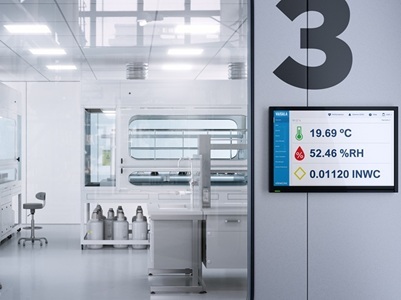
The monitoring implications are profound. CGT manufacturing draws from multiple traditional pharmaceutical disciplines — aseptic manufacturing, clean room operations, bioreactors, genetic modifications — each with its own set of critical parameters requiring oversight. Temperature monitoring alone spans an enormous range, from cryogenic storage at -196 degrees C to incubator temperatures approaching 40 C. Add relative humidity for clean rooms, CO2 for incubators, differential pressure for isolators and particle counting, and the parameter list grows quickly.
Gaps and the compliance challenge
Traditional monitoring approaches create three critical gaps for CGT manufacturers:
The startup gap. Many CGT companies begin with clinical trials requiring just a few sensors. Traditional monitoring systems often demand significant upfront capital investment — servers, licenses, complex validation — creating a barrier that’s disproportionate to initial needs. Yet these companies still need full GMP compliance features from day one.
The scaling gap. As CGT manufacturers grow, they need to add sensors rapidly without creating validation bottlenecks. If adding monitoring capability to a new production line requires weeks of validation work, it directly impacts the speed at which new capacity comes online. In personalized medicine, delays affect real patients.
The multisite gap. CGT’s need for geographic distribution creates unique challenges around time zones, languages, data segregation and network architecture. A monitoring system designed for a single campus may struggle when sites span across continents.
Even worse, these gaps can manifest as compliance failures. According to quality documentation research, the average deviation costs between $5,000 and $15,000 to resolve from a documentation perspective alone — and that figure ignores manufacturing losses and, critically, the human impact when a patient must wait for their therapy.
Strategic requirements for CGT monitoring
Closing these gaps requires a strategic approach to monitoring system selection that typically begins with a comprehensive user requirements specification (URS) that addresses CGT-specific needs.
For CGT applications, the URS process should address several key areas:
- Validation efficiency. The system should support rapid implementation and scaling with minimal validation burden. This typically means choosing what GAMP guidelines classify as a Category 4 “configured” system — one that offers standardization for easy validation but flexibility for growth. Avoid systems requiring vendor services to add capacity or those demanding custom programming.
- Adaptable architecture. A single-server enterprise system that uses template-based objects allows new sensors, alarms and users to be added as clones of existing validated configurations. An adaptability-focused solution dramatically reduces both implementation time and validation requirements when scaling.
- Multisite capabilities. Requirements should specify support for different communication modes (both wireless and wired connections), multiple alarm formats (email, text, signal towers), various interface modes (desktop, view-only terminals, mobile access) and multilanguage support for global operations.
- Network resilience. With small batches and no backup inventory, any monitoring downtime directly impacts patients. Systems should include data backfill capabilities that store information locally during network outages, hot-swappable sensors for maintenance without monitoring interruption and system alarms that provide immediate notice of communication failures or expiring calibrations.
- Calibration flexibility. Different sites may have different calibration needs and capabilities. Requirements should include options for both on-site calibration services and depot calibration through accredited laboratories, plus the ability to hot-swap devices during calibration cycles.
While these requirements address today’s CGT monitoring challenges, selecting a system that will serve an organization for a decade requires looking beyond current needs to anticipate how the regulatory and technological landscape will evolve.
Future-proofing for industry success
A monitoring system for CGT manufacturing should have approximately a 10-year lifespan, which means today’s requirements must account for tomorrow’s compliance landscape. Let’s take a look at some trends that will shape that future.
- Electronic records and data integrity. PDF report outputs and machine-to-machine interfaces (APIs or OPC protocols) drive integration with electronic content management systems. All data should be encrypted in transit and at rest, with comprehensive audit trails and workflows that maintain data visibility — fundamental data integrity requirements increasingly scrutinized by regulators.
- Electronic signatures. Understanding that digital signatures are only valid within the system where documents were signed, monitoring systems should support signature approval of actions (captured in audit trails) while enabling secure data transfer to separate document management systems for report signing and storage.
- Enterprise consolidation. As companies grow, maintaining separate monitoring systems for each site becomes inefficient. An enterprise-level system with logical site separation and a secure multisite architecture prevents the need for costly system replacement during expansion.
- Cloud and virtualization. While full software-as-a-service monitoring solutions are still maturing for high-risk CGT manufacturing applications, systems should at minimum support virtual server deployment. A virtual server can simplify validation through qualified templates and provides a pathway to cloud infrastructure when appropriate.
Future-focused requirements like these go beyond technological readiness, translating directly into business value and risk mitigation for CGT manufacturers operating on tight timelines and even tighter margins.
Making the business case
The cost of compliance gaps extends beyond documentation. Every deviation delays production in operations where there’s no buffer inventory. In personalized medicine, that production delay affects a specific individual waiting for treatment.
Conversely, a well-architected monitoring system becomes an enabler rather than a barrier. Easy sensor installation allows faster capacity expansion. Template-based administration means new manufacturing lines come online without proportional increases in administrative burden. Standardized validation approaches mean companies can confidently scale knowing the compliance framework scales with them.
For CGT manufacturers evaluating monitoring solutions, requesting functional specifications from vendors and conducting thorough gap analyses against your URS can help eliminate the vast majority of problems.
Vendors should be able to provide template URS documents as starting points. Since monitoring requirements are largely universal, these templates accelerate the specification process by months while opening companies’ eyes to modern monitoring capabilities they might not have known to request.
Ultimately, the conversation about monitoring system requirements, validation efficiency and future-proofing comes back to the fundamental reality of what CGT manufacturing represents: a new medicine paradigm that demands a new approach to the infrastructure supporting it.
Closing the loop
Cell and gene therapy environmental monitoring intersects product quality, regulatory compliance and patient access to therapy. CGT manufacturing’s unique characteristics — small batches, rapid cycling, geographic distribution, wide parameter ranges — demand monitoring solutions purpose-built for adaptability.
By starting with comprehensive requirements that address CGT-specific challenges, manufacturers can select systems that meet today’s compliance needs while adapting to tomorrow’s growth. In an industry where a single manufacturing deviation can delay treatment for a patient counting on that therapy, there's no room for monitoring gaps. Technology exists to bridge the gap between regulatory requirements and operational performance, but only if manufacturers know what to require.
When stakes are measured not just in regulatory citations but in patient outcomes, choosing the right monitoring approach fulfills cell and gene therapy’s promise: delivering life-changing treatments safely, consistently and on-time to every patient who needs them.
About the author
Paul Daniel is the Senior GxP Regulatory Expert at Vaisala. He has worked in the GMP-regulated industries for over 25 years helping manufacturers apply good manufacturing practices in a wide range of qualification projects. His specialties include mapping, monitoring, and computerized systems. At Vaisala, Paul oversees and guides the validation program for the Vaisala viewLinc environmental monitoring system. He serves as a customer advocate to ensure the viewLinc environmental monitoring system matches the demanding requirements of life science and regulated applications. Paul also shares his GMP experience through regular blog contributions, webinars, and seminars around the world. Paul’s expertise in the demanding GxP world is applicable to any industry where measurement is critical to product quality. Paul is a graduate of University of California, Berkeley, with a bachelor's degree in biology.