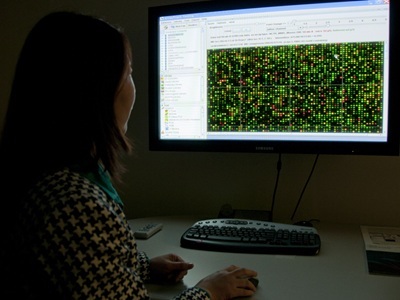
A National Center for Toxicological Research scientist analyzing microarray results to measure and assess the level of genes found in a tissue sample. Credit: FDA/Michael J. Ermarth
by Ravi Gupta, Vice President and General Manager, Microarray, Thermo Fisher Scientific, Inc.
Microarrays have been trusted by genomics researchers for decades, aiding scientists in making groundbreaking discoveries across human health and agrigenomics applications. Take the Human Genome Project, for example. After scientists successfully sequenced the complete human genome, microarrays played a key role in enabling large-scale genetic analysis using the data generated by the project. Today, this data is being used to inform targeted drug discovery, create more accurate diagnostic tools and enable precision medicine.
Microarrays have had a real-world impact on plant and animal genotyping, too. Livestock breeders have turned to technology to improve the productivity of their herds and breed animals that produce less methane. In the aquaculture industry, microarray solutions are used to optimize fish production for healthier and more profitable farms. Farmers and seed companies have applied microarray genotyping platforms to drive global crop improvement and help feed the world’s growing population.
While it’s a versatile tool that enables critical research and discovery, there are inherent challenges—from workflow complexity to lengthy turnaround times to increasing costs—that are only exacerbated by rising demand to accelerate genetic analysis. For labs of all sizes, turning to next-generation microarray technology can unlock flexibility and efficiency, while reducing operational complexity.
Overcoming longstanding industry challenges
Labs across industries have long struggled with unoptimized throughput, labor-intensive workflows and multistep processes that have significantly slowed time to results. With the rising demand for high-throughput microarray analysis, scientists need tools that are faster, more efficient and easier to use.
For example, sample processing has historically been a bottleneck. For days, scientists would organize their workflow to minimize turnaround time and manually process each step to get the sample ready for analysis. However, modern analyzers are coming on market that combine automated handling of the four key steps—hybridization, washing, staining and scanning—and stabilized reagents so that scientists can load samples and walk away. With networkable analyzers, scientists can even monitor runs and download results remotely, increasing productivity and operational efficiency across the lab.
Innovations in hardware, biochemistry, data transfer and analysis also contribute to higher throughput, which is a stellar attribute of next-generation microarray analyzers. Traditional workflows meant waiting a week for results, but now scientists can get their data in as little as 30 hours. When demand is at its peak, speed makes a huge impact.
Next-gen solutions for modern workflows
Microarray technology is evolving to accommodate contemporary genomics studies that demand speed, scale and simplicity. Growing research areas, such as genome-wide association studies (GWAS), population genomics and pharmacogenomics, require high-throughput, scalable solutions that most legacy solutions can’t accommodate. However, next-generation microarray solutions offer simplified and automated workflows that enable users of all experience levels to conduct the research they need to move real-world applications forward. Features like an integrated user interface enable minimal touchpoints, which reduces hands on time and makes it easier—and faster—to achieve high quality results.
What's more is that these innovative features also help labs reduce overhead costs and remain agile when demand fluctuates. Large reference labs often see demand seasonally adjusted, so it’s critical that they have the ability to rapidly scale up when there’s an influx and pull back when business slows. Next-generation microarray analyzers enable this flexibility and scalability, offering the ability to process over 6,000 samples in a five-day work week when it's needed.
The broader impact
Cutting-edge analyzers are making genomics research more impactful. Whether scientists are uncovering deeper insights into health and disease or selecting new plant varietals, next-generation microarray technology can make high-quality data more accessible for a variety of applications.
As we look toward the future of healthcare, precision medicine, which depends on having the right genetic information at the right time, comes clearly into view. With microarray technology, researchers can ask more questions and find the right answers faster than ever before. Pharmacogenomics, epigenetics and multi-omics discoveries can accelerate clinical research and translate to future therapeutic cases across populations. Agrigenomics research can go farther, too. Scientists can design crops that withstand modern environmental stressors or breed healthier animals. The flexibility allotted with modern microarray technology has far reaching and positive impacts on society as a whole.
It’s clear that microarray technology is moving into a new era. Once traditional roadblocks are removed, high-throughput genomics research is made possible. Whether scientists work at a large research organization or a smaller, independent lab, they can use microarrays to streamline lab operations, lower overhead costs and stay ahead as genetic science evolves.
About the author
Ravi Gupta leads the Microarray business strategy through innovation, cross-business collaborations, and leading commercial and business development initiatives to expand the portfolio. He assimilates and optimizes Thermo Fisher company tools, infrastructure, and operating principles into the business, while carrying out the overall business strategy. As a business professional with vast domain knowledge, he has engaged with thought leaders to develop programs and solutions targeted at solving complex genetic analysis challenges. Ravi joined the company in 2001 (formerly Applied Biosystems) and holds MBA degree, from Haas School of Business, Berkeley and Columbia Business School, New York as well as a MSc in Biotechnology and BSc in Chemistry.