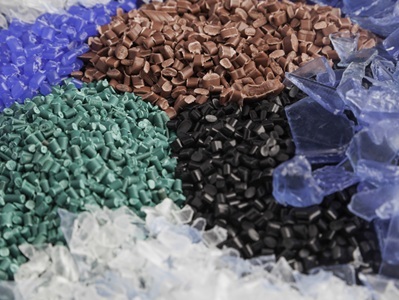
Mass spectrometry (MS) is used for small-molecule analysis because chromatographic separation isolates individual compounds before mass spectral identification. However, polymers are large and non-volatile and must be broken into smaller fragments using techniques such as pyrolysis before GC-MS analysis. They also often contain complex compositions and additives that further complicate the interpretation of the resulting spectra. These challenges are frequently addressed using hyphenated techniques that combine pyrolysis and chromatographic separation with mass spectrometric detection.
Tip 1: Add Dimensions when Necessary
Real-world polymer samples rarely contain just a polymer and typically contain fillers introduced during processing or even environmental contaminants that may interfere with polymer signals.
“As polymer architecture becomes more complex, analysis becomes more challenging, particularly for quantitative methods,” said Amanda Rigdon, Principal Scientist at Restek.
This complexity may carry over into the mass spectra, as polymer samples frequently contain additives like fillers and plasticizers that make it difficult to interpret spectra.
These details can be difficult to resolve using only a single analytical dimension, so Rigdon suggests using orthogonal separation techniques and detection strategies:
“GC×GC–TOF-MS provides substantially greater separation capacity for complex mixtures,” she said.
Adding a chromatography step improves the resolving power, while the spectral deconvolution of TOF-MS can be used to distinguish co-eluents.
Tip 2: But Don’t Overcomplicate your Workflow
While it’s tempting to add dimensions and detectors, it’s not always necessary. Excessively complex workflows that combine multiple separations, detectors, or fragmentation steps increase analysis time and complicate data interpretation. Rigdon advises users to “match the analytical approach to the goal of the analysis.” In practice, this means choosing the simplest method that yields the needed information. For many polymer labs, more capable MS detection can actually simplify the procedure. High-resolution, full-scan instruments can capture all fragment ions, improving the sensitivity for trace fragments and allowing retrospective data mining if unexpected peaks appear later.
Tip 3: Establish a Sample Handling Procedure
Plastic contamination can come from just about anywhere in a lab, and even nitrile gloves have been known to contaminate samples. When handling polymer samples, laboratories should try to minimize plastic in their workflows, especially for trace polymer or microplastic analysis.
“[It’s best to have] a dedicated system to avoid contamination from other analyses, and to maintain a clean sample prep space without plastic containers,” said Cristina Matos Mejias, GCMS Product Coordinator at Shimadzu Scientific Instruments.
Mejias also recommends the use of glassware to prevent contamination from plastic sample containers because this may lead to false positives from microplastics shed by containers. Using glassware in sample handling procedures can avoid introducing plastic particulates or leachables from plastic components of the containers.
Tip 4: Automate to Improve Efficiency
Automated techniques can help boost analysis throughput. Mejias says multiple reaction monitoring (MRM) can improve the selectivity of an analysis.
“This analysis technique allows for the selection of a specific ion from a compound, fragmenting it, and then detecting one of the fragments. This reduces the noise that comes from the background of the sample and allows for a cleaner identification of the compounds,” said Mejias.
Software has been developed to automate certain aspects of the MRM workflow and help boost throughput.
“Double-shot pyrolysis can remove organic interferences through a lower-temperature desorption step before the pyrolysis stage,” said Rigdon.
In this approach, the pyrolyzer is programmed with two sequential temperature steps: a lower-temperature thermal desorption step, and then a higher-temperature pyrolysis step. Once the run begins, the instrument automatically executes both heating stages and transfers volatile compounds to the GC-MS, producing two chromatographic datasets without necessarily requiring manual intervention from an operator.
Tip 5: Consider Sustainability Upfront
Considering sustainability when first developing a MS method can prevent revalidation and workflow changes later, especially if regulations or institutional policies shift from hazardous solvents like dichloromethane (DCM). Many labs are phasing this solvent out, which often means using less solvent or working at lower extract concentrations.
The downside is that signals may drop, placing higher demands on MS sensitivity. On the plus side, Rigdon notes, replacing DCM “provides an opportunity to rethink and improve sample preparation strategies.” Options may include switching to less hazardous solvents, but check that it doesn’t introduce new interferences.
Last Thoughts
Developing a MS method to analyze polymers requires upfront planning to maximize analysis efficiency, minimize contamination, and match the MS technique to your analysis goals. Although it might be tempting to increase the complexity of a workflow, try to keep it as simple as possible or even consider automating certain aspects of the process. By combining chromatography, high-resolution MS, and sustainable sample prep, analysts can tackle complex polymer samples.
About the author
Brandon Sharp, Ph.D., is a freelance technical content writer whose research experience involves designing small-molecule and polymeric photoresists and other organic materials for advanced lithography.