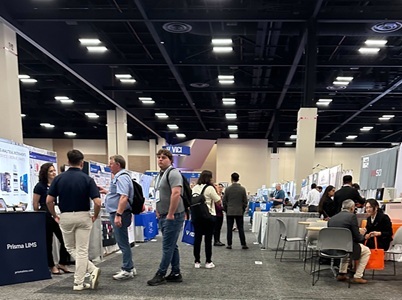
Back in the west for the second time in three years, Pittcon 2026 wrapped up in San Antonio on Wednesday, March 11. With budgetary constraints, tariffs, the uncertain economy and socio-political pressures, the annual conference did feel smaller than is typical. However, both exhibitors and attendees expressed engaging conversations—quality over quantity this year, perhaps.
With so much knowledge and expertise convened in one place, Pittcon is an ideal forum for manufacturers and professionals to collaborate and discuss innovative solutions. Every year, Pittcon serves as a fantastic window into today’s laboratories. In fact, the trends that reveal themselves at Pittcon often carry through the entire rest of the year.
This year, those trends included artificial intelligence (for the fourth consecutive year), real-time data and problem-solving, and designing off end-user input.
Artificial intelligence (AI)
We are now at the point where AI is no longer the exception, but rather the expectation. And that goes for both the laboratory and broader society.
As a laboratory informatics company, LabVantage Solutions has embraced AI since the beginning, often using Pittcon as a platform to announce its next innovation. This year was no different as the company launched LabVantage CORTEX, a platform that integrates autonomous AI agents that can complete complex laboratory tasks inside LabVantage’s core LIMS.
“Agentic AI is the future,” said Denise Bell, Director of Product Management at LabVantage.
The release of CORTEX is timely as a recent survey from Sapio Sciences showed near-unanimous demand for ELNs that act as intelligent research partners and help interpret data, not just capture it. The goal is to have ELN/LIMS solutions that hypothesize, design, plan, act and analyze into a connected workflow across instruments, data and analysis, not just provide an AI veneer on top.
For example, let’s say you are working in the hood and both gloved hands are occupied, but you’re not sure what the next step of the protocol is, or you’re not sure if the results you’re seeing are considered normal. You can just verbally ask with your agent—or “digital colleague.”
“We use real-time voice AI so you can actually have a conversation,” said Gary Stimson, principal architect and head of AI technologies at LabVantage. “It’s not just one-way commands.”
CORTEX has multiple agents built into the platform, such as the Worksheet Agent and the Sample Management Agent. The Stability Agent came from multiple customer requests to be able to build protocols based on natural language.
“We've also been working on some Hazard Agents,” said Bell. “Safety data sheets (SDS) get updated constantly. This way, a lab can evaluate if SDS data has been updated, bring in the new data and then have somebody check it. That's the other really nice thing with these agents—you can stick a human in the loop anywhere you want along the process. Ultimately, our goal is to complement the scientist, not replace them.”
This group of agents will be released first as “starter agents”—agents for processes that most labs run. But, the agents are highly configurable so once the starter agents are integrated, labs can go on to customize and build agents to meet specific workflow needs.
“With an agent you want it to be very specific to your science and how your lab works. Every lab is unique, every lab has a unique way of working, and a unique LIMS,” said Stimson.
One of Shimadzu’s new instruments isn’t AI in the traditional sense, but is inspired by AI—or rather the needs of AI. The TOC-1000e S Online Total Organic Carbon Analyzer is engineered to meet the stringent ultrapure water quality requirements of advanced semiconductor manufacturing. The TOC marks Shimadzu’s entrance into the semiconductor market.
“The rapid growth of AI is driving the demand for more powerful semiconductor chips,” said Haihan Chen, product manager of elemental spectroscopy at Shimadzu. “The architecture of these chips is getting smaller and more complex, and the manufacturing process requires a very high level of purity to maintain product yields and device reliability. The quality of water is very important here.”
About 30% of the semiconductor manufacturing process involves cleaning processes using ultrapure water. If the water used is not ultrapure and contains even a few impurities, it can directly lead to manufacturing defects.
“If you look at the water used in the semiconductor industry, it is the most purified water on the plant,” said Chen. “There’s basically nothing there—no TOC, no organics, no particles, just nothing.”
One of the key features of the TOC-1000e S is rapid contamination response. The analyzer employs a simplified flow path that connects the excimer lamp and conductivity detector in series. This configuration enables real-time monitoring and rapid identification of contamination events, helping manufacturers respond quickly to potential sources of defects before they can impact the end product.
The excimer lamp inside the TOC-1000e S is 172 nanometers, compared with the industry standard of 185 nanometers. This shorter wavelength allows the TOC to detect hard-to-oxidize compounds such as urea, which can persist after purification and compromise fabrication processes.
Customer input and real-time data
Shimadzu also debuted the Nexera IC Ion Chromatograph at Pittcon 2026. The system is designed for streamlined water quality testing on a universal scale—meaning it can be used across different methods, different countries and different regulations.
Essential functions are integrated into the single-analysis system, while an optional dual injection configuration enables simultaneous anion and cation analysis, expanding throughput and versatility for drinking water and environmental testing. Preprogrammed sample preparation ensures dilution and eluent mixing occur automatically prior to injection, eliminating variability and supporting consistent analysis.
Additionally, Shimadzu developed a new software specifically for ion chromatography. The software, called IC Solutions, was designed based on feedback from customers, specifically in regard to which features would be most helpful to the workflow, according to Evgenia Barannikova, assistant LC product manager at Shimadzu.
One such feature is the new “IC Support,” which monitors overall instrument performance.
“It ensures all the maintenance consumables are running and if there's any issues, the system will send you the warning code or prompt you with videos on how to replace certain parts to reduce instrument downtime,” explained Barannikova.
“Every step of the way, there is a feature that saves users time and money,” she concluded.
Xylem is another company that released a product at Pittcon that came directly from customer feedback—specifically, the same common challenges customers were expressing across markets.
“The story is the same across all markets. Labs are being asked to do more—more parameters, more data, more compliance. And they're being asked to do that with less experience, less space, less capital and smaller operating budgets,” said Michelle Kuzio, product manager at Xylem Lab Solutions. “These pressures define the modern laboratory, and they are not temporary.”
Xylem spent over a year listening to their customers and this is what they heard:
- “We run multiple parameters.”
- “We want compliance but not complexity.”
- “Flexibility matters.”
- “Ease of use and integration are key.”
- “We have space constraints.”
From that insight came the Multiab Pro IDS, a multiparameter device with up to four galvanically isolated measuring channels for pH, ORP, mV, conductivity, oxygen, ISE and turbidity measurement. It features a large 7” glove-friendly touchscreen, and can be mounted outside the hood. It’s compact footprint saves space, and no wires are needed. Compliance is built directly into the instrument, not added later through external software, so there's integrated audit trails, user enroll management, tamper-proof data storage, and workflows that we designed to support 21 CFR part 11 expectations.
The backbone of the multiparameter system is the Intelligent Digital Sensor, which converts analog signals directly in the sensor into digital values. This direct conversion in prevents interference and guarantees fail-safe data transmission. Each sensor has a built-in memory to further prevent errors between experiments and instruments.
“We have a unique view into how laboratories really operate,” said Kuzio. “The Multiab Pro IDS is a result of decades of pH and electrochemistry experience combined with very real feedback from labs under pressure.”
Restek also designed their Pittcon-launched product around specific and in-depth customer feedback which had to do with common challenges—similar to what Xylem experienced in their industry. This feedback, however, is for the gas chromatography market.
Through customer interaction, Restek identified four common challenges in GC analysis
- the methylene chloride ban
- method consolidation
- lower detection
- lifetime expectation
This data culminated in the creation of Restek’s new RMX GC Columns with TriMax technology. TriMax is a proprietary three-dimensional deactivation chemistry Restek designed from scratch to specifically meet the identified challenges of customers.
Ramkumar Dhandapani, Director of Product Management at Restek, described TriMax as a “three-dimensional array of bonding, cross-linking and deactivation.” Because it was purpose-built for GC, the result is a surface free of the active sites that cause peak tailing or analyte adsorption. This creates what Dhandapani called “an unbiased surface” that treats acids, bases and neutrals equally.
The analytical result is symmetrical peaks, trace-level sensitivity, extended column lifetime, and performance that bounces back even after aggressive thermal cycles and heavy matrix contamination.
Designing for trace-level sensitivity was deliberate, as Dhandapani noted the environmental industry is now looking for detection in the parts-per-billion and beyond. Maximum inertness improves improves peak shape for problematic active compound classes, enabling lower detection limits and picogram-level sensitivity,
The lesson LabWare learned from customers over the past year is that no matter how good a solution is, if it’s too disruptive to adopt, laboratories will walk away.
“We found what really prevents companies from implementing LIMS (laboratory informatics management system) and benefiting from this digital transformation is the time that it takes from beginning the process to going live,” said John Newtown, Digital Quality Systems Market Director at LabWare.
Newton said it’s common for a LIMS implementation to take 9 to 12 months. That’s why LabWare’s newest software as a service (SaaS) offering, ASSURE, is designed to go live in just 4 weeks.
ASSURE is a complete SaaS LIMS solution for managing microbiology, environmental monitoring, food safety and product quality data. ASSURE is built to minimize manual work, reduce errors and improve audit readiness by standardizing how data is captured and reported across routine programs.
A typical 4-week rollout is presented as training in week 1, master data loading in weeks 1 and 2, process testing and some release in week 3, and additional bulk master data loading in week 4, if needed, and then going live.
A critical reason ASSURE can be onboarded so quickly is that it’s a human-led process. Labware provides multiple teams to coach laboratories through the process of how master data will drive behavior in the LIMS.
“We are not just depending on computer systems for SaaS,” said Newton. “If you have a human walking you through it individually, even if it's an online meeting, it's much more effective than trying to get someone to do that through a bot or an agent or a route process on the computer. The human-led process is a key part of the success of the system.”
While affordability and minimizing disruptions in the timeline are a huge part of lowering the barrier of entry for SaaS in the lab, there’s another part to the story: overcoming barriers of organizational change in the laboratory.
Some users have an expectation of LIMS that it will automate every instrument, integrate into every application, manage every single piece of output data. That, by itself, can be overwhelming.
“What we find is focusing on a smaller footprint and going live faster is more efficient because it’s an amount of change that can be absorbed in short period of time,” said Newton. “The less change, the more likely you are to adopt it. If you can adopt a minimally viable product, use it, find out what works well for you, and what things would do better in a different process, when we move to the next workflow or the next automation or the next area of the lab, we can do that better and better.”