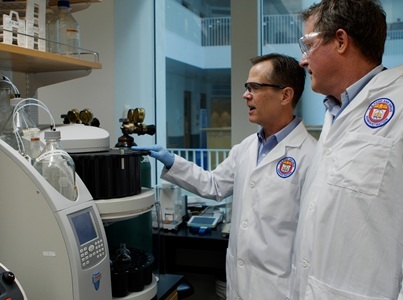
Drs. Gregory Noonan and Paul South of the FDA help address knowledge and data gaps in the areas of contaminant identification/detection, food processing/packaging, food chemistry/composition, and development of new approach methods in toxicology.
PFAS, or per- and polyfluoroalkyl substances, are aptly called “forever chemicals” because of their extreme persistence. This persistence is why PFAS chemicals became popular in the first place—they are good at what they do. But, as we now know, this extreme persistence is also what contributes to pollution in a variety of matrices, as well as toxic effects on human health.
For example, PFAS—present in water, soil, food, food packaging, air and more—have been linked to an increased risk of certain cancers, increased cholesterol, immune system changes, increased risk of asthma, changes in fetal and child development and more.
In response to increased research illustrating the risks of PFAS, both the U.S. government and individual states have released regulations to safeguard the public. The popular EPA Method 1633, for example, provides guidance on analyzing 40 PFAS in aqueous, solid, biosolids and tissue samples using LC-MS/MS—which is the current gold standard due to its sensitivity.
“With LC-MS/MS, you can get down to part per trillion and in some cases part per quadrillion levels of sensitivity, and that's unparalleled. There aren't many techniques that can get down that far,” said Landon Wiest, Product Manager, LC-MS at Shimadzu Scientific Instruments. “Pairing that with the specificity and the selectivity of the method, it just is a perfect match.”
When analysts are measuring at the nanogram per liter level, it is the equivalent of finding one drop of water in four to five Olympic-sized swimming pools. And that is the key to PFAS detection and analysis—the lower the detection limit, the more PFAS we find.
The sheer demand for PFAS detection and analysis is another element that is likely to drive up sensitivity needs. Tarun Anumol, Director, Global Environment Market at Agilent Technologies says he is confident PFAS testing is going to persist for the next two to three decades, only increasing over time. This increase will not only affect instrumentation sensitivity, but the rest of the PFAS workflow as well.
“An increase in sample volume means sample preparation needs to decrease,” explains Wiest. “Throughput is going to increase so we need systems that can be more sensitive and mitigate the matrix components that will come along with that, like more direct inject or a dilute-and-shoot type of sample prep rather than the more purifying SPE types.”
Reducing sample preparation necessitates more sensitive instrumentation and equipment as samples will be dirtier and less concentrated. From a sensitivity and robustness perspective, the instrument now needs to do even more work.
Another reason labs are reducing sample preparation has nothing to do with technology in the lab, but rather people in the lab.
“A lot of labs, especially on the environmental and food side, are facing labor and skills shortages,” said Anumol. “The people that are operating the instruments now and doing the testing are not PhDs, or even have a master's in analytical science, so there's a higher chance of error or failure. When you have people that have less time and less skill, obviously that's an area you try to cut.”
The success of LC-MS/MS doesn’t mean other technologies are not also suited for specific PFAS detection and analysis. For example, GC-MS is ideal for detecting fluorotelomer alcohols and total organic fluorine, which end up in air—a matrix that is most likely going to be regulated in the near future.
“GC-MS allows you to use certain sample introduction techniques like canister sampling or thermal desorption. That make it more suitable to collect air samples to put into the GC-MS/MS,” said Anumol. “Analysts are also using GC-MS more to monitor some of the newer volatile PFASs.”
Anumol says combustion ion chromatography (CIC) is also becoming an increasingly popular technique for the quick measurement of total organic fluorine, which can then be used as a proxy for PFAS. Although the less sensitive CIC measures at the lower part per billion level, it’s an ideal initial PFAS screening test that can be completed on-site.
Background contamination
No matter what analytical technology is used, reducing and eliminating background contamination is important. Lab equipment, supplies and consumables are not immune to the ubiquitous nature of PFAS. From fluoropolymers to packaging, tubing, solvents/reagents, aluminum foils, caps and more, PFAS compounds can and will leach into samples and cause interference.
Some manufacturers, such as Agilent, have developed guidelines to remove fluoropolymer from their analytical pathway. Additionally, most manufacturers now offer a PFAS-free kit or a PFAS-reducing kit.
“But these kits are geared toward the 20 to 30 PFAS that we regularly monitor. There’s over 15,000 PFAS, conservatively, so chances are you can still find background when you're measuring new compounds,” said Anumol. “Background is probably the biggest issue for someone starting analysis of PFAS, and it's really important to characterize that and move forward.”
As with many other types of analyses, following good laboratory practices and establishing clear SOPs is the beginning of the story; but, more active intervention needs to occur when working with PFAS that are at the parts per trillion and parts per quadrillion level. For example, users could change out their sinkers, put in PFAS-free tubing, change out the material in the degasser or even bypass it altogether. While effective, these measures pose the risk of allowing air into the LC system. Thus, many experts—Wiest included—recommend a delay column be used between the mobile phase mixer and sample injector to temporarily trap any system-related interferences.
“The beauty of this is everything is upstream,” explained Wiest. “It now gets delayed, held up on the column before you get to your sample so all you need to do is make sure your sample is in a contaminant-free area.”
Despite these best efforts, background contamination can still happen. But depending on what kind it is, it may be able to be managed at the reporting level rather than voiding the entire run.
“The key is to do repeatable and a lot of field blanks and lab blanks,” said Anumol. “Do not skip on that because that's what will really tell you how much background you have and potentially where it's coming from.”
Future-proofing an evolving industry
In the U.S., water was the EPA’s first PFAS regulation target. In January 2024, the agency released three methods to better measure PFAS in the environment, the most popular being EPA Method 1633. Then, three months later, the EPA issued the first-ever national, legally enforceable drinking water standard.
In February 2024, the Food and Drug Administration (FDA) announced that substances containing PFAS used as grease-proofing agents on paper and paperboard for food contact use are no longer being sold by manufacturers into the U.S. market. Despite being a voluntary phase-out, the regulation does remove the primary source of exposure to PFAS from food contact uses.
And this is just at the federal level. In many instances, states are taking the lead to regulate PFAS. For example, in 2024, lawmakers considered more than 200 bills with PFAS-related language in at least 36 states. At least 17 of those states enacted over 40 bills on PFAS. For example, Colorado enacted a broad bill banning PFAS in consumer products, including cleaning products, certain clothing items and outdoor apparel, cookware and dental floss and menstrual products, among other products. In California, the manufacturing, selling or delivering of any cosmetic products with PFAS is prohibited.
In terms of matrices, the industry seems poised to target PFAS in air next. After that, it’s anyone’s guess—although Anumol has his suspicions.
“We’re hearing a lot about pharmaceutical raw materials as potentially an emerging area of regulation. There's a lot of public concern because of importing and exporting. Once one region has regulations, that will force everyone else to follow the strictest regulation because of the global nature of trade,” the environmental director said. “My guess is we will probably see more regulation on the environmental side for new PFAS, and then we will see more bans and regulations on the raw materials and consumer products side within the next few years.”
Labs that are involved with PFAS detection and analysis know it’s an evolving, dynamic industry, which can make future-proofing difficult—but not impossible. In fact, there’s multiple parts to the future-proofing puzzle: 1) the instrumentation; 2) the regulations; and 3) the humans.
To future-proof throughput, Wiest recommends multiplexing, so one instrument has much less downtime. With a single multiplexing HPLC on the front end, users can increase throughput by approximately 4-fold.
“There is always a greater and greater desire to have more analytical precision and accuracy at lower detection limits,” said Wiest. “The demands of PFAS analysis could very well lead to greater sensitivity in instruments. High-resolution mass spectrometry could also end up becoming more sensitive, meaning untargeted analysis would be able to go down to even lower detection limits. Instead of looking for the classic PFOS and PFOA, more advanced PFAS could be analyzed and detected simultaneously.”
Anumol suggests working with an analytical vendor that has the necessary expertise.
“In this case, you're future-proofing yourself with the vendor's expertise, knowing that they're going to stick around and help you. Whether that's on the instrumentation side, the service side or the consumables side, they should be able to provide the entire PFAS workflow,” he said.
Both Wiest and Anumol agree that it’s critical to always have an ear close to the ground and be in tune with any upcoming regulations.
“Staying on top of public websites like EPA and ASTM will really help you stay ahead of the curve and be first to market,” said Wiest.
Last, but perhaps most importantly, laboratories need to future-proof their labor. If PFAS testing is going to be around for at least 20 more years, it must become part of a lab’s core competencies if they want to succeed in the industry.
“This kind of investment takes time,” said Anumol. “You can't just move someone from a metals lab to PFAS testing—there's a lot of expertise involved. My advice to labs is to hire people that either have a PFAS background or if they don't—which is most cases since testing is new—invest in their training and development so that they can become a ‘super user.’ I think a lot of times labs forget how important training and skill development is.”