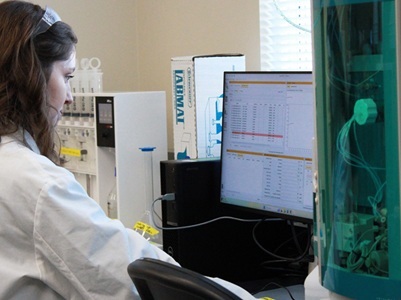
Sarah Ortbal measures readings from Metrohm's combustion ion chromatograph. Credit: University of Alabama
This year, Metrohm USA presented their annual Young Chemist Award to Sarah Ortbal of the University of Alabama, recognizing her impactful research spanning PFAS monitoring, non‑target fluorine analysis and promising treatment pathways. The 2026 Young Chemist Award includes a $15,000 cash prize.
Ortbal’s work addresses PFAS at multiple critical points—wastewater treatment, surface waters and targeted remediation—using both targeted PFAS methods and adsorbable organic fluorine (AOF) to reveal the broader fluorinated organic load that traditional methods can miss. Her studies documented PFAS behavior and recirculation inside wastewater processes, flagged contaminated chemical additives, and showed how non‑target analysis can quantify up to 25x more fluorinated organics than targeted methods alone.
For her research, Ortbal expanded statewide monitoring across Alabama—including upstream/downstream sampling near wastewater treatment plants—and added trifluoroacetic acid (TFA) to analytical capabilities given its prevalence at higher concentrations. For treatment, she evaluated activated carbon to pull PFAS out of water and a heat-driven chemical process to break them apart. Subsequent lab tests showed loss of organic fluorine and overall PFAS reduction.
Michelle Taylor, Editor-in-Chief of Labcompare, recently caught up with Ortbal to further discuss her innovative research and her Young Chemist award.
Q: Can you highlight the core of the PFAS research that helped you win the 2026 Young Chemist Award?
A: PFAS are typically difficult to measure, as conventional typically include around 40 different PFAS compounds; however, there are thousands of PFAS compounds that exist. I am also using non-target analysis for adsorbable organic fluorine (AOF), which is a bulk measurement for total PFAS and other organic fluorine compounds (all synthetic, could be fluorinated pharmaceuticals or pesticides as well).
I analyzed PFAS and AOF through 14 stages of an advanced wastewater treatment plant, to evaluate fate and transport within the plant. From this, we saw that the targeted PFAS compounds accounted for <4% of the AOF at every site, highlighting an underestimation of fluorinated contamination when only looking at the targeted PFAS.
I also sampled across Alabama in every county to assess the impact of wastewater treatment plant effluent on downstream rivers. From our results, we didn’t see any substantial impact. The combination of low population density across Alabama results in small wastewater treatment plants, and the heavy rain that Alabama gets resulted in wastewater treatment plant effluent making up an average of 3% of total streamflow. These results highlight a difference from what is seen in arid regions, and that site-specific context should be used when enacting regulations.
Additionally, my research group has worked on projects for enhanced PFAS removal and degradation, using colloidal activated carbon for PFAS removal and advanced oxidation processes for PFAS degradation.
Q: What makes your PFAS evaluation method different than others?
A: Typically, research will only include looking at the targeted PFAS. The method I am using for AOF—EPA Method 1621—is a non-targeted analysis that we are using in conjunction with the targeted analysis to provide a more comprehensive measurement that allows us to identify the amount of overall organic fluorine in a sample and understand the load of fluorinated organics going through the wastewater treatment plant.
Q: What is the difference between targeted and untargeted analysis for PFAS?
A: Targeted analysis looks at specific compounds, so one specific chemical formula. The non-target analysis looks at the total amount of carbon-fluorine bonds in a sample, so we don’t know what the specific compounds are, we just know the amount of organic fluorine.
Q: What made you decide to utilize adsorbable organic fluorine, specifically, in your method?
A: AOF has an established, standardized method (EPA Method 1621). I wanted to be able to identify both the known PFAS compounds, such as PFOA and PFOS, as well as the unknown organic fluorine amount to get both an idea of the concentrations of the individual compounds that are being regulated, as well as the overall organic fluorine load that typically isn’t measured.
Q: How does your research address critical PFAS knowledge gaps?
A: I was once told during an internship that you can’t solve a problem when you don’t know what the problem is. And I think with PFAS, the problem is so complex that the more we know, the better we can solve the problem. Monitoring is essential to track PFAS, to know where they are, and to know how to deal with them.
In Alabama, we noticed industrial inputs were more of a factor for PFAS contamination in waterways, and from that it may be more useful to regulate industrial discharges as opposed to municipal wastewater treatment plants for PFAS. We also were able to establish baseline PFAS concentrations across the state so that in the future, we can evaluate temporal changes to see if PFAS contamination is increasing or decreasing—and t figure out why.
Q: What was the hardest part of your research?
A: Field sampling and minimizing contamination. With field sampling, there is always the possibility that something may go wrong, so you have to be prepared. With PFAS, we are measuring at the part per trillion level, which one part per trillion is equivalent to one drop of water in 20 Olympic sized swimming pools, so in both lab and field work, we must be very careful not to introduce any contamination to ensure we are still getting accurate results.
Q: What's next for this research project?
A: Currently, I am working on evaluating PFAS and organic fluorine in wastewater solids to establish a fluorine mass balance for the wastewater treatment plant. Doing so, we can fully track PFAS fate and transport throughout the plant, which will help identify areas where PFAS are concentrating and where removal or treatment technologies should be implemented within the plant. My research group is also working on an in-depth sampling campaign in Alabama and Mississippi counties that are near the Gulf Coast to evaluate and establish PFAS concentrations in coastal areas and the impact of PFAS on coastal communities.
Q: When you're done with your Ph.D., what do you want to do?
A: I could see myself going into academia, industry, or non-profit work. I want to continue working on water-related issues and tackling complex problems.
Q: What do you see for PFAS analysis/testing in the future?
A: I think analytical advancements are coming to make testing easier and more affordable. Currently, PFAS analysis can be very expensive, which makes it hard to have comprehensive testing and for individuals to test their own water supply.