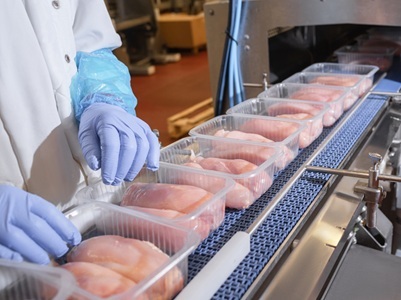
Food safety and quality are top priorities for manufacturers, retailers and consumers alike. In recent years, as food supply chains have become more and more globalized, the demand for intelligent food quality control has increased.
Near-infrared (NIR) spectroscopy is now a well-established and popular technique for quality control in the food industry. Today’s NIR spectrometers can analyze both liquid and solid samples and are the ideal tool for the non-destructive and rapid analysis of raw materials, intermediate and finished products throughout the entire manufacturing process.
In contrast to most wet-chemistry and other reference methods, NIR technology is quick, cost-effective, non-destructive and safe since it does not use chemicals, solvents or gases. It simply measures the absorption of near-infrared light of the sample at different wavelengths, recording molecular vibrations of all molecules containing C-H, N-H or O-H groups.
The NIR region of the electromagnetic spectrum is about 700 to 2500 nanometers. By measuring the light that is scattered off and through sample material, an NIR spectrometer can rapidly determine the material’s properties. This form of analysis requires little to no preparation of samples, and it can measure multiple parts in a single scan. It can also examine irregular surfaces, ideal for varying foodstuffs.
Despite its versatility, NIR remains a secondary analytical method whose performance depends heavily on calibration quality, representative reference datasets and robust chemometric modeling. For busy modern labs, the value of NIR lies less in replacing primary methods entirely than in enabling high-throughput screening, process control and rapid compositional analysis at scales not achievable by conventional wet chemistry alone.
Old and new food matrices
Traditionally, NIR is used most often in grains, dairy, meat and oils, with additional specialty areas such as condiments, coffee, spirits and confectionary also relatively common.
For example, wheat, corn, barley, soy and feed materials are routinely analyzed for protein, moisture, starch, gluten and ash content using both benchtop and inline systems. In flour milling, NIR instruments are integrated directly into process streams to monitor flour protein and moisture in real time, enabling tighter control over dough rheology and baking performance. Meanwhile, milk processors commonly use NIR to quantify fat, protein, lactose, total solids, and somatic-cell-associated quality changes in raw and processed dairy streams. Cheese and milk powders are also routinely analyzed by diffuse reflectance and transmittance methods. For meat products, fat content is a critical parameter, as well as moisture, collagen and protein content.
However, several newer food sectors are adopting NIR spectroscopy as the technology becomes less expensive, more portable and more tightly integrated with chemometric and machine-learning workflows.
One major sector is alternative proteins, including plant-based meat and precision-fermentation products. Manufacturers producing pea, soy, fava bean, mycoprotein, and cultivated-fat ingredients use NIR to monitor moisture, protein, lipid distribution, particle size and texturization consistency during extrusion and blending operations. In high-moisture extrusion systems used to create meat analogs, inline NIR enables companies to track compositional variability in real-time rather than relying solely on offline wet chemistry.
Pet food manufacturing has also become a significant adopter of NIR recently. Here, manufacturers increasingly use spectroscopy to monitor protein, fat, moisture, fiber and ash during extrusion and drying. Pressure for tighter nutritional labeling accuracy and greater consistency in pet food and feed has partially driven the sector’s rapid growth.
“Formulations are becoming more complex, quality requirements are increasing and manufacturers need faster analytical tools to control production more efficiently,” said José Ortega Agodino, Sales & Marketing Manager, IRIS Technology Solutions. Indeed, he says, ingredient variability associated with rendered proteins and novel ingredients has made rapid compositional monitoring especially valuable.
As nutrition trends and demands change in the United States, NIR is also being introduced for functional foods and nutraceuticals. Producers of protein powders, botanical extracts, probiotics and fortified foods use NIR for identity testing and blend uniformity assessment, particularly where ingredient substitution risks and fraud are high.
Lastly, food companies and ingredient suppliers are turning to portable NIR systems for assessing soil-linked crop quality traits, carbon-related metrics and compositional variability tied to climate stress. Grain handlers and specialty crop processors need rapid field-based analytics that can support traceability and sustainability claims.
NIR portability and miniaturization
Portability and miniaturization have been transformative for the NIR market, particularly with food quality testing.
“Handheld and portable NIR analyzers have moved testing from the central lab to the field, warehouse, production floor, and even point-of-purchase settings,” said Juzhong Tan, Assistant Professor, Department of Animal and Food Sciences at the University of Delaware. Tun’s research at UD focuses on integrating novel multidisciplinary technologies into food production to improve the safety and sustainability of the food supply chain.
Miniaturization has shifted food testing from reactive, lab-based confirmation toward faster, decentralized and preventive quality control. Laboratories can screen more samples, make quicker decisions, reduce waste and detect quality deviations earlier. While it does not eliminate reference methods, it changes their role: wet chemistry becomes the calibration and validation backbone, while NIR becomes the rapid screening and process-control tool.
“The tradeoff, however, is that handheld devices often have narrower spectral ranges and lower signal-to-noise ratios than benchtop systems, so robust calibration and validation are critical,” said Tan.
Portable systems have become particularly attractive for the analysis of cannabis-infused foods and hemp-derived ingredients as many operators in the newish industry lack large centralized analytical laboratories. Although regulatory fragmentation is still a barrier in the field, NIR spectroscopy can provide rapid cannabinoid quantification, moisture analysis and raw-material authentication in edible products and hemp protein ingredients.
“Ultra-small systems absolutely have their own market niche, especially in agriculture, field testing and rapid screening applications. But ultra-portability should not be confused with analytical and industrial robustness,” said Agodino. “In NIR spectroscopy, the quality of the collection optics, sampling geometry, spectral resolution and signal-to-noise ratio still determine a large part of the final analytical performance. The real evolution of the industry is not simply toward smaller devices, but toward portable analyzers that maintain a good balance between compactness, real autonomy, usability and analytical robustness.”
In the future, machine-learning algorithms could compensate for some hardware limitations by extracting more useful information from lower-quality spectra. This could make portable NIR even more viable for decentralized testing in farms, warehouses, ports, processing plants and retail supply chains.
AI in spectral interpretation
In addition to enhancing the technical capabilities of portable NIR, artificial intelligence (AI) is poised to play a huge role in the future testing by improving chemometric modeling, automating interpretation and expanding the range of matrices that can be analyzed.
The core challenge in NIR has never been collecting spectra; it has been translating broad, overlapping absorption signals into accurate data. AI is increasingly being positioned as the tool that can overcome this limitation.
Historically, food quality NIR analysis has relied on classical chemometric approaches such as principal component analysis (PCA) and partial least squares (PLS) regression. These methods remain dominant because they are interpretable and well established in regulated laboratory environments. However, food matrices are often highly variable, nonlinear, and influenced by environmental factors such as moisture, temperature, particle size and seasonal composition changes. By integrating AI here, machine learning models can analyze and document the more complex relationships between spectra and food properties.
“AI will make NIR interpretation more robust, automated, and transferable,” said Tan. “I expect stronger models for nonlinear food matrices, better calibration transfer across instruments, automated outlier detection, fusion of NIR with Raman, hyperspectral imaging, and electronic nose data, and real-time decision support for process control.”
Conventional NIR calibration models often degrade when transferred between instruments, facilities or crop seasons. AI-assisted calibration methods can help compensate for spectral drift, instrument variability and matrix heterogeneity by continuously retraining models using larger and more dynamic datasets.
Food fraud and authenticity testing is another area where AI can substantially expand NIR’s capabilities. While traditional compositional measurements such as moisture or protein are straightforward, identifying subtle adulteration patterns is much harder. Machine-learning classification models could be trained to distinguish geographic origin, species substitution, adulteration and processing history in products such as olive oil, honey, spices, coffee, seafood and meat. These deep-learning approaches may improve the ability to detect spectral signatures too subtle for current conventional chemometric methods.
Of course, the expansion of AI in NIR analysis raises known concerns for laboratory professionals. One major issue is interpretability. Classical chemometric methods are generally easier to audit and validate than deep-learning systems. Regulators and ISO-accredited laboratories may be reluctant to rely on “black box” algorithms that cannot easily explain why a sample was classified in a particular way. Overfitting, biased training datasets, and inadequate external validation are also risks.
“The key will be explainable and validated AI, because food companies need models that are not only accurate but also trustworthy and regulatory defensible,” said Tan.
As a result, in the near future at least, most laboratories are unlikely to replace conventional analytical methods outright. Instead, AI will likely enhance screening efficiency, calibration stability, automation and anomaly detection while confirmatory laboratory methods continue to anchor regulatory and high-risk testing workflows.
“AI is a very powerful support tool that will improve usability, automation and robustness around spectroscopy,” said Agodino. “At the same time, this does not exempt us from properly educating users on how to use these tools and providing them with a solid conceptual basis on how to build a good calibration model. AI can simplify many processes, but understanding sample variability, reference methods and proper calibration strategy will remain essential.”