by Jim McMahon
Since its commercial introduction in 1985, the atomic force microscope (AFM) has become one of the foremost tools for imaging microstructures on the micrometer and nanometer scale. Capable of revealing sample details down to the atomic level, with resolution on the order of fractions of a nanometer, the AFM is instrumental for imaging in an array of applications, such as in materials science and semiconductor fields, and can even be involved in the manipulation of atoms and nano-sized structures on a variety of surfaces.
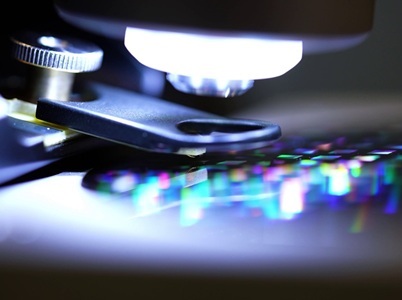
The atomic force microscope utilizes a sharp tip (probe), with a radius of curvature on the order of nanometers, attached to the end of a tiny cantilever used to scan across a sample surface to image its topography and material properties. When the tip is brought into proximity of a sample surface, forces between the tip and the surface lead to a deflection of the cantilever. This deflection is recorded using, typically, a laser beam that is reflected from the top surface of the cantilever to a photo-sensitive detector. The resultant change of position of the cantilever permits characteristics, such as mechanical, electrostatic, magnetic, chemical and other forces to be precisely measured by the AFM. These characteristics are displayed in a three-dimensional surface profile of the sample (in the X, Y and Z axes)—an advantage that the microscope can provide compared with other microscopy techniques.
AFM challenges
AFM is widely recognized as a powerful, yet complex and time-consuming technique for nanoscale imaging and measurement. Traditional, legacy AFM requires highly skilled operators and intensive manual labor, operating at slow scanning speeds, to achieve high-resolution nanoscale imaging.
Operators often spend significant time manually loading cantilever probes using tweezers and aligning lasers for optical detection.
Manually positioning the probe close enough to the surface without crashing requires skill, patience, and time. Operation often requires specialized PhD-level training to manage tip-sample dynamics of finicky silicon probes and complex tuning to avoid tip crashes or artifacts. New users often struggle with breaking expensive, delicate probes, making training a slow and costly process.
Traditional AFM scanning is slow, often taking several minutes to acquire a single, high-quality image. Because the probe cannot scan and manipulate a sample simultaneously, multi-step modifications are exceptionally slow.
Further complicating AFM operation, high-resolution scanning is easily influenced by noise, necessitating repeated scans or intensive post-processing.
Recent advancements in AFM technology
Within the past decade, however, research into AFM design has demonstrated success with improving scanning performance. While traditional AFM remains a demanding technique, these innovations are rapidly making the technology more accessible and faster for users.
Recent developments with AFMs now make possible automated sample probing, laser-free alignment, and one-click motorized approaches to the sample. Researchers are applying deep learning to automate image reconstruction, improve signal-to-noise ratios, and speed up data acquisition.
Of particular interest is the introduction of chip-based AFM. Data collection speeds can now be achieved that are an order of magnitude faster than traditional AFMs, enabling broader use in manufacturing and scientific research.
Chip-based AFM
Chip-based AFM refers to integrating AFM components, like cantilevers and sensing architecture, onto a single microchip using MEMS (micro-electromechanical systems) technology, creating a miniaturized, and more robust system for nanoscale imaging and sensing.
It provides advantages like reduced size, simpler operation, and higher speed. The on-chip design removes the need for manual laser alignment and complex probe exchanges, as sensors and actuators are pre-aligned during manufacturing.
Chip-based AFMs were first commercialized in 2007 by ICSPI, with the goal of bringing fast, powerful, and easy-to-use nanoscale metrology to everyone. The company has pushed the boundaries of nanoscale imaging, and semiconductor metrology and inspection with the introduction of its nGauge and Redux AFM systems.
“Frustrated by the poor versatility, complexity and slow speeds of traditional instruments, ICSPI has been focused on resetting the expectations for nanoscale imaging with intuitive AFM systems,” said Qianshu Wang, Application Engineer at ICSPI. “Our Redux AFM, for example, reduces setup time to as little as three minutes, eliminating manual laser alignment. It is a motorized, automated AFM that can precisely navigate to regions of interest on the sample.”
Sensor-integrated AFM Chip
AFM-on-a-chip technology uses an integrated MEMS actuator and a piezoresistive sensor to move the tip and detect cantilever deflection that provides a fully automatic, one-click approach from the tip to the sample. The precise XYZ scanners and positioning sensors are integrated onto a single 1mm x 2mm chip.
The tip typically oscillates (taps) on the surface, and the changes in oscillation (amplitude, phase) are measured to map topography. The on-chip components provide robust feedback enabling precise tip-sample interaction.
“The AFM probes are securely bonded onto the end of a carrier printed circuit board (PCB), making them robust and durable for extended use,” said Wang. “They can be handled by hand, provided the probe itself is not directly contacted or subjected to mechanical stress.”
Two different types of tips are available depending on resolution requirements: a) high-aspect ratio diamond-like carbon (DLC) tips for high-resolution and general-purpose imaging; and b) alumina wedge (WDG) tips for coarse imaging, training and step-height measurements.
High-Aspect Ratio Diamond-Like Carbon (DLC) Tips: ideal for general imaging and for demanding applications. These tips provide excellent lateral resolution with a tip radius of <20 nm. DLC is a durable material that enables thousands of scans without noticeable degradation in scan quality.
The DLC tips are tilt-compensated by 15º to provide symmetrical, high-fidelity scans. The DLC tip is >1 µm tall. DLC is a low surface energy material, meaning that it also offers excellent contamination resistance (against particles, debris, polymer build-up and other contaminants).
Aluminum Wedge (WDG) Tips: well suited for coarse imaging, training and step heights. The native oxide (alumina) of aluminum is a low surface energy material. Alumina is a durable material that enables hundreds or thousands of scans without noticeable degradation in scan quality.
Vibration isolation
Typically, AFMs need to be used in the basements of buildings with a dedicated metrology room to minimize vibrations. The Redux AFM, however, is lighter than traditional AFMs, so it is uninfluenced by much of the low frequency noise that commonly causes issues with AFM scans. However, not all low-frequency vibrations are cancelled out. Redux AFMs still require vibration isolation to guarantee their performance.
For this purpose, ICSPI chose Negative-Stiffness vibration isolators because they do not require air or electricity, and their compact size and portability makes them a good fit for small-form AFMs in different environments.
Introduced in the mid-1990s by Minus K Technology, Negative-Stiffness vibration isolation has been widely accepted for vibration-critical applications, largely because of its ability to effectively isolate lower frequencies, both vertically and horizontally. The company’s isolators are used by more than 300 universities and government laboratories in 53 countries.
Negative-Stiffness isolators are unique in that they operate purely in a passive mechanical mode. They do not require electricity or compressed air. There are no motors, pumps or chambers, and no maintenance because there is nothing to wear out.
Vertical-motion isolation is provided by a stiff spring that supports a weight load, combined with a Negative-Stiffness mechanism. The net vertical stiffness is made very low without affecting the static load-supporting capability of the spring. Beam-columns connected in series with the vertical-motion isolator provide horizontal-motion isolation. A beam-column behaves as a spring combined with a Negative-Stiffness mechanism. The result is a compact passive isolator capable of very low vertical and horizontal natural frequencies and high internal structural frequencies.
Negative-Stiffness isolators achieve a high level of isolation in multiple directions, with the flexibility of custom-tailoring resonant frequencies to 0.5 Hz vertically and horizontally (with some versions at 1.5 Hz horizontally). When adjusted to 0.5 Hz, the isolators achieve approximately 93 percent isolation efficiency at 2 Hz, 99 percent at 5 Hz, and 99.7 percent at 10 Hz.
As AFM technology continues to evolve, innovations such as chip-based architectures, automated operation, and advanced vibration isolation are helping overcome many of the limitations of traditional systems. By reducing complexity, increasing imaging speed, and improving accessibility, these advancements are expanding the use of nanoscale metrology beyond specialized research laboratories into broader scientific applications. Together, integrated AFM platforms and high-performance isolation technologies are setting new expectations for fast, reliable and user-friendly nanoscale imaging.