by Jeff Elliott, Technical Writer
Nanosecond Transient Absorption Spectroscopy (TAS) is a time-resolved pump–probe technique that reveals how molecules and materials behave in the first moments after they absorb light. Instead of producing a single static absorption spectrum, the method tracks how the spectrum evolves over time after a short excitation pulse from a laser.
One reason TAS is such an effective tool is because it allows researchers to measure dynamic behaviors that cannot be measured through steady state spectroscopy. A number of significant photophysical and photochemical processes—such as triplet and charge-carrier dynamics, exciton migration, and metastable photochemical intermediates—occur in the nanosecond to millisecond time domain and often produce weak, transient absorption features that require sensitive time-resolved spectroscopy for detection.
By directly measuring these short-lived spectral changes, nanosecond TAS gives researchers insight into the relationship between molecular structure and functional performance in photovoltaic devices, photocatalytic systems, light harvesting assemblies, biological chromophores, conductive polymers, and new energy conversion materials.
Now advances in laser technology are rapidly redefining the operational limits of nanosecond TAS. In particular, the emergence of tunable, high repetition rate lasers that dramatically increase pulse delivery frequency while maintaining ultrafast temporal resolution.
Tunable lasers allow researchers to precisely adjust the excitation wavelength in the UV, Visible and Near-Infrared (NIR) portions of the spectrum. At high repetition rates, these systems increase the amount of data collected per unit time, which reduces the effect of random noise on the measured signals and improves detection of weak transient components. The result is a more complete study of the kinetics of the system and a better understanding of the dynamic processes that occur.
The excitation laser
In a basic TAS setup, a nanosecond or shorter pump pulse excites a portion of the sample from the ground state into an electronically excited state. A weaker probe beam then passes through the same region at a controlled delay. By comparing the probe transmission with and without excitation, the system produces a wavelength-resolved differential absorption signal.
The laser light source contributes significantly to the overall performance of the measurement system. Pulse duration defines the achievable temporal resolution. Pulse energy governs how effectively the pump pulse drives measurable population changes within the sample. Source stability is essential to maintain clean differential signals and prevent noise from obscuring subtle effects.
The laser’s repetition rate is also an important factor in determining the ability of the transient absorption technique to produce high quality measurements. Although it affects both the amount of signal averaging that can be performed as well as the quality and throughput, it is often overlooked when evaluating a system.
Until recently, however, most tunable lasers have been limited to an operating repetition rate of 10-20 Hz. Exceeding this threshold requires a new generation of diode-pumped solid-state (DPSS) lasers capable of operating at 100 Hz or higher.
Improving signal-to-noise ratio
One of the principal challenges in TAS is detecting weak signals that are frequently masked by electronic noise. Traditionally, improving the signal-to-noise ratio (SNR) in TAS measurements involves averaging the results of multiple experiments, where the SNR increases with the square root of the number of averaged data points. Averaging one hundred measurements only reduces the noise level tenfold, for instance.
However, when using lower repetition-rate lasers, this method is time-consuming and impractical when repeated measurements are required. Fluctuations in the pump laser's shot-to-shot stability and drifts in the probe light source's intensity can also affect the SNR of TAS measurements during long data collection periods.
Additionally, SNR can still be poor even after prolonged scanning when using this approach, specifically when probing the vibrational dynamics of materials following photoexcitation. The signals generated from these dynamic processes are typically weak and therefore difficult to detect due to the presence of unwanted electrical noise; in fact, several hours of collected data may not be enough to adequately remove unwanted noise.
At higher repetition rates, more pump-probe pulses can be collected in less time with fewer variances in the entire system, thus improving the signal-to-noise ratio and enabling the use of lower pulse energies. Gentler excitation conditions reduce the risks of cumulative heating or photodamage and shorten the time required to obtain a full kinetic map.
However, the rate cannot be pushed too high, since samples must have time to relax or exchange between pulses. A 100 Hz excitation source strikes a desirable balance for many nanosecond-scale systems: fast enough to achieve efficient averaging, yet slow enough for most condensed-phase samples to fully recover between pulses.
“A stable, tunable pump laser that operates at 100 Hz offers an efficient, practical solution for many nanosecond and microsecond applications. In this case, speed and sensitivity go hand in hand,” says Eric Kennehan, Ph.D., Co-founder & CEO of Magnitude Instruments. Based in State College, Pennsylvania, the company offers multiple product lines of fully integrated, benchtop nanosecond transient absorption spectrometers designed for advanced time-resolved spectroscopy applications.
Kennehan’s doctoral research centered on transient absorption studies of photovoltaic materials, which required extensive use of TAS. At the time, he found the available TAS instrumentation cumbersome, slow and lacking in sensitivity. The limitations of the equipment spurred him to collaborate with colleagues to design and build an improved spectrometer so that he “could spend less time in the lab and more time analyzing data and writing papers,” While still a grad student at Penn State University, he founded Magnitude Instruments with Christopher Grieco, John Asbury, Eric Kline and Ted Graef.
To improve SNR, the company has prioritized the development and implementation of advanced noise suppression technologies (NSTs). NSTs enable the precise subtraction of electronic artifacts that traditionally obscure weak signals in TAS measurements. This advancement allows researchers to collect the entire time axis for TA measurements directly from the detector response with each laser shot, dramatically accelerating data collection times and enhancing accuracy.
Previously, the strategy to improve signal detection in TAS was to increase the pump fluence, thereby increasing the total number of excited states that could be probed. While this approach can improve signal visibility, it also may induce nonlinear interactions among excited states.
Such interactions occur when the high concentration of excited states begin interacting with one another, which can complicate and often obscure the interpretation of the results. Critically, elevated pump fluences can also hasten sample degradation, notably affecting sensitive biological specimens or materials prone to photodegradation.
“Whenever you are studying biological samples like proteins or enzymes, they are really susceptible to pump fluence,” explains Kennehan. “If you hit them extremely hard with a laser as was done in the past, you risk damaging the sample and measuring the damage versus measuring maybe their actual function or the catalytic properties.”
Integrating tunable lasers
For most applications, a fixed wavelength Nd:YAG laser capable of generating excitation wavelengths of 1064, 532, 355, and 266 nm is included in nanosecond TAS systems. However, when a project requires wavelength flexibility, integration of an optical parametric oscillator (OPO) or optical parametric amplifier (OPA) can help.
The ability to vary the wavelength enables researchers to select and activate discrete electronic or vibrational transitions within their samples with a high degree of precision and control. This allows researchers to achieve more detailed and application-specific results from their experiments.
“Firing a tunable laser at 100 hertz is significant because the spectrometer can collect data much faster,” said Kennehan. “Everything else being equal, if I am collecting data at 100 hertz versus 10 hertz, I am getting my data 10 times faster.”
Higher repetition rates reduce background interference, resulting in cleaner signals and improved overall data quality. High repetition rates also allow the detection of weaker signals while operating at lower laser fluences. This approach minimizes the risk of sample damage or degradation during measurement. At the same time, it reduces complications, such as nonlinear effects, multi-exciton generation, excited-state annihilation and thermal artifacts, that can develop on nanosecond to microsecond timescales.
Although several manufacturers offer 100 Hz OPO systems, each presented distinct advantages and trade-offs. Magnitude Instruments ultimately decided to partner on the project with OPOTEK, a leading developer of tunable laser solutions.
Benchtop-ready
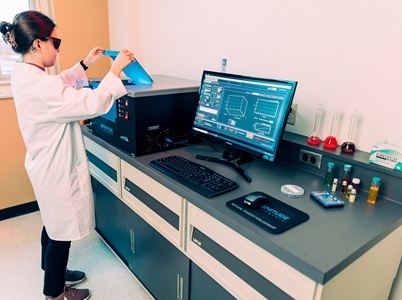
Historically, transient absorption spectroscopy setups have posed considerable challenges for many laboratories due to the large, complex, and expensive nature of the equipment required to make TAS measurements. As a result, Magnitude Instruments has consistently emphasized developing a true benchtop system that can be integrated seamlessly into standard laboratory environments.
“We are already trying to push the size limits of spectrometers,” explains Kennehan. “To achieve that you need a compact laser. In the past, when we paired our unit with an OPO, the laser system was often the same size or larger than our spectrometer.”
As nanosecond transient absorption spectroscopy continues to gain traction in biotechnology and medical research, high-repetition-rate lasers are becoming less of a premium feature and more of a practical necessity. With high-repetition-rate lasers, data collection is much faster, enabling scientists to sample and process more points in an order of magnitude less time.
By dramatically increasing the number of pulses per second, it is expected that scientists to collect and evaluate many more data points in about one order of magnitude less time than with low-repetition-rate lasers.
As laser platforms continue to evolve toward higher stability, greater tunability and scalable repetition rates, their integration into TAS setups is expected to significantly enhance both performance and experimental versatility. This progression opens new possibilities for investigating nanosecond time scale phenomena in increasingly complex systems.
About the author
Jeff Elliott is a Torrance, Calif.-based technical writer. He has researched and written about industrial technologies and issues for the past 20 years.