The coexistence of superconductivity and magnetism in materials is rare due to the destruction of Cooper pairs by ferromagnetic ordering. Materials that benefit from both properties could lead to advancements in areas such as computer engineering and green energy technology, but the mechanisms that allow materials to be both magnetic and superconductive are not well understood.
A recent study by physicists at the University of Bath collaborating with international partners sought to better understand the interaction between superconductivity and magnetism in RbEuFe4As4, which is superconducting below -236°C and exhibits both properties below -258°C.
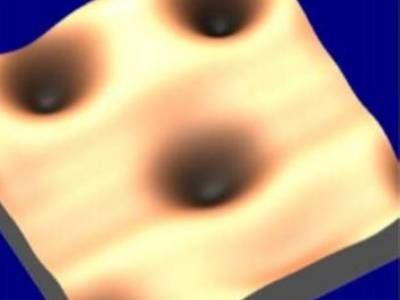
The researchers used scanning Hall probe microscopy to create magnetic field maps of the material as the temperature was reduced. The researchers discovered a significant broadening of vortices near the magnetic ordering temperature, indicating a strong suppression of superconductivity. The findings, published in Physical Review Letters, support the theoretical model recently proposed by Alexei Koshelev of Argonne National Laboratory that magnetic fluctuations nearing the magnetic transition would suppress, but not destroy, superconductivity in RbEuFe4As4.
“This suggests that in our material, the magnetism and superconductivity are held apart from each other in their own sub-lattices, which only minimally interact,” said David Collomb, a physics postgraduate research student at the University of Bath and lead author of the study.
The discovery could spur further research on this rare coexisting phenomenon in applied fields, bolstering the development of next-generation computing devices and other new technologies.
Photo: A scanning Hall microscope image of a segment of an RbEuFe4As4 crystal showing the vortices that were studied. Credit: University of Bath