In a new overview article, the efforts of an international team, who are applying a variety of innovative strategies for protein sequencing at the single-cell and even single-molecule level, are described.
The field of protein research, (known as proteomics) has traditionally been dominated by mass-spectrometry technologies, which are expensive and generally only sequence batch proteins contained in complex mixtures. Ferreting out single proteins in individual cells will require a transformation in sequencing technology similar to the DNA sequencing revolution.
The approach of Stuart Lindsay, a researcher at the Biodesign Institute at ASU, involves a technique known as recognition tunnelling, which relies on a technology known as scanning tunnelling microscopy (STM). In earlier research, Lindsay applied STM to identify DNA bases sequentially fed through a tiny aperture known as a nanopore, much as one might feed thread through the eye of a needle.
As DNA nucleotides transit through the nanopore, they are momentarily held captive between a pair of electrodes. Current passing through each base, known as tunnelling current, produces tell-tale electrical spikes, which are like a fingerprint of each of the 4 bases, adenine, thymine cytosine and guanine.
Recent advances have allowed the same basic idea to be applied to the identification of proteins, through sequential identification of the 20 amino acids from which all proteins are built. While recognition tunneling of proteins follows the same basic game plan used to sequence DNA bases, the task is far more delicate for protein sequencing, requiring the bonding of amino acids to specialized adapter molecules for the tunneling current to pass through as well as machine learning algorithms to help pick out the precise amino acid being sequenced.
"This review is part of the launch of a world-wide effort to make single-molecule protein sequencing a reality, with many labs around the world contributing to a variety of new technologies, our electronic approach being one," Lindsay says.
Continued advancement in protein sequencing may open the door to routine clinical application for diagnostic and treatment purposes, fulfilling the longstanding ambition of personalized medicine.
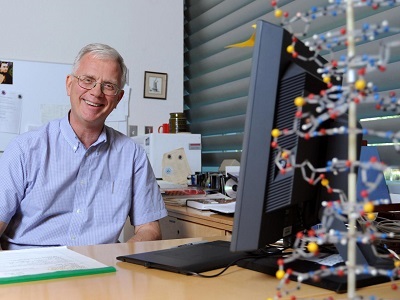
Photo: Stuart Lindsay is the director of Biodesign's Center for Single-Molecule Biophysics, the Edward and Nadine Carson Presidential Chair in Physics at ASU and Regents Professor in the College of Liberal Arts and Sciences, Chemistry and Biochemistry. Credit: The Biodesign Institute at Arizona State University