Renewable bio-based materials are an attractive alternative to synthetic materials and have the potential to improve sustainability and lower costs in a wide range of industries. Extreme biomimetics is a field that searches for biomaterials that can withstand extreme conditions to serve as a model for new hybrid materials to use in industrial environments. Biomimetics researchers from the University of Freiberg recently studied the possible use of marine sponges to dispose of copper-containing industrial waste, and found that combining these two components created a hybrid spongin-atacamite material with multiple potential functions.
The researchers placed the spongin material from Hippospongia communis bath sponges in an alkaline solution that mimics copper-containing waste from circuit board manufacturing. The spongin reacts with the copper in the solution, and nanometer-sized crystals form on the spongin fibers. The resulting composite material is stronger than the original sponge material but retains its unique porous micro-architecture and remains very light. The combination of this architecture with the properties of the atacamite crystals could be useful in a range of applications, and could be used in the development of sensors, catalysts and industrial filter systems. The scientists tested the use of a spongin-atacamite filter to eliminate E. coli and found that the bacteria’s growth was completely inhibited, demonstrating the possible use of the material for water treatment.
A major benefit of this new material is its renewability. The researchers found that placing the composite sponge material in an acidic solution reversed the reaction and brought the sponge back to its original state. This means the material could potentially be reused multiple times and have a longer life cycle than synthetic filters, reducing costs and waste. This research was published in Advanced Materials.
“Even after up to 100 application cycles, the responsiveness of the spongin-atacamite composite is still given,” said Martin Bertau, a chemist and co-author of the paper. “If the material is ultimately no longer usable, the sponge is biodegradable and the copper is recovered from the solution - ideally, electrochemically with renewable energies. We have already shown that this is possible.”
The researchers hypothesized that biomaterials such as spongin could be 3D printed in the future to allow for large-scale production and application of hybrid materials in extreme industrial conditions. Extensive further research would be needed to explore this possibility, as well as to improve the performance and reliability of new materials such as spongin-atacamite for industrial use, the researchers conclude.
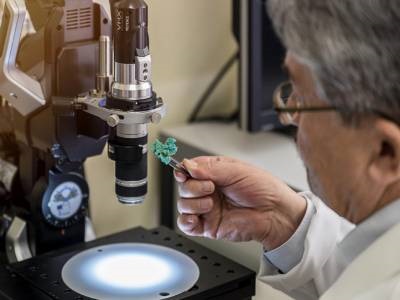
Photo: Lead author Hermann Ehrlich looks at a piece of the new composite spongin-atacamite material. Credit: TU Bergakademie Freiberg/C. Mokry