CRISPR is typically associated with gene editing, but the ability of Cas9 and guide RNA (gRNA) to target specific DNA sequences has inspired applications in other areas, including clinical diagnostics. While the function of Cas9 is typically to cleave DNA for editing, the variant nuclease-dead Cas9 (dCas9) can be used to target DNA for other purposes. A team led by researchers from Harvard Medical School have developed a new antibody-based diagnostic tool using dCas9 to self-assemble proteins on a DNA microarray.
The proteins fused with dCas9 and barcoded with unique single gRNA were placed on the DNA chip template where they self-assembled by binding to their corresponding sequence. Karl Barber, a Schmidt Science Fellow and lead author on the study, described the CRISPR-facilitated self assembly as being “like an automated paint-by-number kit.”
With the target proteins binded to the microarray in their pre-programmed positions, the chip can then be used to detect specific antibodies in serum. The antibodies in the patient serum applied to the chip will bind to their target pathogen-derived proteins and can then be detected in their position on the microarray. The technique, named peptide immobilization by Cas9-mediated self-organization (PICASSO), can be used for multiplex antibody screening and was able to detect SARS-CoV-2 antibodies from blood samples of COVID-19 patients. The research was published in Molecular Cell.
“In this work, we demonstrated the application of PICASSO for protein studies, creating a tool that we believe could be quickly adapted for medical diagnostics,” said Barber. “Our protein self-assembly technique could also be harnessed for the development of new biomaterials and biosensors just by attaching DNA targets to a scaffold and allowing Cas9-linked proteins to bind.”
The researchers said their new technique shows how CRISPR applications can be expanded, going beyond the study of nucleic acids and enabling further protein studies and diagnostic tools. The method also provides a fast method of screening for multiple antibodies on one small device.
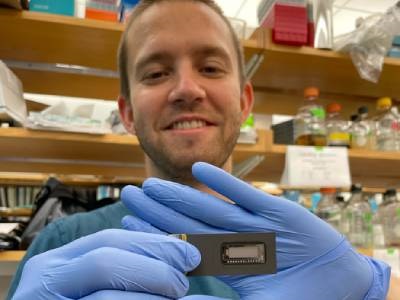
Photo: Lead author, Karl Barber, with a PICASSO microarray. Credit: Karl Barber, Schmidt Science Fellows