Nature produces many valuable materials and abilities that could be leveraged in a wide range of applications such as medicine and manufacturing. Translating biological products and functions into practical and scalable solutions can be challenging, as a natural product such as mussel foot protein (Mfp), which allows the animals to stick to underwater surfaces, often won’t give the same results in isolation as it does in its natural state. Researchers led by Fuzhong Zhang of the McKelvey School of Engineering at Washington University have overcome some of the limitations of using Mfp to create functional adhesives by combining the power of this sticky substance with the strength of spider silk.
The Zhang lab researchers previously engineered bacteria to produce Mfp in the lab, but found that the synthetic Mfp was difficult to handle underwater due to the rapid diffusion of protein molecules. Formulating the protein into a strong hydrogel to prevent diffusion creates another problem, as some of the adhesive strength is lost resulting in a weak glue that easily comes unstuck. To strike a balance between reliable adhesion and strength, the team looked to their own recent work producing a spider silk-amyloid hybrid protein that is stronger and steel and more durable than Kevlar. The researchers got the idea to combine this protein with Mfp, using their synthetic biology approach to create a tri-hybrid protein that benefits from both the strength of the spider silk and adhesion of the mussel-derived protein.
The engineers used the new tri-hybrid protein to prepare adhesive hydrogels that are both biocompatible and biodegradable, and these new glues performed well and were easy to use underwater during tests. The hydrogel exhibited strong adhesion to a range of different surfaces such as plastics, tendon and skin. The bacteria used to synthesize the protein can be engineered to modify it in order to tailor the final product to its potential applications such as underwater repair and tissue repair. This research was published in ACS Applied Materials and Interfaces.
“Spiders, bacteria, slimy sea creatures, and rotator cuff tears have very little in common. It is fascinating that the Zhang lab was able to combine the best parts of the first three and to make the new elastic materials with molecular-scale crystalline structures that can serve as a stronger and flexible adhesive,” said study co-author Young-Shin Jun. “It would be even cooler when we can use it in medical care for repairing shoulder injuries.”
The authors wrote that they expect their approach to synthetic biology will inspire future tunable hybrid protein-based materials that could be used in a broad range of applications.
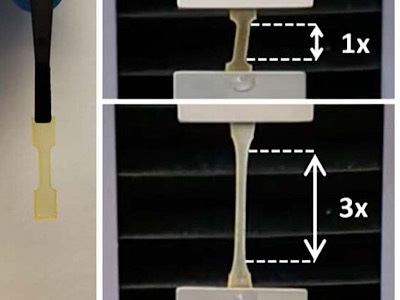
Photo: The mussel foot protein hydrogel set-up for tensile strength measurements. The measurement (labeled in white) shows the hydrogel at its original gage length. During testing, the hydrogel stretches to approximately three times its original gage length. Credit: Fuzhong Zhang