Grignard reagents are one of the most widely-used reagent types in the chemical industry, as they aid the creation of new carbon-carbon bonds, enabling organic synthesis. However, these reagents typically must be produced using toxic organic solvents and without any exposure to moisture or oxygen, making the synthesis process both complicated and harmful to the environment. A group of researchers led by scientists at Hokkaido University have no proposed a new method for Grignard reagent synthesis that uses just one-tenth of the amount of organic solvents used in conventional methods, resulting in both a simpler and more sustainable way to obtain these valuable reagents.
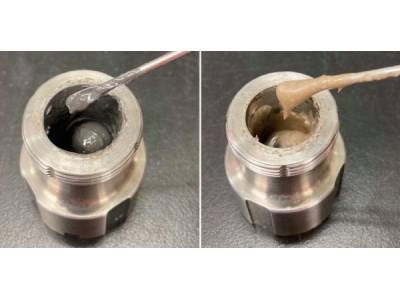
The researchers took a mechanochemical approach to producing the reagent, specifically employing a ball-milling method to create a Grignard reagent paste. The method involves loading the magnesium metal and organohalide reactants into a metal chamber with a stainless-steel ball along with just a small amount of tetrahydrofuran (THF). The chamber is then spun for one hour, with the stainless steel ball causing the solid-state reactants to thoroughly mix and react to form the paste. Spinning the reactants together without any solvent resulted in an only 6% yield of the desired product, but with just a small amount of THF, the yield from the ball-milling method was increased to 94%.
Additionally, the team was able to use this method to create new Grignard reagents using organohalides that have poor solubility in the organic solvents used in conventional methods. Removing the heavy use of organic solvents from the process also made it more difficult for water and oxygen to impact the reagents, meaning that removal of moisture and oxygen from the air was not necessary prior to the synthesis process. This makes Grignard reagent synthesis not only more environmentally friendly, but also more simple and less costly to perform. This research was published in Nature Communications.
“With a growing need to address environmental concerns and reduce CO2 emissions, it is important to develop chemical reactions that don’t require organic solvents,” said Koji Kubota, a corresponding author on the paper. “Grignard reagents are arguably the most well-known, commonly used reagents in industry, and so our work could fundamentally change the way a vast number of chemicals are produced at scale, leading to significantly reduced impact on the environment.”
By removing some of the solubility problems of conventional reagent synthesis methods, the new mechanochemical method opens up new possibilities for reactions with Grignard reagents prepared from insoluble compounds.
Photo: (Left) Reaction mixture of magnesium metal and organohalide after one hour of ball milling. Use of this material in subsequent reactions led to only a 6% yield of the desired product. (Right) Same process, but with a small amount of organic solvent also added at the beginning. Use of this paste form of Grignard reagent in subsequent reactions led to yields of up to 94% of the desired product. Credit: Koji Kubota