Pollutant emissions from sources such as factories and traffic can impact rainfall, as volatile organic compound (VOC) aerosol particles can act as cloud condensation nuclei at a certain size. While these humanmade secondary aerosols can be factored into meteorological models to help predict rainfall and storm activity, nanoparticles of pollution smaller than 10 nm are often overlooked in these calculations, as they are too minute to serve as cloud condensation nuclei. However, new research conducted through the Fundação de Amparo à Pesquisa do Estado de São Paulo (São Paulo Research Foundation) shows that these smaller nanoparticles could serve a greater role in weather patterns than previously thought, as analyses revealed that these tiny nanoparticles can rapidly expand in size as they move throughout the atmosphere.
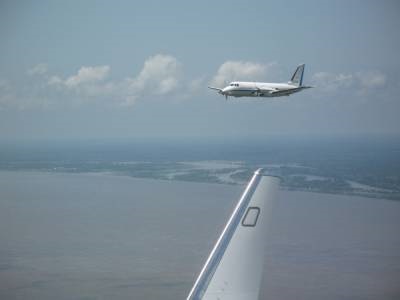
In 2014 and 2015, the researchers flew a specialized aircraft over the area of Manaus, a large city located in the center of the Amazon rainforest. The aircraft was equipped with a number of instruments including condensation particle counters, a fast integrated mobility spectrometer (FIMS) for measuring aerosol mobility size distribution, a high-resolution time-of-flight aerosol mass spectrometer to determine the chemical composition of nonrefractory aerosol particles and a quadrupole high-sensitivity proton-transfer reaction mass spectrometer for measuring concentrations of VOCs. Additionally, a continuous-flow thermal-gradient diffusion chamber was used to measure concentrations of aerosols that can act as cloud condensation nuclei and a fast cloud droplet probe was used to measure cloud droplet size distribution.
Through their analyses, the researchers found that small aerosol particles less than 10 nm in size, which are carried in a southwestern direction from a pollution plume over Manaus, can grow rapidly during their journey due to oxidation. These nanoparticles can expand to up to 400 times their original size, and are often large enough to form cloud condensation nuclei by the time they are about 30 km out from the city, said study co-author Luiz Augusto Machado. A large number of condensation nuclei from secondary aerosol emissions in the atmosphere can prevent the formation of large water droplets in clouds and lead to reduced rainfall. However, when large clouds of pollution and water are driven to higher altitudes by a strong vertical wind, this can cause large numbers of ice particles to form and fuel a major storm, Machado added. This research was recently published in the journal Science Advances.
“We found that as the particles grow and become condensation nuclei, scant rainfall results if they meet a small, warm cloud. The aerosols reduce the precipitation. However, if the cloud builds up to become a mass of cumulonimbus, for example, the aerosols increase the precipitation,” Machado said. “In other words, even these small particles of pollution influence the rainfall regime.”
The data for this study was collected at a relatively low altitude, but the team now plans to conduct further experiments with the aid of sophisticated German research aircraft that can fly up to 15,000 meters. Additional remote sensing studies are also underway at the Amazon Tall Tower Observatory in the heart of the rainforest.
Photo: Researchers collected aerosol samples over the Manaus area within the Amazon rainforest from a specialized research aicraft equipped with analytical instruments. Credit: Luiz Augusto Machado, University of São Paulo Physics Institute