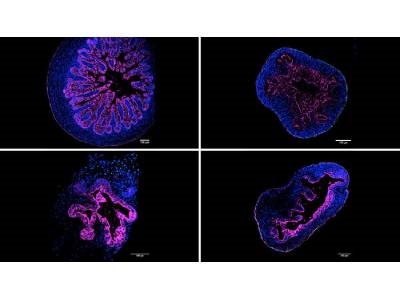
Organoids serve as miniaturized model organs allowing researchers to study human development and diseases in vitro. While organoids can be conveniently grown in the lab, this process is not always simple, typically relying on the use of basement membrane extracellular matrices that can be expensive and include biological components from other species. Researchers at the University of Michigan Medical School have now demonstrated their ability to grow intestinal organoids using a suspension culture, greatly simplifying the process while also yielding greater insights into intestinal development.
Previously the Michigan Medicine team had demonstrated the ability to grow human intestinal organoids on a biologically inert alginate gel rather than a substrate derived from animal cells. During this process, the researchers found that the organoids can develop their own basement membrane, leading to the theory that they could possibly be grown without any 3D scaffold at all. To test this theory, the team developed a suspension culture, placing intestinal hindgut spheroids in a low attachment plate with growth media. After four weeks of culture, the suspension organoids were examined by bright-field microscopy and hematoxylin and eosin staining, and found to have defined inner epithelium and outer mesenchyme, similar to those grown on alginate gel and a conventional extracellular matrix.
However, there were differences seen in the suspension organoids, namely in their mesenchymal organization. The researchers observed that the mesenchyme of the suspension organoids more closely resembled the fetal intestinal mesenchyme than those grown by conventional methods. Additionally, the suspension organoids formed a new layer resembling the serosa mesothelium, the protective outer layer of the intestine that also helps prevent friction within the abdominal cavity. This layer has not been seen in previous organoids and closely resembles the human fetal serosa at the molecular level, according to the researchers. Using the suspension-grown organoids, the researchers investigated how the serosa forms by using drugs to block the activity of specific proteins. Through these tests they identified two pathways, the Wnt and Hedgehog pathways, that were found to be essential for normal formation of the serosa. This study was published recently in Cell Reports.
“This is one of the first studies to gain an idea of the specific regulators that might play a role in the proper development of the intestinal serosa,” said lead author Meghan Capeling.
The researchers noted that while the suspension method yielded fewer organoids overall, they hope the new, simpler technique will help open the possibility of larger-scale organoid experiments.
Photo: Comparison of mesothelial markers in human intestine compared with organoids cultured in Matrigel, 1% alginate and suspension. Credit: Jason Spence Lab