The breakthrough of CRISPR-Cas genome editing systems has allowed for new approaches in treating diseases by editing genes within the nucleus. However, dozens of diseases are caused by mutations within the mitochondrial genome, which has thus far been inaccessible to CRISPR-Cas and more of a challenge to edit. Now, scientists from the Center for Genome Engineering within the Institute for Basic Science have developed a new tool they consider the missing puzzle piece for editing the mitochondrial genome, which enables A-to-G base conversion within the mitochondria for the first time.
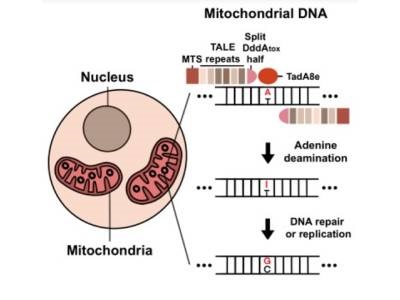
In 2020, researchers led by David R. Liu of the Broad Institute of Harvard and MIT created a base editor platform called DddA-derived cytosine base editors (DdCBEs), which was capable of performing C-to-T conversion from DNA in the mitochondria; this system could correct about 10% (9 out of 90) of the confirmed disease-causing mitochondrial point mutations, but was mostly limited to converting TC motifs to TT. Hoping to expand the capabilities of mitochondrial DNA (mtDNA) editing systems to include A-to-G conversion, the team at the Center for Genome Engineering developed a new platform called transcription activator-like effector-linked deaminases (TALED) by combining three different components. The first component, the transcription activator-like effector (TALE) enables the system to target a DNA sequence in the mitochondria; the second component, TadA8e, is an adenine deaminase that facilitates A-to-G conversion. The third key component is DddAtox, a cytosine deaminase which serves to make the DNA more accessible to TadA8e.
The researchers found that this combination of components enabled TALED to enter the mitochondria and for TadA8e to perform A-to-G editing on the double-stranded mtDNA. Normally TadA8e is specific only to single-stranded DNA, but the researchers theorize that DddAtox transiently unwinds the double strands, allowing enough time for the fast-acting TadA8e to make the necessary edits. The research demonstrated the abilities of the TALED system to edit mtDNA by creating a single cell-derived clone containing desired mtDNA edits. The TALEDs were found to be neither cytotoxic nor cause instability in mtDNA, and resulted in no undesirable off-target editing in nuclear DNA, and very few off-target effects in mtDNA. The ability to perform A-to-G conversions alone could correct up to 43% (39 out of 90) pathogenic mtDNA mutations. The team was ultimately able to develop a technology capable of both A-to-G and C-to-T base editing simultaneously. This research was published in Cell.
“Our new base editor dramatically expanded the scope of mitochondrial genome editing. This can make a big contribution not only to making a disease model but also to developing treatment,” said first author Sung-Ik Cho.
The group now plans to further develop the TALED system by increasing editing efficiency and specificity; they will also focus on using the TALED technology to develop a system for A-to-G base editing in the chloroplast DNA of plants. Mitochondrial genome editing can help address the lack of animal models currently available for diseases caused by mtDNA point mutations, in addition to opening the possibility of new gene therapies for such diseases.
Photo: Graphical abstract showing how TALEDs work in mitochondria. First, adenine is deaminated to inosine. Next, inosine is converted to guanine by DNA repair or replication. Credit: Institute for Basic Science