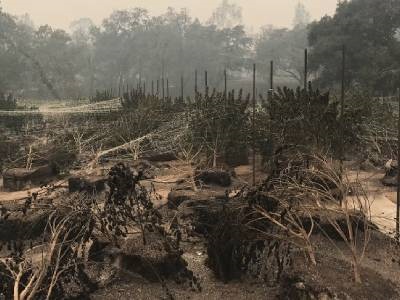
The Nuns Fire in 2017 destroyed millions of dollars worth of cannabis at this Glen Ellen farm. Credit: Erich Pearson
More than 6,000 wildfires have burned nearly 250,000 acres across California just this year, posing a major threat to life and property, including the state’s many agricultural crops. Cannabis is one of California’s newer and more lucrative commercial crops, and is already one of the state’s top five grossing agricultural commodities. Researchers from UC Berkeley’s Department of Environmental Science Policy and Management have now found that California wildfires pose a greater threat to cannabis crops than any other crop in the state, with more than half of the state's licensed cannabis farms being located in high or very high fire hazard zones.
The researchers analyzed wildfire risk to licensed cannabis farms in 11 cannabis-producing counties by comparing CAL FIRE maps of fire hazard severity zones, historic wildfire perimeters and areas likely to experience increased fire activity in the future with the locations of cannabis farms and other crops in those counties. CAL FIRE classifies fire hazard zones based on vegetation, topography, climate, crown fire potential, ember production and movement, and fire history. The team found that about 36% of the state’s cannabis cultivation area, or 986 farms, were located in high fire hazard zones. Additionally, 24% of farms, or 788 farms total, were located in very high fire hazard zones.
The team applied descriptive statistics and generalized additive models (GAMs) to understand how the wildfire risk to cannabis crops compared to other agricultural areas, including grapes, pasture and other general crops. Grapes had the next highest risk with 8.8% of cultivation area in high fire hazard zones and 2.9% in very high fire hazard zones, followed by pasture, with 4.3% and 1.7% in high and very high fire hazard zones, respectively. The study also identified three counties – Santa Barbara, Trinity and San Luis Obispo – in which more than half the cannabis cultivation area fell within new or intensifying hot spots based on burn pattern projections. In Santa Barbara, which is currently the top cannabis-producing county in the state, more than 95% of cannabis farms were located in these new or intensifying hot spot zones, the authors wrote. This study was published in the journal Ecosphere.
“This work only serves as a starting point for understanding how vulnerable cannabis farms may be to wildfire, as this analysis did not include indirect impacts, such as smoke and ash damage, which may be far-reaching,” said lead author Christopher Dillis, a postdoctoral researcher at UC Berkeley’s Cannabis Research Center. “However, we can confidently say that the places where cannabis continues to be grown are at greater risk now, and likely in the future as well.”
The authors recommend that cannabis farms already established in high-risk areas should implement fire-safety programs to reduce the impacts of wildfire to crops and human health. This includes traditional risk reduction activities such as managing vegetation and creating fire breaks, as well as measures to protect both farmworkers and crops from wildfire smoke. In addition, they recommend the state pursue options for providing crop insurance to licensed cannabis farmers.