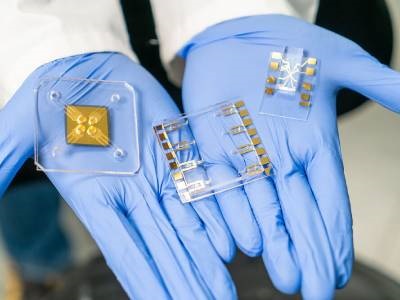
The single-cell electrorotation microfluidic device utilizes an electric field to probe the cell’s properties. Credit: Texas A&M Engineering
Single-cell analysis is indispensable in a range of applications including diagnostics, pharmaceutical drug development, disease research and bioproduction. Certain biophysical properties of individual cells are difficult to probe, however, due to large variations in these properties even among cells within the same population, as well as the presence of rare cell types within larger populations. Researchers at Texas A&M University’s College of Engineering have now developed a novel microfluidics platform to isolate and analyze single cells using a high-frequency electric field to both trap individual cells and measure their rotation.
The microfluidic device uses a four-electrode negative dielectrophoretic (nDEP) structure to capture the individual cells in a position at the center for four more electrodes, which apply an electrorotational force to the cell. As the cell rotates under specific electrorotation frequencies, its rotation speed is measured, revealing its dielectric properties. Properties that can be gauged by processing the measurement data through computation models include membrane capacitance and cytoplasm conductivity.
“By knowing how much force was applied and how fast the cell turns, you can extract many basic biophysical properties of cells,” said corresponding author Arum Han.
The team tested their system using cells from the lipid-accumulating microalga Chlamydomonas reinhardtii, applying electrorotation signals up to 100 MHz. Previous efforts using electrorotation to probe single cells have used lower frequencies, but expanding the frequency range enabled more accurate measurements that could be fit within theoretical models to obtain new insights. The researchers’ experiments suggest their dielectric measurement technology could be used for a range of applications such as screening of microalgae based on their lipid production abilities, identification of different cell types and separation of cells based on their dielectric properties, the authors wrote. This study was published in Biomedical Microdevices.
The researchers are now working to further advance the method by achieving even higher rotation speeds and developing platforms that can analyze multiple individual cells simultaneously.