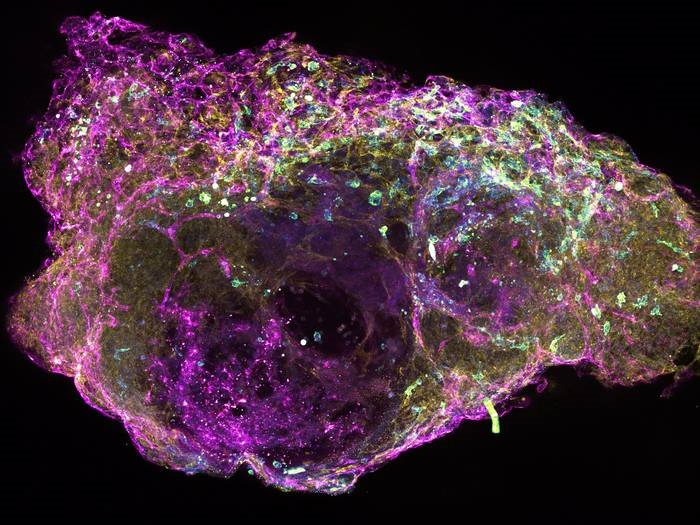
A cross section of a mini bone marrow organoids showing cells that produce blood platelets, in a network of blood vessels. Credit: Abdullah Khan, University of Birmingham
Organoids – miniature versions of organs and tissue grown in the lab – are valuable models that accelerate disease research and drug screening efforts. For researchers studying blood cancers and other hematological disorders, few models have been available that faithfully represent the complex functionality and structural features of human bone marrow, hampering research and drug development processes. Now, researchers from Oxford University and the University of Birmingham have developed a method to produce the first human bone marrow organoids that faithfully capture the key cellular, molecular and architectural aspects of myelopoietic bone marrow, opening up new opportunities to study disease mechanisms and potential treatment options.
The researchers developed a step-wise, directed-differentiation protocol to generate the bone marrow organoids from induced pluripotent stem cells (iPSCs) committed to mesenchymal, endothelial and hematopoietic lineages, the authors wrote. The protocol enabled the cell types to “self-organize” similarly to how they would in real human bone marrow, said first author Abdullah Khan, a Sir Henry Wellcome Fellow at the University of Birmingham’s Institute of Cardiovascular Sciences. The resulting organoids included important features of bone marrow such as stroma, lumen-forming sinusoids and myeloid cells, including pro-platelet forming megakaryocytes, and also supported the survival of cells from patients with blood malignancies, including multiple myeloma cells, the authors wrote.
The team used the bone marrow organoids to study how the cells in bone marrow interact to support normal blood cell production, and how bone marrow fibrosis (myelofibrosis) disrupts this healthy production when scar tissue builds up in the marrow. Bone marrow fibrosis can develop in patients with certain types of blood cancers and remains incurable; the organoid model provides a new avenue for researchers to study this condition and screen potential treatments. The organoids could further provide insights into different types of blood cancers and bone marrow disorders, such as research into the growth patterns of cancer cells within the marrow, said Khan. This research was published in Cancer Discovery.
“To properly understand how and why blood cancers develop, we need to use experimental systems that closely resemble how real human bone marrow works, which we haven’t really had before,” said senior study author Bethan Psaila, a hematology medical doctor and research group leader at the Radcliffe Department of Medicine, University of Oxford. “It’s really exciting to now have this terrific system, as finally, we are able to study cancer directly using cells from our patients, rather than relying on animal models or other simpler systems that do not properly show us how the cancer is developing in the bone marrow in actual patients.”