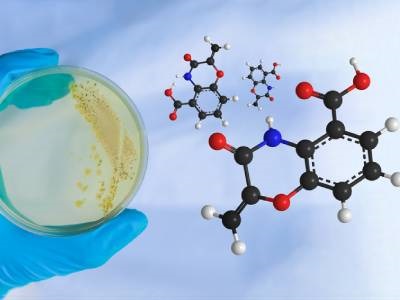
Natural products containing benzoxazolinate, a structure with two rings, are excellent candidates for pharmaceutically valuable substances, such as antibiotics, anticancer drugs or immunosuppressants. But how can their producers be identified? Credit: Max Planck Institute for Terrestrial Microbiology/Crames
Benzoxazolinate is a rare natural compound with a two-ring structure that grants it special biological activity and makes it a valuable drug candidate. However, details of the final step in the formation of benzoxazolinate by bacteria has long been unclear, making the search for producers of this compound similar to the search for a “needle in a haystack.” Now, researchers from the Max Planck Institute for Terrestrial Microbiology have uncovered the enzyme responsible for mediating this final step in benzoxazolinate biosynthesis, and used it as a probe for genome mining to reveal a wide range of natural producers of benzoxazolinate-containing compounds, or benzobactins.
The researchers first used the protein sequence of an enzyme called SgcG as a probe to attempt to elucidate the biosynthetic gene clusters responsible for benzoxazolinate production; SgcG is an enzyme known to be involved in the natural synthesis of this compound. From this starting point, the team narrowed down the genetic origins of benzoxazolinate biosynthesis, and discovered that the biosynthetic pathway “borrows'' an intermediate, 2-amino-2-deoxyisochorismic acid (ADIC), from the phenazine pathway. More importantly, they identified the enzyme that mediates the final cyclization step of benzoxazolinate production – a putative acyl AMP-ligase – which they then used as a probe for genome mining to identify similar biosynthetic pathways in other organisms.
Only four bacteria have previously been identified as natural producers of benzobactins. The two-ring structure of benzoxazolinate enables it to interact with both proteins and DNA, and the compound is an essential part of lidamycin, a highly cytotoxic antitumor antibiotic. By mining all bacterial genomes in the NCBI database using the protein sequence of the putative acyl AMP-ligase as a query, the team discovered benzobactin pathways in a diverse range of bacteria across the Proteobacteria and Firmicutes phyla, creating new opportunities to study and harness these compounds for pharmaceutical applications. This research was published in Angewandte Chemie International Edition.
“Our findings reveal the immense biosynthetic potential of a widespread biosynthetic gene cluster for benzobactin,” said corresponding author Helge Bode. “Now, we have to find out their ecological function and if we can apply them as antibiotics or other drugs.”