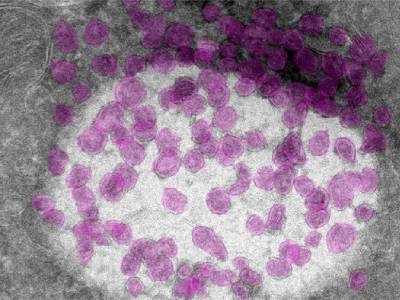
Release of vesicles with transduction proteins in electron microscope magnification. Credit: Devendra Kumar Maurya
A diminished sense of smell is a common symptom of COVID-19, and it can also be caused by other factors such as hormonal changes, head injuries, medications and other illnesses. In order to better understand the mechanisms behind an impaired sense of smell, and learn how to treat it, researchers must uncover details about the signaling pathways involved in smell perception. Using correlative microscopy techniques, researchers at Umeå University have now discovered a previously unobserved organelle in olfactory neurons that provides insights into how the nervous system reacts to odorous substances.
In order to study the internal structures of intact olfactory neurons in thin sections of mouse tissue, the researchers used correlative light-electron microscopy (CLEM). This technique leverages both the ability of confocal fluorescence microscopy to provide information about protein locations, and the capability of electron microscopy to provide high-resolution data on cellular structures. The team utilized double and triple immunohistochemistry and lectin staining to identify proteins involved in olfactory transduction, or the conversion of odors into nerve impulses sent to the brain. Using these techniques, the researchers discovered a previously unidentified organelle containing only transduction proteins, which they named the multivesicular transducosome.
The authors observed that the multivesicular tranducosome stores and separates transduction proteins prior to olfactory stimulation. When an odorous substance is encountered, the outer membrane of the tranducosome ruptures and releases the proteins, which reach the cilia of the olfactory neurons and facilitate transduction. The researchers further found that the newly discovered organelle contains the protein retinitis pigmentosa 2 (RP2), which is known to regulate transduction in the photoreceptor cells of the eye; mutations in the RP2 gene can cause a variant of the eye disease retinitis pigmentosa. This finding could open up new avenues to study neuronal activity beyond the sense of smell. This research was published in Nature Communications.
“A question for further research is whether the transducosome has a role in vision and whether it is present in brain neurons that are activated by neurotransmitters and not light and smell. If so, the discovery may prove even more significant,” said corresponding author Staffan Bohm.