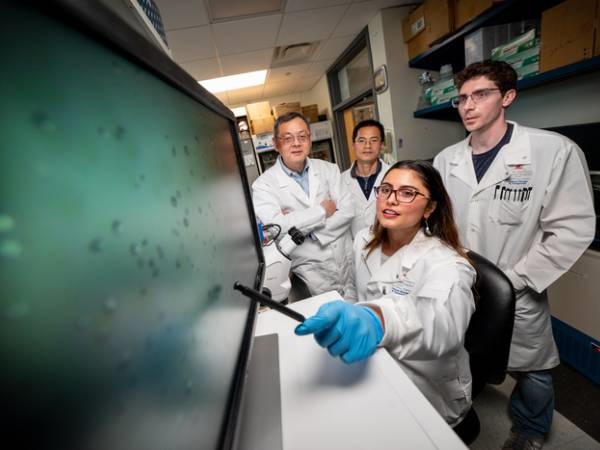
(L to R) Co-corresponding author Taosheng Chen, Ph.D., PMP, first author Wenwei Lin, Ph.D., Shyaron Poudel and co-corresponding and co-first author Andrew Huber, Ph.D., all of the St. Jude Department of Chemical Biology and Therapeutics. Credit: St. Jude Children's Hospital
Drug resistance and side effects frequently result from interactions between drug molecules and the body’s natural detoxification network. The pregnane X receptor (PXR), which regulates these detoxification processes, can bind to molecules of many different structures and sizes, posing a significant challenge for drug design and development. In a recent study, researchers from St. Jude Children’s Research Hospital examined the structure of PXR’s ligand-binding pocket and developed a new approach for designing drugs that better evade detoxification.
The team utilized X-ray crystallography to better characterize PXR’s structure and understand its binding interactions with a variety of drug molecules. They compared the conformation of PXR binded with weakly and strongly-binding molecules, including different variants of the tuberculosis drug rifampicin, one of the largest molecules that binds to PXR. They identified specific structural regions in weakly-binding molecules that cause the binding pocket of PXR to expand, reducing the efficiency of PXR activation.
The researchers used this information to engineer existing drug molecules to determine whether binding affinity could be reduced or improved through structural changes. They found that removing the region that caused PXR to expand enabled larger molecules to bind more efficiently to the receptor. Additionally, engineering smaller molecules to include this specific region, which forces PXR to expand due to a compound-protein clash within the binding pocket, caused it to bind more weakly despite its small size. This work provides a framework for engineering drug molecules that can better avoid the detoxification network, potentially preventing resistance and side effects. This study was published in the Proceedings of the National Academy of Sciences.
“We showed you could make a drug in a smarter way that interacts less favorably with PXR, so it will limit drug-drug interactions, reduce clearance and metabolizing,” said co-first author Wenwei Lin of the St. Jude Department of Chemical Biology and Therapeutics. “This type of approach will enhance drug efficacy, which is important for certain patients - like those with cancer. They need to receive treatment over a long time. Reducing drug resistance will be particularly beneficial in these patients, because using a lower dose over an extended period can reduce future health complications.”