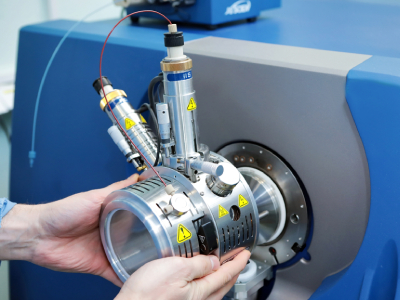
Mass spectrometry is one of the most powerful techniques employed by scientists worldwide to identify the building blocks of most substances. Despite this, it does have one major drawback, about 99% of the sample introduced is lost before analysis even begins.
In the research, published in Nature Communications, researchers from Brown University have developed a novel method for transferring ions that drastically reduces sample loss.
"The conventional technique for producing ions for mass spectrometry, called electrospray ionization, basically involves a very sharp needle getting placed just in front of the mass spectrometer, hitting it with an electric field that pulls out a spray of charged droplets that eventually dry out to produce bare ions that make it into the mass spectrometer from open air," said Nicholas Drachman, a physics Ph.D. student at Brown. "Basically, it's a process where you're really spraying your sample all over the place to produce these ions and only get a tiny portion of them into the mass spectrometer's vacuum for analysis. Our approach skips all of that."
The new technique, called nanopore ion source, relies on a tiny capillary 600 times smaller than those used in electrospray ionization. The nanotube can deliver ions dissolved in water directly into the vacuum instead of producing a spray that then needs to be dried before complete ionization can be achieved.
"Rather than place it in front of a mass spectrometer and generate this spray of droplets, we just place it directly into the mass spectrometer, skipping this messy spray, drying and vacuum process," Drachman said. "By generating ions in the vacuum directly, it drastically reduces the pumping requirements, which should significantly simplify the complex hardware of mass spectrometers."
Nanopore ion source has the potential to revolutionize mass spectrometry. The next steps for the team include optimizing the method to unlock the full potential of the nanopore ion source.
"We need to show that this can improve the workflow of proteomic analyses," Drachman said. "We'd like to take that to the next level and make it something that will improve the science of researchers throughout the field."