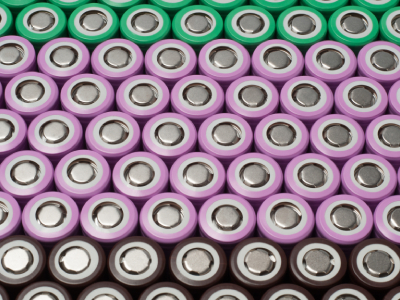
Lithium-ion batteries (LiBs) have become the world's most commonly used rechargeable batteries. New research from the University of Maryland and the University of Rhode Island has identified a potential new electrolyte to improve the performance of LiBs using alloying anodes.
With the increasing popularity and demand, researchers have been searching for new materials that could be used to improve battery performance and efficiency while maintaining low production costs. Traditional LiBs rely on graphite anodes thanks to their low cost, low weight, and excellent durability. Recently though, researchers have identified micro-sized alloying anodes as a potential alternative to improve performance.
Despite their advantages micro-sized alloying anodes have thus far proven less reliable than traditional graphite anodes partly because they result in the rapid decay of capacity and efficiency when combined with carbonate-based electrolytes.
In the research, published in Nature Energy, the team of researchers has developed a novel asymmetric electrolyte that could improve the performance of micro-sized alloying anode-equipped lithium-ion batteries.
"Using nano-sized alloying anodes can enhance the cell cycle life but also reduces the battery calendar life and increases the manufacturing costs," said Ai-Min Li, Zeyi Wang and their colleagues "We significantly improved the cycle performance of micro-sized Si, Al, Sn and Bi anodes by developing asymmetric electrolytes (solvent-free ionic liquids and molecular solvent) to form LiF-rich inorganic SEI, enabling 90 mAh μSi||LiNi0.8Mn0.1Co0.1O2 and 70 mAh Li3.75Si||SPAN pouch cells (areal capacity of 4.5 mAh cm−2; N/P of 1.4) to achieve >400 cycles with a high capacity retention of >85%."
"The asymmetric electrolyte design forms LiF-rich interphases that enable high-capacity anodes and high-energy cathodes to achieve a long cycle life and provide a general solution for high-energy Li-ion batteries," added Li, Wang and their colleagues.
In the future, the electrolyte developed by the researchers could be used for a wider range of batteries with varying anode and cathode configurations, potentially leading to the development of next-generation battery solutions.