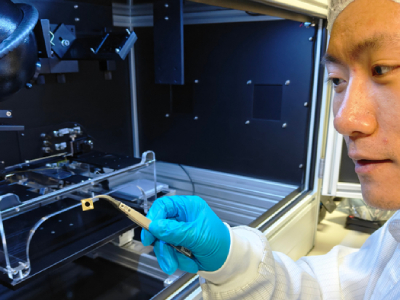
The new, more sensitive infrared sensor brings benefits to many different technologies. Credit: Aalto University/Xiaolong Liu
Aalto University researchers have developed a novel photodiode which is 35% more responsive at key telecommunication wavelengths when compared to other traditional germanium-based components. Fine tuned for improve responsiveness at 1.55 µm, the device can be produced using current production techniques, making it extremely practical for widespread adoption.
The study, published in the journal Light: Science & Applications, describes the device. While germanium photodiodes have seen recent interest thanks to their compatibility with current semiconductor manufacturing processes, previous iterations have performed poorly when capturing infrared light.
"The high performance was made possible by combining several novel approaches: eliminating optical losses using surface nanostructures and minimizing electrical losses in two different ways," said Hanchen Liu, the researcher who built the device.
During their testing, the team demonstrated that their photodiode outperformed not only existing germanium photodiodes in responsivity, but also the commercially available indium gallium arsenide photodiodes currently in use. The device efficiently captures infrared photons across a wide range of wavelengths and could be easily fabricated by existing facilities.
"The timing couldn't be better. So many fields nowadays rely on sensing infrared radiation that the technology has become part of our everyday lives," said Hele Savin, a professor at Aalto University.