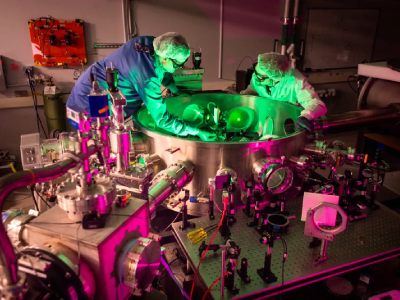
John Nees (left) and laser engineer Paul Campbell (right) work in Target Area 1, where the first 2 petawatt user experiment took place. ZEUS is now the most powerful laser in the U.S. Photo: Marcin Szczepanski/Michigan Engineering
Located at the University of Michigan, the ZEUS laser facility has developed a 2 petawatt laser, more than doubling the peak power of any other laser within the United States. With a power output more than 100 times higher than global electricity outputs, the power lasts for just 25 quintillionths of a second, equal to the duration of its pulse.
"This milestone marks the beginning of experiments that move into unexplored territory for American high field science," said Karl Krushelnick, director of the Gérard Mourou Center for Ultrafast Optical Science, in a recent release.
"One of the great things about ZEUS is it's not just one big laser hammer, but you can split the light into multiple beams," said Franklin Dollar, professor of physics and astronomy at the University of California, Irvine. "Having a national resource like this, which awards time to users whose experimental concepts are most promising for advancing scientific priorities, is really bringing high-intensity laser science back to the U.S."
Developing the 2 petawatt laser has been a slow and methodical process, with acquiring the materials to assemble the laser being more challenging than initially expected. The largest hurdle being the titanium infused sapphire crystal which is the critical component of the amplifier system that brings the laser to full power.
"The crystal that we're going to get in the summer will get us to 3 petawatts, and it took four and a half years to manufacture," said Franko Bayer, project manager for ZEUS. "The size of the titanium sapphire crystal we have, there are only a few in the world."
Despite its recent improvement to a 2 petawatt laser the Zeus team has been conducting 1 petawatt experiments with the device since late 2023, welcoming 11 different experiments from researchers at 22 different universities. The team plans to continue upgrading the system over the next year to bring it closer to its maximum power of 3 petawatts.