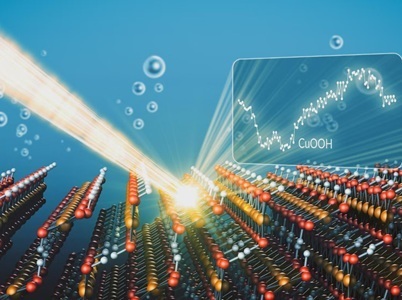
An X-ray beam (white/yellow ray from upper left) hits the catalyst surface, submerged in an electrolyte. The modulation excitation X-ray absorption technique detects the signature, or structural fingerprint, of an electrochemically formed species of copper, CuOOH, that SLAC researchers were able to synthesize and observe directly for the first time. Credit: Greg Stewart/SLAC National Accelerator Laboratory)
Using advanced computation methods and a novel X-ray technique, SLAC researchers have found an elusive form of copper. Published in the Journal of the American Chemical Society, the findings map out under what conditions this special form of copper is most stable, paving the way to make more durable copper catalysts.
Co-lead author and SLAC and SUNCAT Center for Interface Science and Catalysis postdoctoral fellow Pooja Basera used powerful computational methods to predict conditions where the team could produce the kinds of copper compounds they were after. The, the team turned to the Stanford Synchrotron Radiation Lightsource’s (SSRL’s) bright X-rays at SLAC to test these predictions. Because catalytic reactions take place in the first few atomic layers of the catalyst, they needed techniques sensitive to surface reactions under operating conditions to capture the formation of oxidized copper compounds in detail.
One novel technique has that sensitivity. Developed by SSRL and Berkeley Lab researchers, modulation excitation X-ray absorption spectroscopy cycles electrical pulses on and off at rapid rates while probing the sample with X-rays, revealing “structural fingerprints” in the copper electrodes.
“We could see, as predicted by the calculations, a new copper spectral signature we haven’t seen before,” indicating the presence of copper hydroxide, said Angel T. Garcia-Esparza, an SSRL staff scientist.
These calculations and fingerprints show that, in the right form, copper can withstand higher operating voltages, increasing its durability. Increasing the durability of copper catalysts has important implications in electrochemical water splitting, the process of splitting water into oxygen and hydrogen, which could help create the fuels society needs in a more cost efficient, less energy intensive way, particularly if energy from the sun is used instead of other sources.
Data from SLAC