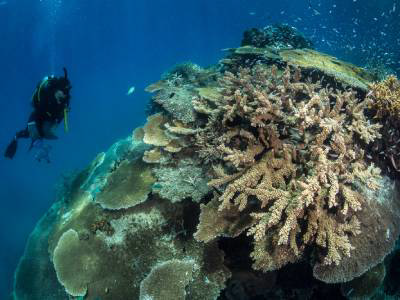
Credit: Queensland Museum
A team of researchers, working in collaboration with Queensland Museum's CoralBank, have published recent findings which reshape our understanding of table coral, one of the world’s most ecologically significant corals. The findings of the study raise new questions for coral conservation.
The work, which is published in the journal Invertebrate Systematics, employed modern genomic techniques along with traditional taxonomic methods to reveal that the lineage which previously was thought to be made up of only three species, in fact is a complex group containing at least 16 distinct species. 5 of these species were previously unknown to science.
"Table corals are some of the most familiar and beautiful corals on the reef, so we assumed they were well understood," said Dr. Sage Rassmussen from the University of Technology Sydney. "But our research reveals the opposite—what was once considered a single, widespread species is actually a whole group of species with much smaller geographical ranges. This reshapes how we view the reef's biodiversity and the roles these corals play.
"It's like realizing the 'one' tree you've always seen in the rainforest is a dozen distinct species hiding in plain sight."
The findings, which serve as a wakeup call for reef conservation, are thanks to a unique blend of modern DNA testing, taxonomic analysis, and machine learning.
"We combined the latest genome-scale DNA analysis and machine learning with a fresh look at century-old museum specimens to uncover evolutionary details we've never seen before," added Queensland Museum Principal Scientist of Marine Biodiversity Dr. Peter Cowman. "It's like reading the coral's genetic history book. This allows us to identify new species with much more confidence, and it reveals a hidden world of coral diversity that's been right in front of us all along."
"Many of the specimens analyzed were housed in museum archives, some collected decades ago," Queensland Museum CEO Dr. Jim Thompson.
"This research shows how historical specimens, combined with modern science, can uncover new species and reveal the fragility of marine ecosystems, emphasizing the need for ongoing conservation efforts."