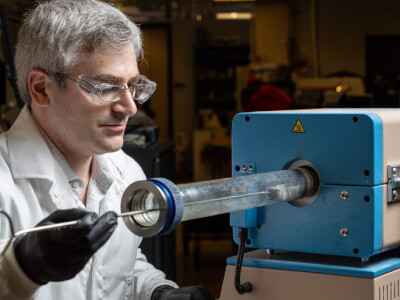
Texas A&M University doctoral student Charles Borenstein loads a high-temperature tube furnace. Credit: Emily Oswald/Texas A&M University College of Engineering
Texas A&M researchers have developed the first known metallic gel, a discovery which could be a game changer for energy storage. Unlike typical gels, this new material is comprised entirely of metals and is capable of withstanding extreme heat.
Described in a recent publication in the journal Advanced Engineering Materials, the gel was created by mixing two metal powders and applying heat. After heating, one metal melts into a liquid while the other remains solid and forms a microscopic scaffold, trapping the liquid metal.
“Metallic gels have never been reported before, probably because no one thought liquid metals could be supported by an internal ultrafine skeleton,” said Dr. Michael J. Demkowicz, professor in the Department of Materials Science and Engineering. “What’s surprising in this case is that when the majority component — copper — was melted into liquid, it didn’t just collapse into a puddle. That’s what pure copper would have done.”
Metallic gels made from reactive metals with strong electronegativity could prove to be very useful in liquid metal batteries (LMBs). While LMBs have been used in large stationary applications, their use in mobile energy storage has been limited due to concerns surrounding the risk of short circuiting when the liquid inside shifts during movement.
By using a metallic gel electrode, the liquid metal inside of an LMB could be held in place making LMBs viable for mobile applications such as powering large ships or heavy industrial vehicles where the heat of LMBs can be safely handled.