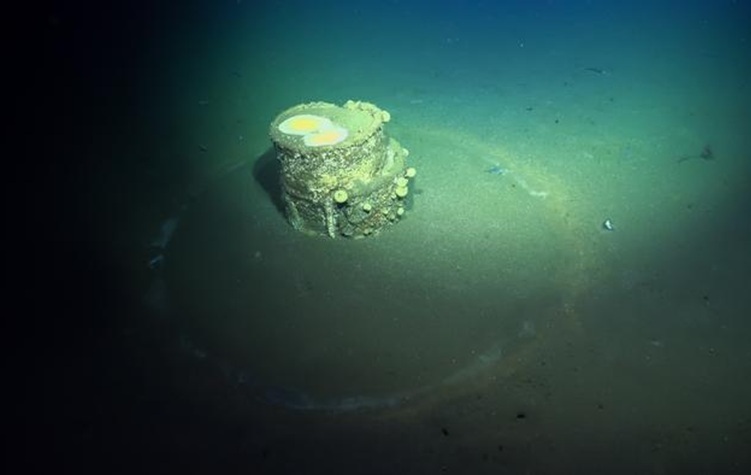
A discarded barrel on the seafloor off the coast of Los Angeles. The image was taken during a survey in July 2021 by remotely operated vehicle SuBastian. Credit: Schmidt Ocean Institute.
From the 1930s to the early 1970s, 14 deep-water dump sites off the coast of Southern California received “refinery wastes, filter cakes and oil drilling wastes, chemical wastes, refuse and garbage, military explosives and radioactive wastes,” according to the EPA.
In 2020, images of corroded metal barrels in the deep ocean off Los Angeles were made public. Initially linked to the toxic pesticide DDT, some barrels were encircled by “ghostly” halos in the sediment. The halos cast uncertainty over the barrels’ contents.
Now, new research from UC San Diego's Scripps Institution of Oceanography reveals that the barrels with halos contain caustic alkaline waste, which created the halos as it leaked out. Though the study’s findings can’t identify which specific chemicals are present in the barrels, DDT manufacturing did produce alkaline as well as acidic waste. Other major industries in the region, such as oil refining, also generated significant alkaline waste.
“One of the main waste streams from DDT production was acid and they didn’t put that into barrels,” said Johanna Gutleben, a Scripps postdoctoral scholar and the study’s first author. “It makes you wonder: What was worse than DDT acid waste to deserve being put into barrels?”
Analysis
In 2021, aboard the Schmidt Ocean Institute’s Research Vessel Falkor, Gutleben and her team set out to collect sediment samples at precise distances from five barrels—three of which had white halos—to better understand the contamination near Catalina.
The team was quickly met with an unexpected challenge: inside the white halos, the sea floor became like concrete, preventing the researchers from collecting samples with their coring devices. They pivoted to the ROV’s robotic arm and were able to grab a piece of the hardened sediment from one of the halo barrels.
Once back in the lab, the researchers analyzed the sediment samples and the hardened piece of halo barrel crust for DDT concentrations, mineral content and microbial DNA. During the analysis, Gutleben says she struggled to extract microbial DNA from the samples taken through the halos. Eventually, she tested one of these samples’ pH and was shocked to find it was extremely high—around 12. In fact, all the samples from near the barrels with halos turned out to be similarly alkaline.
This explains the limited amount of microbial DNA Gutleben and her colleagues had been able to extract. Analysis of the hard crust showed that it was mostly made of a mineral called brucite. When the alkaline waste leaked from the barrels, it reacted with magnesium in the seawater to create brucite—which cemented the sediment into a concrete-like crust. The study shows the brucite is slowly dissolving, which maintains the high pH in the sediment around the barrels and creates a place only few extremophilic microbes can survive. Where this high pH meets the surrounding seawater, it forms calcium carbonate that deposits as a white dust, creating the halos.
“It’s shocking that 50-plus years later you’re still seeing these effects,” said Paul Jensen, emeritus marine microbiologist at Scripps and senior author of the study. “We can’t quantify the environmental impact without knowing how many of these barrels with white halos are out there, but it’s clearly having a localized impact on microbes.”
Two Scripps-led surveys in 2021 and 2023 identified thousands of objects, including hundreds of discarded military munitions, on the seafloor, although the actual number of barrels remains unknown. Sediments in the area are heavily contaminated with the pesticide DDT, a chemical banned in 1972 now known to harm humans and wildlife. Scant records from this time period suggest DDT waste was largely pumped directly into the ocean.
Removal
Next, Gutleben and Jensen said they are experimenting with DDT-contaminated sediments collected from the dump site to search for microbes capable of slowly breaking down the toxic pesticide.
In addition to being a logistical nightmare, trying to physically remove the contaminated sediments would likely do more harm than good at this point.
“The highest concentrations of DDT are buried around 4 or 5 centimeters below the surface—so it’s kind of contained,” said Jensen. “If you tried to suction that up you would create a huge sediment plume and stir that contamination into the water column.”