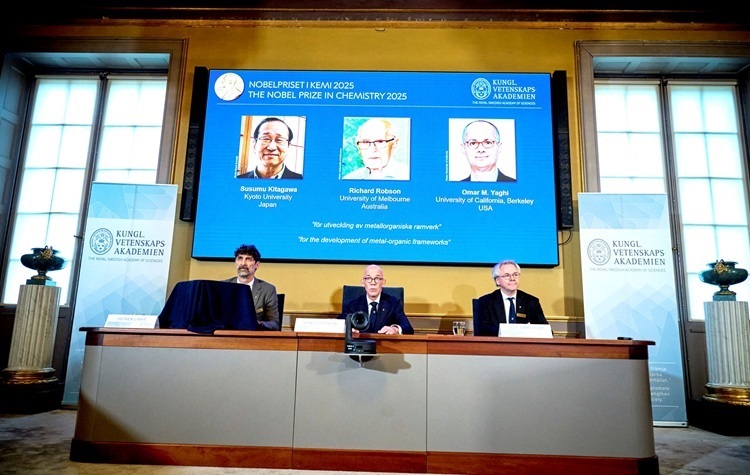
Heiner Linke (Chair of the Nobel Committee for Chemistry), Hans Ellegren (Secretary General, The Royal Swedish Academy of Sciences) and Olof Ramström (member of the Nobel Committee for Chemistry) presents the Nobel Prize in Chemistry 2025. Credit: Patrik Lundin.
The Royal Swedish Academy of Sciences has decided to award the Nobel Prize in Chemistry 2025 to Susumu Kitagawa, Kyoto University, Japan; Richard Robson, University of Melbourne, Australia; and Omar M. Yaghi, University of California, Berkeley, for the development of metal–organic frameworks. The 11 mililon Swedish kronor prize will be shared equally among the three scientists.
The now-laureates developed a new form of molecular architecture. In their constructions, metal ions function as cornerstones that are linked by long organic (carbon-based) molecules. Together, the metal ions and molecules are organised to form crystals that contain large cavities. These porous materials are called metal–organic frameworks (MOF). By varying the building blocks used in the MOFs, chemists can design them to capture and store specific substances. MOFs can also drive chemical reactions or conduct electricity.
“Metal–organic frameworks have enormous potential, bringing previously unforeseen opportunities for custom-made materials with new functions,” says Heiner Linke, Chair of the Nobel Committee for Chemistry.
It all started in 1989, when Richard Robson tested utilising the inherent properties of atoms in a new way. He combined positively charged copper ions with a four-armed molecule; this had a chemical group that was attracted to copper ions at the end of each arm. When they were combined, they bonded to form a well-ordered, spacious crystal. It was like a diamond filled with innumerable cavities.
Robson immediately recognized the potential of his molecular construction, but it was unstable and collapsed easily. However, Susumu Kitagawa and Omar Yaghi provided this building method with a firm foundation; between 1992 and 2003 they made, separately, a series of revolutionary discoveries. Kitagawa showed that gases can flow in and out of the constructions and predicted that MOFs could be made flexible. Yaghi created a very stable MOF and showed that it can be modified using rational design, giving it new and desirable properties.
Following the laureates’ groundbreaking discoveries, chemists have built tens of thousands of different MOFs. Some of these may contribute to solving some of humankind’s greatest challenges, with applications that include separating PFAS from water, breaking down traces of pharmaceuticals in the environment, capturing carbon dioxide or harvesting water from desert air.
New ideas and new molecules
Robson was the first to both theorize and build innovative chemical creations. The idea first came to him in 1974 when he was teaching at the University of Melbourne (Australia) and had been tasked with turning wooden balls into models of atoms, so students could create molecular structures. While placing each atom in a very specific part of the molecule to create the correct structure, he wondered if he could design new types of molecular constructions?
A decade later he finally tested it out—and was successful. Robson combined copper ions with a molecule that has four arms: 4′,4″,4‴,4 ⁗-tetracyanotetraphenylmethane. As he predicted, the ions and molecules inherent attraction to each other caused them to organize into a large molecular construction. They formed a regular crystalline structure, but it was not compact—this crystal contained a vast number of large cavities.
In 1989, Robson presented his innovative chemical creation in the Journal of the American Chemical Society. In his article, he speculates about the future and suggests that this could offer a new way to construct materials. These, he writes, could be given never previously seen properties, potentially beneficial ones.
From unstable to flexible
Kitagawa was interested in the potential of porous molecular structures, but he was having trouble obtaining funding because the materials Robson was creating in Australia and he himself was creating in Japan were unstable.
However, Kitagawa did not give up and in 1997 he had his first major breakthrough. Using cobalt, nickel or zinc ions and a molecule called 4,4’-bipyridine, his research group created 3D metal–organic frameworks that were intersected by open channels. When they dried one of these materials, it was stable and the spaces could be filled with gases.
But chemists already had zeolites, stable and porous materials that they could build from silicon dioxide. These could absorb gases, so why would anyone develop a similar material that did not work as well?
Kitagawa knew that if he were to receive any major grants, he had to define what made metal–organic frameworks unique. So, in 1998, he described his vision in the Bulletin of the Chemical Society of Japan. He presented several advantages with MOFs. For example, they can be created from many types of molecules, giving them enormous potential for integrating differen functions.
Most importantly, Kitagawa realized that MOFs can form soft materials. Unlike zeolites, which are usually hard materials, MOFs contain flexible molecular building blocks that can create a pliant material. After this, all he had to do was to put his ideas into practice by developing flexible MOFs.
Kitagawa did so just a few years later while Yaghi was working on his own innovations. The Japanese scientist created a flexible material that, when filled with water or methane, changed shape. When it was emptied, the materials returned to its original form. Critically, even with the shape changes, the material stayed stable.
Naming and finalizing the innovation
In 1992, when Yaghi started his first position as a research group leader at Arizona State University, he wanted to find more controlled ways in which to create materials. While challenges abound, in 1995, Yaghi succeeded and published the structure of two different 2D materials—like nets that were held together by copper or cobalt. The latter could host guest molecules in its spaces and, when they were fully occupied, it was so stable that it could be heated to 350°C without collapsing.
Yaghi described this material in an article in Nature where he coined the name “metal–organic framework.” Nowadays, this term is used to describe extended and ordered molecular structures that potentially contain cavities, and are built from metals and organic (carbon-based) molecules.
Yaghi established the next milestone in the development of metal–organic frameworks in 1999, when he presented MOF-5 to the world. This material has become a classic in the field. It is an exceptionally spacious and stable molecular construction. Even when empty, it can be heated to 300°C without collapsing. Even more innovative: a couple of grams of MOF-5 holds an area as big as a football field, which means it can absorb much more gas than a zeolite—proving its unique usefulness.
Yaghi laid the final bricks in the foundation of metal–organic frameworks in 2002 and 2003. In two articles, in Science and Nature, he showed it possible to modify and change MOFs in a rational manner, giving them different properties.
A bright future for MOFs
Researchers have created numerous different and functional MOFs. So far, in most cases, the materials have only been used on a small scale. To harness the benefits of MOF materials for humanity, many companies are now investing in their mass production and commercialization. Some have succeeded.
For example, the electronics industry can now use MOF materials to contain some of the toxic gases required to produce semiconductors. Another MOF can instead break down harmful gases, including some that can be used as chemical weapons. Numerous companies are also testing materials that can capture carbon dioxide from factories and power stations, to reduce greenhouse gas emissions.
“Some researchers believe that metal–organic frameworks have such huge potential that they will be the material of the twenty-first century. Time will tell, but through the development of metal–organic frameworks, Susumu Kitagawa, Richard Robson and Omar Yaghi have provided chemists with new opportunities for solving some of the challenges we face. They have thus—as Alfred Nobel’s will states—brought the greatest benefit to humankind,” concluded the Royal Swedish Academy of Sciences.
Information from the Royal Swedish Academy of Sciences