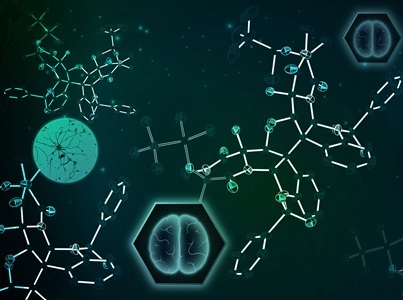
In tests in human cancer cells, a derivative of verticillin A showed particular promise against a type of pediatric brain cancer called diffuse midline glioma. Credit: MIT News; figure courtesy of the researchers
For the first time, MIT chemists have synthesized a fungal compound known as verticillin A, which was discovered more than 50 years ago and has shown potential as an anticancer agent. In tests in human cancer cells, a derivative of verticillin A showed particular promise against a type of pediatric brain cancer called diffuse midline glioma.
Researchers first reported the isolation of verticillin A from fungi in 1970. But, the compound’s complex structure made it extremely difficult to synthesize. In 2009, the lab of Mohammad Movassaghi, an MIT professor of chemistry, reported the synthesis of (+)-11,11'-dideoxyverticillin A—a fungal compound similar to verticillin A. That molecule has 10 rings and eight stereogenic centers, or carbon atoms that have four different chemical groups attached to them. These groups have to be attached in a way that ensures they have the correct orientation, or stereochemistry, with respect to the rest of the molecule. Once that synthesis was achieved, however, synthesis of verticillin A remained challenging, even though the only difference is the presence of two oxygen atoms.
Both of the verticillin A compounds consist of two identical fragments that must be joined together to form a molecule called a dimer. To create (+)-11,11'-dideoxyverticillin A, the researchers had performed the dimerization reaction near the end of the synthesis, then added four critical carbon-sulfur bonds. Yet when trying to synthesize verticillin A, the researchers found that waiting to add those carbon-sulfur bonds at the end did not result in the correct stereochemistry. As a result, the researchers had to rethink their approach and ended up creating a very different synthetic sequence.
“What we learned was the timing of the events is absolutely critical. We had to significantly change the order of the bond-forming events,” said Movassaghi.
The verticillin A synthesis begins with an amino acid derivative known as beta-hydroxytryptophan, and then step-by-step, the researchers add a variety of chemical functional groups, including alcohols, ketones, and amides, in a way that ensures the correct stereochemistry. A functional group containing two carbon-sulfur bonds and a disulfide bond were introduced early on, to help control the stereochemistry of the molecule, but the sensitive disulfides had to be “masked” and protected as a pair of sulfides to prevent them from breakdown under subsequent chemical reactions. The disulfide-containing groups were then regenerated after the dimerization reaction.
Once the researchers successfully completed the synthesis, they were also able to tweak it to generate derivates of verticillin A. Researchers at Dana-Farber then tested these compounds against several types of diffuse midline glioma (DMG), a rare brain tumor that has few treatment options.
The researchers found that the DMG cell lines most susceptible to these compounds were those that have high levels of a protein called EZHIP. This protein, which plays a role in the methylation of DNA, has been previously identified as a potential drug target for DMG.
The verticillin derivatives appear to interact with EZHIP in a way that increases DNA methylation, which induces the cancer cells to under programmed cell death. The compounds that were most successful at killing these cells were N-sulfonylated (+)-11,11'-dideoxyverticillin A and N-sulfonylated verticillin A. N-sulfonylation — the addition of a functional group containing sulfur and oxygen — makes the molecules more stable.
“The natural product itself is not the most potent, but it’s the natural product synthesis that brought us to a point where we can make these derivatives and study them,” said Movassaghi.
The Dana-Farber team is now working on further validating the mechanism of action of the verticillin derivatives, and they also hope to begin testing the compounds in animal models of pediatric brain cancers.
Data from MIT